
work of the United States federal Government / Public domain, via Wikimedia Commons
Rosa laevigata: complete guide
Rosa laevigata
¿Quieres ver Rosa laevigata: complete guide en tu jardín?
1 minuto, sin tarjeta de crédito
Overview
Rosa laevigata, also known as Cherokee rose or golden thread rose, is a unique rose species native to southern China, Taiwan, and Vietnam. This vigorous climbing plant is at home in warm temperate gardens where it produces spectacular white flowers. The rose was exported to the American South centuries ago where it extensively naturalized and became known as the Cherokee rose.
This rose reaches heights of 3 to 5 meters or more under ideal conditions, making it suitable for brick walls, fences, arbors, and pergolas. The plant grows quickly and produces an impressive mass of white flowers in early summer. This makes it a popular choice for garden owners seeking dramatic, rapid growth.
Appearance and bloom
The leaves of Rosa laevigata are glossy dark green and trifoliate (with three leaflets), distinguishing it from many other roses. The plant has numerous long red thorns along its branches, so it is not ideal for locations where people frequently pass.
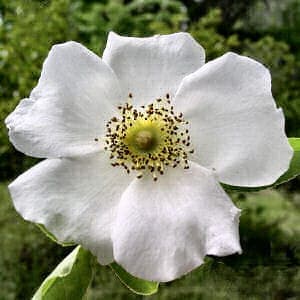
Flowers appear in May and June at branch tips in clusters of a few blooms. Each flower measures approximately 6 to 8 cm in diameter with five creamy white petals. The flowers have a delightful fragrance and attract many bees and butterflies. After flowering, orange-red glossy spherical fruits form and remain decorative through winter.
Ideal location
Rosa laevigata grows best in full sun where it receives at least 6 hours of direct sunlight daily. The plant can tolerate partial shade but will flower less abundantly.
Provide protection from strong wind that can damage the tendrils. A warm, protected wall is ideal. In cool climates, the plant can be positioned against the south side of a building where it absorbs extra warmth.
Soil
Rosa laevigata grows in well-drained soil with normal to good nutrient content. The plant tolerates both acidic and alkaline soils, although it grows better in neutral to slightly alkaline soil.
Heavy soils can be improved with sand and organic material. Ensure good drainage as the plant is susceptible to root rot in waterlogged conditions. Mulch around the plant to reduce moisture loss and suppress weeds.
Diseño gratis
¿Quieres ver Rosa laevigata: complete guide en tu jardín? Crea un diseño gratis ahora.
Watering
Rosa laevigata requires regular watering, especially during the growing season and dry periods. Water at the base of the plant in the morning, not over the foliage. Ensure the soil remains moist without becoming waterlogged.
During dry summers, watering twice per week may be needed. Once established, the plant tolerates some drought, although regular watering promotes better growth.
Pruning
Rosa laevigata flowers on the previous season's growth (old wood), so prune carefully. After flowering, spent flowers can be removed by pinching them off. Avoid aggressive pruning which can result in loss of next season's flowers.
The plant can be guided in growth by training shoots along a support. Pruning work should be done after flowering.
Maintenance calendar
Spring (March-April): Check for winter damage, work compost around the base, and begin regular watering.
Late spring (May-June): The plant flowers. Enjoy the white blooms and water regularly.
Summer (July-August): Fruits form. Check for pests such as rose aphids and spider mites.
Autumn (September-October): Fruits turn red and decorative. Reduce watering.
Winter (November-February): The plant rests. Minimal watering. Protect against severe frost.
Winter hardiness
Rosa laevigata is not fully winter-hardy in the cold north. In zones with winter temperatures down to minus 15 degrees Celsius, it can survive against a protected wall, although young plants may need protection.
In harsh climates, it is better to keep the plant in a pot that can be brought indoors. In the south, it is very winter-hardy and grows nearly year-round.
Companion plants
Rosa laevigata combines beautifully with other warm-climate roses and climbing plants. Common companions are clematis, jasmine, and wisteria which prefer similar growing conditions.
The rose attracts many butterflies and bees, so it is perfect for wildlife gardens.
Closing
Rosa laevigata is a beautiful choice for garden owners in temperate climates seeking a vigorous climbing plant with spectacular white flowers. Although it requires some protection in cooler regions, it rewards with abundant flowering and interesting fruits. Find your plant at specialized rose nurseries. Discover more roses and climbing plants on gardenworld.app where you can create your ideal garden design.
¿Quieres ver Rosa laevigata: complete guide en tu jardín? Crea un diseño gratis ahora.
Sube una foto, elige un estilo y obtén un diseño fotorrealista con lista de plantas en menos de un minuto.
Más de 10.000 jardines diseñados
Sin tarjeta de crédito


Plantas similares
Siberian crab apple: complete guide
Malus x robusta
Complete guide to the Siberian crab apple (Malus x robusta): location, soil, pruning, winter hardiness and the best companion plants for your garden.
Chinese flowering crabapple (Malus x spectabilis): complete guide
Malus x spectabilis
Meet the Chinese flowering crabapple (Malus x spectabilis): a classic spring bloomer with carmine buds and pink blossom.
Potentilla crassinervia: complete guide
Potentilla crassinervia
Potentilla crassinervia, the Corsican cinquefoil, grows wild on Corsica and Sardinia's peaks. Discover how to grow this hardy alpine rock garden gem.