
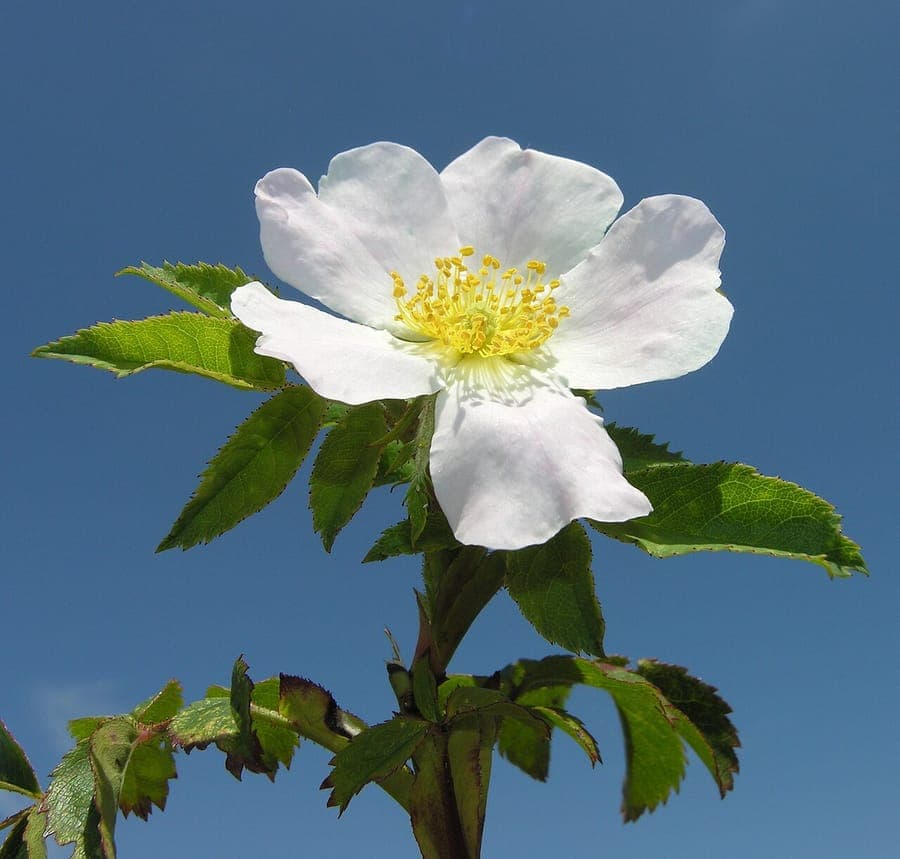
Andrea Moro / CC BY-SA 4.0, via Wikimedia Commons
Fieldbriar: complete guide
Rosa agrestis
¿Quieres ver Fieldbriar: complete guide en tu jardín?
1 minuto, sin tarjeta de crédito
Overview
The Fieldbriar (Rosa agrestis), sometimes called the Small-leaf Sweetbriar, is a native wild rose species from the Rosaceae family. This is an exceptionally hardy and unpretentious shrub found throughout Europe and North Africa along roadsides, in hedgerows, and on rough ground. It's not a cultivated variety but a true wild species that has been part of the European landscape for centuries.
This rose is celebrated for its elegance despite – or perhaps because of – its simplicity. Small, delicate flowers give way to handsome red rose hips (rosehips) that persist throughout autumn and winter, providing vital food for wildlife.
Appearance and bloom cycle
The Fieldbriar grows as an open, loose shrub reaching 1–2 meters in height. Its branches are slender and graceful, armed with straight thorns. The leaves are small, finely divided compound leaves with 5–9 small leaflets, green and somewhat glossy.
In May and June, the flowers appear: soft pink to white, single (not doubled) blooms about 3 cm across. They carry a pleasant fragrance and attract countless bees and bumblebees. After flowering, around August and September, characteristic rosehips form – oval, glossy red fruits that signal ripeness and nutrition for birds.
Ideal location
The Fieldbriar is undemanding about location. It thrives in full sun to partial shade but tolerates less-than-ideal conditions. Ensure good air circulation to prevent fungal issues. This wild rose is perfect for:
- Natural hedgerows and shrub borders
- Landscape garden designs
- Wild gardens and ecological margins
- Fallow and undisturbed areas
- Bird-friendly plantings
The plant feels at home almost anywhere and makes no fuss about wind, pollution, or soil compaction.
Soil requirements
The Fieldbriar is highly soil-tolerant. It thrives on heavy clay, light sandy soil, and everything in between. Slightly alkaline to neutral soil (pH 6.5–7.5) is ideal, but more acidic soils are also tolerated.
The plant makes no great demands on nutrition and grows happily on nutrient-poor ground. Add compost or leaf mold when planting to improve soil structure, but more isn't necessary. Well-draining soil is essential – waterlogging leads to root rot.
Diseño gratis
¿Quieres ver Fieldbriar: complete guide en tu jardín? Crea un diseño gratis ahora.
Watering
Once established, the Fieldbriar is quite drought-tolerant. In the first season, water regularly (2–3 times weekly) until the plant develops root strength. Once mature, water only during prolonged dry spells.
The plant tolerates wet feet too, but sustained waterlogging isn't ideal. In autumn and winter, provide no supplemental water – natural rainfall is sufficient.
Pruning
Prune the Fieldbriar in February or March, once the last hard frosts have passed. Remove dead branches and weak shoots. The shrub tolerates hard cutting – you can even cut it back to 30 cm above ground without harm.
For a more compact, full shrub, perform light shaping in June if desired, but this isn't essential. The wild form is often more attractive than strict formal shaping.
Maintenance calendar
- January–February: Check soil moisture; no action needed
- February–March: Perform pruning
- April–May: Monitor for disease; no feeding needed
- May–June: Flowering period; no action
- July–August: Rose sawfly and aphids may appear; spray with water
- August–September: Harvest rosehips (optional)
- October–December: Leaf drop; no action
Winter hardiness
The Fieldbriar is extremely winter-hardy (USDA zone 4, down to –30°C). The plant endures frost, snow, and persistent cold weather without any problem. In severe winters, branches may suffer frost damage, but the plant always regrows.
Companion plants
The Fieldbriar pairs beautifully with:
- English holly (Ilex aquifolium): White-green contrast
- Blackthorn (Prunus spinosa): Same ecological niche
- Gooseberry (Ribes uva-crispa): Small fruits
- Bramble (Rubus fructicosus): Structural form
- Early dog-violet (Viola reichenbachiana): Understory
Conclusion
The Fieldbriar is indispensable for anyone seeking a natural, wildlife-friendly garden. On gardenworld.app, you can see how this rose integrates into garden design. With its fine foliage, soft pink flowers, and red rosehips, it adds beauty throughout the year.
Plant them in groups of three or more for maximum impact. A few specimens along a fence or low wall instantly transforms your garden into a slice of wild European countryside. For more inspiration on roses in modern garden design, visit gardenworld.app and discover how this plant can transform your space.
¿Quieres ver Fieldbriar: complete guide en tu jardín? Crea un diseño gratis ahora.
Sube una foto, elige un estilo y obtén un diseño fotorrealista con lista de plantas en menos de un minuto.
Más de 10.000 jardines diseñados
Sin tarjeta de crédito


Plantas similares
Siberian crab apple: complete guide
Malus x robusta
Complete guide to the Siberian crab apple (Malus x robusta): location, soil, pruning, winter hardiness and the best companion plants for your garden.
Chinese flowering crabapple (Malus x spectabilis): complete guide
Malus x spectabilis
Meet the Chinese flowering crabapple (Malus x spectabilis): a classic spring bloomer with carmine buds and pink blossom.
Potentilla crassinervia: complete guide
Potentilla crassinervia
Potentilla crassinervia, the Corsican cinquefoil, grows wild on Corsica and Sardinia's peaks. Discover how to grow this hardy alpine rock garden gem.