
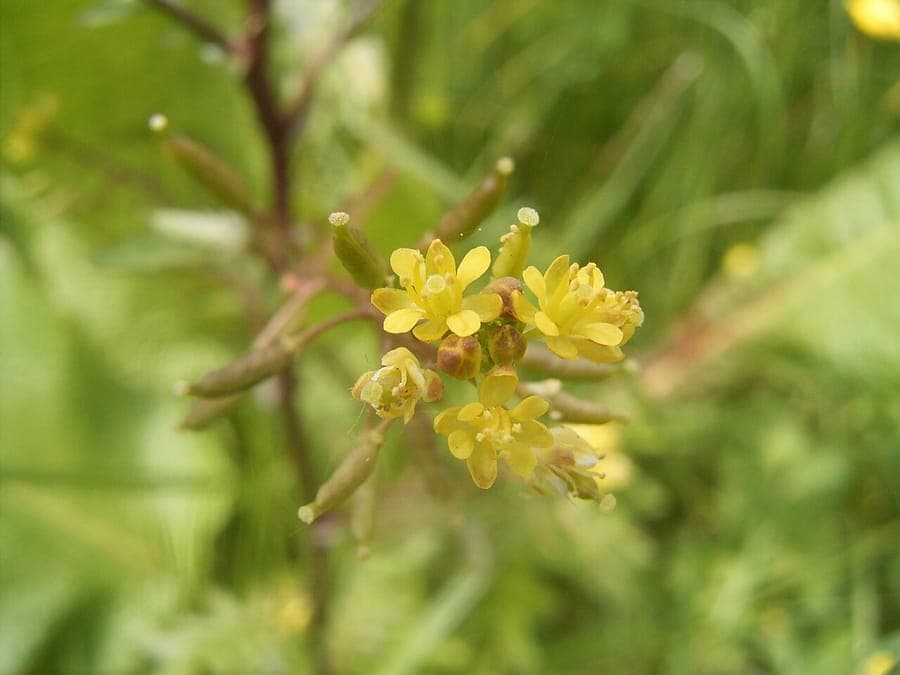
Me / Public domain, via Wikimedia Commons
Marsh cress: complete guide
Rorippa palustris
¿Quieres ver Marsh cress: complete guide en tu jardín?
1 minuto, sin tarjeta de crédito
Overview
Marsh cress (Rorippa palustris) is a compact, creeping aquatic plant native to temperate zones of the northern hemisphere through tropical mountains. This highly adaptable plant grows in both shallow waters and wet, marshy ground and is ideal for ecological water features. With its small yellow flowers and low-growing habit, this plant offers an elegant solution for wetland gardens. The plant usually stays under 16 inches and spreads horizontally, making it perfect for small spaces.
Appearance and Bloom
Marsh cress distinguishes itself through its fine leaf morphology and compact growth form. The leaves are extremely diverse in form; in shallow waters the leaves can be very finely divided and airy, while in drier environments the leaves are larger and undivided. This gives the plant a highly adaptive characteristic.
Yellow flowers appear from May to October in small clusters. These flowers are very small but extremely numerous, creating an attractive small yellow haze over the plant. After flowering, small, slender seed pods form.
Ideal Location
Marsh cress thrives best in shallow water (up to 4 inches deep) and on wet marsh ground. Sunny to partially shaded locations give the best growth. This plant is very suitable for water edge design, marsh pools, and wetland areas.
Soil
Marsh cress accepts a broad range of soils as long as they are sufficiently moist. Nutrient-rich, silt or muddy soil is ideal. The plant can even grow in wet, organic soils full of dead plant material.
No additional feeding is needed; the plant even benefits from moderately polluted waters (it filters nutrients).
Diseño gratis
¿Quieres ver Marsh cress: complete guide en tu jardín? Crea un diseño gratis ahora.
Watering
For marsh cress, water saturation is essential. The plant grows in both shallow waters and permanently wet ground. Ensure that the water table remains high.
The plant can tolerate short dry periods but flourishes better with continuous moisture.
Maintenance
Marsh cress requires minimal maintenance. Regularly remove dead plant material. In summer months pruning may be needed to prevent overgrowth, although this is usually not necessary because of the compact growth pattern.
This plant can self-seed, resulting in many young specimens.
Maintenance Calendar
March-April: Water feature preparation. May-October: Flowering period; yellow flowers appear regularly. October-November: Seed ripening and dispersal. December-February: Winter rest; plant remains active beneath water line.
Winter Hardiness
Marsh cress is very winter-hardy and survives winters down to -4 degrees Fahrenheit underwater. The plant is suitable for all temperate European climates and even subtropical mountains.
Companion Plants
Marsh cress naturally combines with:
Other low-growing aquatic plants: Glossostigma and riccia form carpet-like ground cover.
Medium aquatic plants: Alternanthera and hippuris add height.
Marsh plants: Buttercup and marsh marigold create edges.
Small rock plants: Soleirolia complements perfectly.
Final Thoughts
Marsh cress is a perfect plant for those who desire a compact, ecological water feature. With its fine leaves, yellow flowers, and highly adaptive nature, this plant is indispensable for aquatic ecology. Plant this species en masse for a natural carpet effect.
Available at: Water garden centers, aquatic plant specialists
Want to learn more about wetland plants? Visit gardenworld.app for plant selection. Visit gardenworld.app for plant selection.
¿Quieres ver Marsh cress: complete guide en tu jardín? Crea un diseño gratis ahora.
Sube una foto, elige un estilo y obtén un diseño fotorrealista con lista de plantas en menos de un minuto.
Más de 10.000 jardines diseñados
Sin tarjeta de crédito


Plantas similares
Brassica cretica: complete guide
Brassica cretica
Brassica cretica, the Cretan cabbage, grows wild on Aegean cliffs. Discover how to grow this drought-tolerant, yellow-flowered Mediterranean perennial.
Corsican cabbage: complete guide
Brassica insularis
Corsican cabbage is a rare Mediterranean rock cabbage with white flowers and blue-green leaves. Location, soil and winter protection.
Prostrate cabbage: complete guide
Brassica procumbens
Prostrate cabbage is a creeping North African cliff plant with yellow flowers. Discover location, soil type and winter protection.