
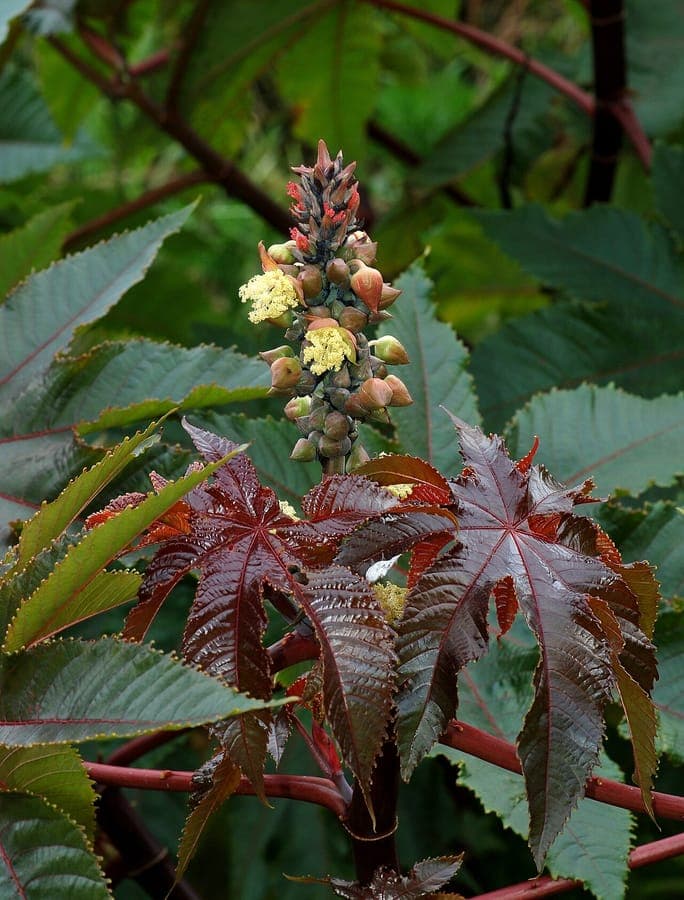
Alvesgaspar / CC BY-SA 3.0, via Wikimedia Commons
Castor oil plant: complete guide
Ricinus communis
¿Quieres ver Castor oil plant: complete guide en tu jardín?
1 minuto, sin tarjeta de crédito
Overview
The castor oil plant or ricinus (Ricinus communis), also called palma-christi, is a fast-growing tropical plant in the Euphorbiaceae family. Despite its subtropical origin, it can be grown in our climates as a summer annual. It is renowned for its enormous, deeply lobed leaves and impressive presence.
It is critical to understand that all parts of the plant are poisonous, particularly the seeds. This demands caution in households with children or pets. Nonetheless, it remains popular as an ornament due to its spectacular foliage.
Appearance and Bloom
The castor oil plant grows rapidly into an impressive specimen. Leaves are palmate with 5-11 deeply lobed segments, dark green to reddish in colour, reaching 30-60 centimeters in diameter. Some cultivars feature glossy red foliage.
Flowers are inconspicuous, greenish with red stamens. These appear in tall, upright inflorescences. After flowering, characteristic spiky seed capsules form. These are highly poisonous and must always be removed by hand if children are present.
Ideal Location
The castor oil plant demands a sunny, warm location. Minimum 6-8 hours of direct sunlight daily for optimal growth. In shade, it becomes leggy and less compact. Shelter from strong wind is important as large leaves damage easily.
This plant is utterly non-hardy and must be removed after first frost. It can overwinter in heated greenhouse or as houseplant, but grows minimally in winter.
Soil
The castor oil plant makes few soil demands. Well-draining, nutrient-rich potting compost works well. Heavy clay soils should be improved with sand and compost.
pH is not critical; it tolerates both neutral and slightly acid soils. Seed compost or universal potting mix is suitable.
Diseño gratis
¿Quieres ver Castor oil plant: complete guide en tu jardín? Crea un diseño gratis ahora.
Watering
During growing season (May-October), the castor oil plant needs copious water. Water regularly but ensure good drainage to prevent waterlogging. In hot spells, daily watering may be required.
Spraying foliage helps control pests and keeps leaves fresh. After two years, it can be planted out and will require even more water.
Pruning
Pruning is seldom needed as it grows naturally compact. Remove only side shoots or damaged leaves. Topping the plant early promotes bushier growth.
Remember that sap can cause irritation; always wear gloves when pruning.
Maintenance Calendar
May: Sow from seed or plant seedlings after last frost. June-August: Water regularly, feed every two weeks, control spider mites. September-October: Reduce feeding, water carefully. November: Protect from frost or bring indoors. Remove all seed pods. December-April: Transition to greenhouse or house. Minimal water.
Winter Hardiness
Completely non-hardy. The plant dies at first frost. This is actually beneficial for safety as poisonous seed capsules do not overwinter and new seed production is prevented.
Companion Plants
In containers, combine the castor oil plant effectively with:
- Coleus (contrasting foliage colours)
- Ipomoea (climbing vine)
- Plumbago (blue flowers)
- Sunflowers and other summer bloomers
Final Thoughts
The castor oil plant is a spectacular specimen bringing genuine tropical atmosphere to your garden. Its rapid growth and impressive foliage make growing worthwhile, especially for experimenters. Seeds are available online and at garden centres. Great caution is essential due to poisoning risk.
At gardenworld.app, design exotic summer gardens with this statement plant as focal point. Use it for drama, but with respect for safety.
¿Quieres ver Castor oil plant: complete guide en tu jardín? Crea un diseño gratis ahora.
Sube una foto, elige un estilo y obtén un diseño fotorrealista con lista de plantas en menos de un minuto.
Más de 10.000 jardines diseñados
Sin tarjeta de crédito


Plantas similares
Chingma-lantern: complete guide
Abutilon theophrasti
How to grow Abutilon theophrasti: ideal light, soil pH, watering, pruning and companion plants for this fast-growing annual in USDA zones 2-11.
Chinese Rice-Paper Plant: Complete Care Guide
Tetrapanax papyrifer
Discover the spectacular Chinese rice-paper plant (Tetrapanax papyrifer) with enormous leaves and vigorous growth. Learn about care and location.