
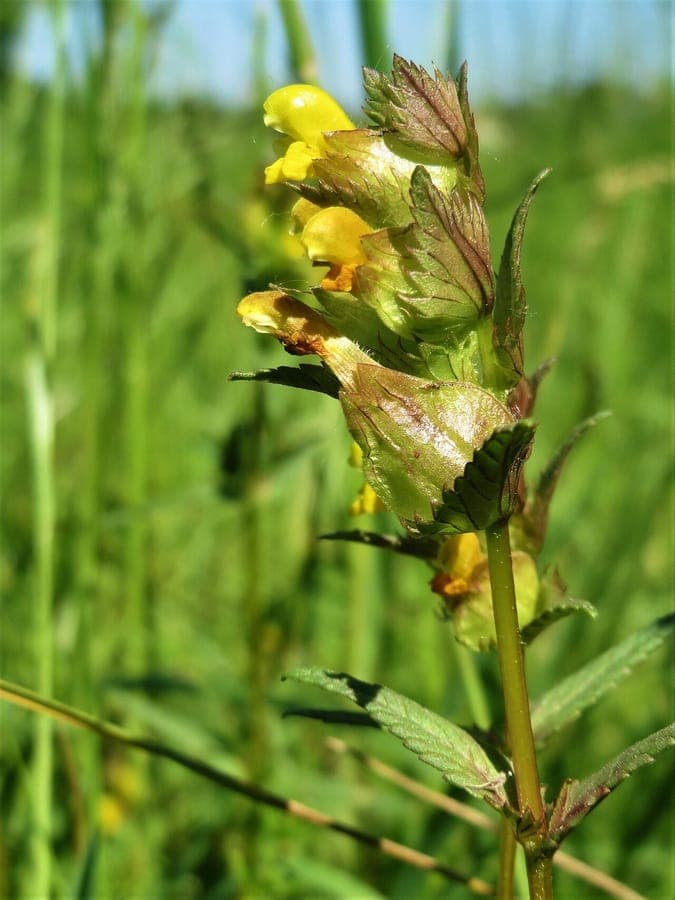
AnRo0002 / CC0, via Wikimedia Commons
Yellow-rattle: complete guide
Rhinanthus minor
¿Quieres ver Yellow-rattle: complete guide en tu jardín?
1 minuto, sin tarjeta de crédito
Overview
Yellow-rattle (Rhinanthus minor) is a delicate semi-parasitic herb from the Orobanchaceae family native throughout Europe. This slender annual plant plays a crucial ecological role in grasslands by reducing the competitive strength of certain grass species, thereby creating space for other flowering plants to flourish.
The plant is known for its bright yellow flowers and characteristic seed pods that produce a soft rattling sound when mature. Yellow-rattle is popular in ecological gardening systems and is widely used in wildflower seed mixes.
Appearance and bloom period
Yellow-rattle is a slender, upright herb typically reaching 15 to 40 centimeters in height, though it can reach 50 centimeters under favorable conditions. The stems are green to light reddish, smooth to very slightly hairy. The leaves are linear to lanceolate, finely toothed and dark green.
The bright yellow flowers are small to medium-sized, appearing in May through June in a two-lipped arrangement. The calyx is prominent with distinct veins. After pollination, characteristic inflated seed pods form that become papery. In July and August, these pods produce their typical soft rattle sound.
Ideal location
Yellow-rattle thrives in open, sunny locations with full sun to very light shade. The plant performs excellently on grassland, field margins, meadow areas and abandoned ground. It is not fussy about shelter and performs well in windy, open environments.
The plant readily establishes in species-rich grassland where it can maintain parasitic relationships with grass plants. This makes it incredibly valuable for biodiversity-focused management.
Soil requirements
Yellow-rattle has no special soil requirements and grows well on various soils from acidic to neutral (pH 5.0 to 7.0). The plant grows better on moderately poor to very poor nutrient soils. On excessively fertilized soils, its parasitic potential diminishes.
The plant tolerates diverse soils well as long as they are not permanently waterlogged. Good drainage is important, although the plant appreciates some soil moisture.
Diseño gratis
¿Quieres ver Yellow-rattle: complete guide en tu jardín? Crea un diseño gratis ahora.
Watering
Yellow-rattle has low to moderate water needs. The plant thrives on regular rainfall but tolerates dry periods reasonably well. Extra watering is usually not needed for established plants in temperate climates.
The plant does not perform well in permanently wet conditions. Good drainage is more important than regular watering, although some soil moisture is beneficial for seedling growth.
Pruning
Pruning yellow-rattle is not relevant because it's an annual herb. The plant is allowed to grow and naturally form seed. If you want to harvest seed for future seasons, let the seed pods ripen on the plant.
When you wish to remove the plant after seeding for tidiness, this can be done without issues. However, always allow some plants to set seed for natural sowing in subsequent years.
Maintenance calendar
Autumn (October-November): Direct sowing on soil. This is the ideal time because the plant requires winter chilling for optimal emergence.
Winter: Plant rests underground as a seedling. No maintenance required.
Spring (March-April): Growth begins. Plant develops roots and first leaves.
Late spring (May-June): Flowering period. Ensure insects can easily visit.
Summer (July-August): Seed maturation. Seed pods dry out and produce their characteristic sound.
Autumn (September-October): Seed dispersal via wind and animals. Plant completes its cycle.
Winter hardiness
Yellow-rattle is a winter annual herb that is very winter hardy. The plant tolerates frost down to minus 25 degrees Celsius without any problem. The plant actually grows better when experiencing winter dormancy, as this gives the plant the dormancy period needed for optimal growth in the following season.
Companion plants
Yellow-rattle grows well with:
- Other wildflower species such as buttercups, cranesbill and daisies
- Various grassland compositions from which it parasitically feeds
- Meadow and field vegetation
- Natural grass mixtures
Final thoughts
Yellow-rattle is a beautiful addition to any wildlife-friendly garden or wildflower project. The plant helps increase diversity in grassland and supports pollinators and insects. Available from wildflower seed suppliers and through gardenworld.app for plant consultations. This plant transforms simple grass compositions into flowering meadows where nature can flourish.
¿Quieres ver Yellow-rattle: complete guide en tu jardín? Crea un diseño gratis ahora.
Sube una foto, elige un estilo y obtén un diseño fotorrealista con lista de plantas en menos de un minuto.
Más de 10.000 jardines diseñados
Sin tarjeta de crédito


Plantas similares
Northwestern Indian paintbrush: complete guide
Castilleja angustifolia
All about Castilleja angustifolia, the northwestern Indian paintbrush from dry western US steppes. Growing, care, and companion plant advice.
Wavyleaf Indian paintbrush: complete guide
Castilleja applegatei
Everything about Castilleja applegatei, the wavyleaf paintbrush from Oregon and California. Host plants, care, location, and garden use covered.
Bushy bird's-beak: complete guide
Cordylanthus ramosus
Complete guide to Cordylanthus ramosus, the hemiparasitic annual of western US steppes: ecology, host plants, cultivation and uses.