
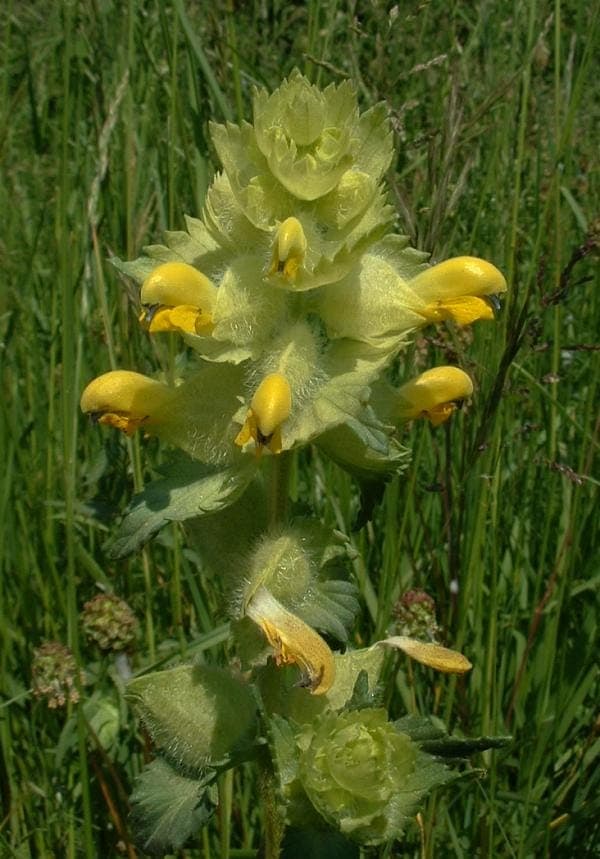
J.F. Gaffard Jeffdelonge at fr.wikipedia / CC BY-SA 3.0, via Wikimedia Commons
European yellow rattle: complete guide
Rhinanthus alectorolophus
¿Quieres ver European yellow rattle: complete guide en tu jardín?
1 minuto, sin tarjeta de crédito
Overview
European yellow rattle (Rhinanthus alectorolophus), also known as greater yellow rattle, is a fascinating semi-parasitic herb from the Orobanchaceae family. Native to Europe, this plant plays an interesting ecological role in meadows and gardens. The name 'rattle' refers to the characteristic rattling sound of seeds in the mature seed pods.
Rhinanthus alectorolophus distinguishes itself from related species through its more hairy appearance. The plant produces striking yellow flowers that attract insects and transforms the appearance of wild meadows in early summer.
Appearance and bloom period
European yellow rattle is an annual herb reaching 20 to 60 centimeters in height. The stems are upright, hairy and often lightly branched. The leaves are lanceolate, green with fine teeth along the edges, and also hairy. This hairiness gives the plant its characteristic name.
The flowers are striking yellow, set in a prominent, inflated calyx that extends upward. They appear in May through June, attracting bees and other insects. After flowering, papery seed pods form. In August-September, these pods produce a delightful rattle when fully mature and dry.
Ideal location
Rhinanthus alectorolophus thrives in full sun to light shade. The plant performs well on open meadows, field margins and semi-natural habitats. It readily establishes in grassland where it can parasitically feed from grass species.
The plant is not fussy about wind exposure and performs well in open, windy environments. This makes it ideal for wild gardens and ecological projects.
Soil requirements
Rhinanthus alectorolophus prefers moderately nutrient-rich to poor soils. The plant grows excellently on acidic to neutral soils with pH between 5.5 and 7.0. Heavily fertilized soils don't support the plant well and may even reduce its parasitic potential.
The plant prefers well-draining soils. On wet, stagnant soils, the plant struggles. Good drainage is important for successful growth.
Diseño gratis
¿Quieres ver European yellow rattle: complete guide en tu jardín? Crea un diseño gratis ahora.
Watering
Rhinanthus alectorolophus has moderate water needs. While the plant appreciates some moisture, especially during the growth phase, it tolerates drought stress reasonably well once established. In very dry environments, supplemental watering can help, but it's not essential.
The plant tolerates brief periods of excess water better than prolonged stagnation. Good drainage is therefore more important than frequent watering.
Pruning
Pruning Rhinanthus alectorolophus is not needed because it's an annual herb. Let the plant grow and form seed. If you want to spread seeds for following years, let the seed pods dry on the plant and allow them to naturally disperse.
If you wish to remove the plant after flowering to make room for other plantings, you can do so. This doesn't diminish the ecological value the plant provides.
Maintenance calendar
Autumn/Winter: Sow seed directly on the soil where you want the plant. This ideally happens in October-November for pre-chilling. The plant is a winter annual that emerges in spring.
Spring (March-April): Bird formation and initial growth. Plant develops roots and early growth.
Late spring (May-June): Flowering. Ensure insects have easy access.
Summer (July-September): Seed maturation. Seed pods dry out and produce their characteristic rattle.
Autumn (October): Seed dispersal. Collect seed or let it naturally fall for next year's cycle.
Winter hardiness
Rhinanthus alectorolophus is a winter annual in temperate climates. The plant tolerates winter frost down to minus 15 degrees Celsius without problems. As a true winter annual, the plant actually performs better with a cold period. This renews the plant's internal physiology and strengthens flowering.
Companion plants
Rhinanthus alectorolophus grows well in combination with:
- Other wildflowers such as buttercups and daisies
- Grassland plants from which it parasitically feeds
- Field margins with diverse plant composition
- Natural grass mixtures
Final thoughts
European yellow rattle is a valuable plant for those supporting ecological gardening. The plant helps reduce competition in grass mixtures, creating space for other wildflowers. Available from wildflower seed suppliers and through gardenworld.app consultations. This plant transforms neglected areas into flowering meadows where bees and insects thrive. A beautiful, useful addition to any wildlife-friendly garden.
¿Quieres ver European yellow rattle: complete guide en tu jardín? Crea un diseño gratis ahora.
Sube una foto, elige un estilo y obtén un diseño fotorrealista con lista de plantas en menos de un minuto.
Más de 10.000 jardines diseñados
Sin tarjeta de crédito


Plantas similares
Northwestern Indian paintbrush: complete guide
Castilleja angustifolia
All about Castilleja angustifolia, the northwestern Indian paintbrush from dry western US steppes. Growing, care, and companion plant advice.
Wavyleaf Indian paintbrush: complete guide
Castilleja applegatei
Everything about Castilleja applegatei, the wavyleaf paintbrush from Oregon and California. Host plants, care, location, and garden use covered.
Bushy bird's-beak: complete guide
Cordylanthus ramosus
Complete guide to Cordylanthus ramosus, the hemiparasitic annual of western US steppes: ecology, host plants, cultivation and uses.