
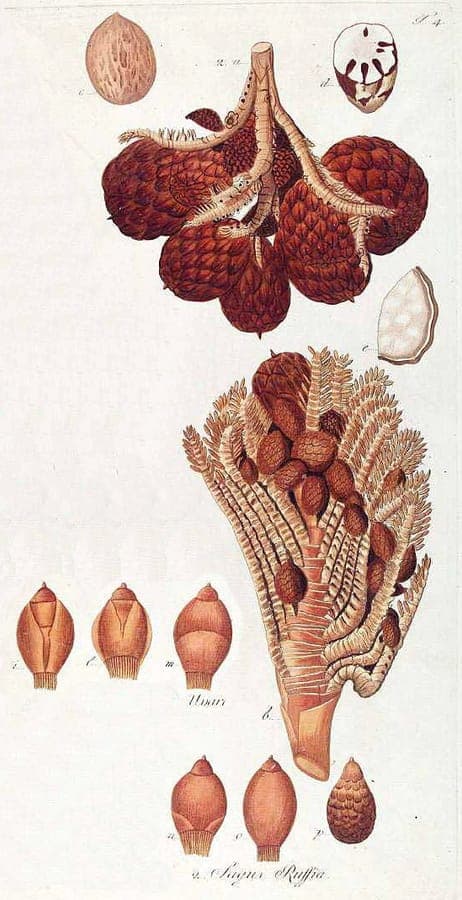
Jacquin, N.J. von / Public domain, via Wikimedia Commons
Raffia palm: complete guide
Raphia farinifera
¿Quieres ver Raffia palm: complete guide en tu jardín?
1 minuto, sin tarjeta de crédito
Overview
The Raffia palm, scientifically known as Raphia farinifera, is a spectacular tropical palm from tropical Africa and Madagascar. This palm from the Arecaceae family is renowned for its enormous, feathery leaves that can reach 20 meters long. In warmer climate zones and greenhouses, this plant is an impressive ornament.
This monocarpic palm dies after seed production, usually after 10-15 years of growth. The characteristic raffia fiber is commercially used, making this palm both ecologically and economically valuable.
Appearance and bloom
The leaves of Raphia farinifera are the largest leaves of any plant in the world. The leaves grow upright from the stem-like trunk and are doubly feathered with up to a hundred pairs of small segments. These leaves are gracefully curved and give the palm a majestic appearance.
Blooming occurs after approximately 10-15 years of growth. Large flowering spikes with yellow flowers appear at the base of the leaves. After flowering, large red fruits form adorned with fibers from the raffia fiber.
Ideal location
This palm grows optimally in tropical and subtropical climates with warm temperatures year-round. Full sun to partial shade are both suitable. In temperate climates, the palm can only be cultivated in heated greenhouses.
Protection from strong wind is essential for this plant with its large leaves.
Soil
Raphia farinifera grows well on various soil types, provided they are well-draining and nutrient-rich. The palm prefers moist soil with high organic matter content. In natural habitats, the palm grows in swampy areas.
Adding garden peat and compost when planting promotes healthy growth. pH between 6 to 7.5 is ideal.
Diseño gratis
¿Quieres ver Raffia palm: complete guide en tu jardín? Crea un diseño gratis ahora.
Watering
This palm loves regular, abundant moisture, especially during the growing season. In tropical habitats, this plant receives high rainfall monthly. Water well, but avoid stagnation.
Mulching around the plant helps with moisture retention. During dry periods, supplemental water is essential.
Pruning
This palm requires minimal pruning. Remove only old, yellow leaves carefully. Watch for sharp edges on stems when pruning.
Maintaining natural palm form contributes to the exotic appearance.
Maintenance calendar
Spring (March-May): Growing season starts, water regularly, apply compost and slow-release fertilizer.
Summer (June-September): Peak growing season, high water requirements, ensure excellent drainage.
Autumn (October-November): Growth slows, water less frequently.
Winter (December-February): Rest period, minimal watering, protect from cold.
Winter hardiness
Raphia farinifera is cold-sensitive and cannot be grown outdoors outside tropical and subtropical climates. Temperatures below 15 degrees Celsius can be harmful. This palm is thus for heat lovers and greenhouse owners.
Companion plants
In tropical settings, this palm combines well with:
- Other exotic palms (Cocos, Phoenix)
- Bananas (Musa) - tropical atmosphere
- Orchids - exotic blooming
- Heliconia - large leaves, tropical
- Anthurium - elegant contrast
These combinations create a tropical paradise garden-like effect.
Closing
The Raffia palm is a spectacular choice for heat zone gardeners seeking an impressive exotic plant. With its gigantic leaves and majestic appearance, this palm forms an unforgettable focal element in warm gardens.
Discover specialized tropical plant nurseries for Raphia farinifera. Ask for advice on gardenworld.app for tropical garden designs with exotic plants.
¿Quieres ver Raffia palm: complete guide en tu jardín? Crea un diseño gratis ahora.
Sube una foto, elige un estilo y obtén un diseño fotorrealista con lista de plantas en menos de un minuto.
Más de 10.000 jardines diseñados
Sin tarjeta de crédito


Plantas similares
Needle palm: complete guide
Rhapidophyllum hystrix
Everything about the needle palm: the world's hardiest palm, suitable for gardens in temperate climates down to USDA zone 7b.
Saw palmetto: complete guide
Serenoa repens
A complete guide to saw palmetto (Serenoa repens), the iconic fan palm from Florida and the southeastern United States, prized for its toughness.
Puerto Rican hat palm: complete guide
Sabal causiarum
Grow Puerto Rican hat palm successfully. A majestic fan palm with tropical presence suited to sheltered Mediterranean-style gardens.