
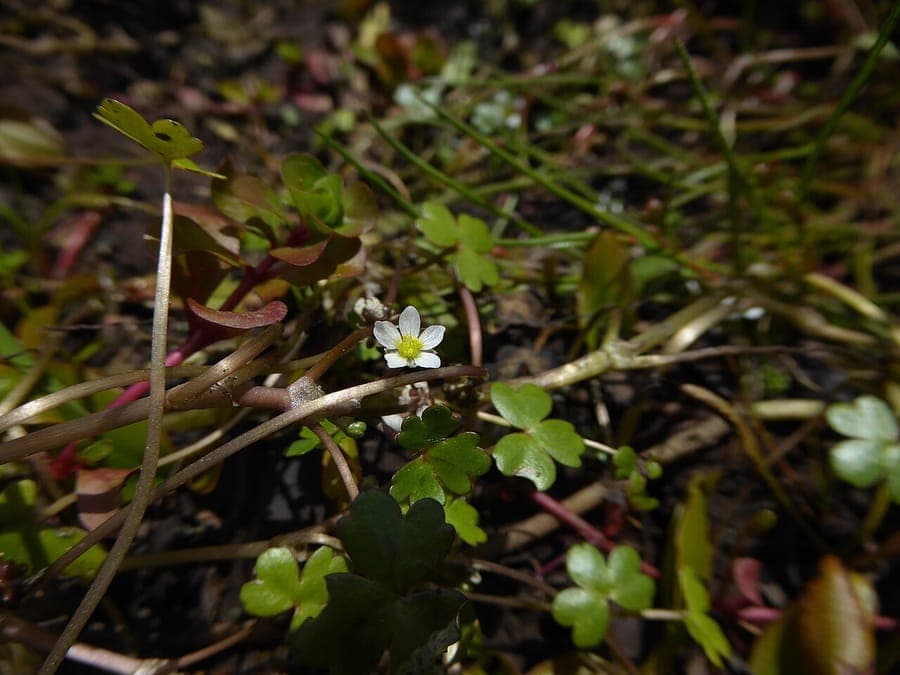
Alex Lockton / CC BY-SA 4.0, via Wikimedia Commons
Three-lobed Crowfoot: complete guide
Ranunculus tripartitus
¿Quieres ver Three-lobed Crowfoot: complete guide en tu jardín?
1 minuto, sin tarjeta de crédito
Overview
The three-lobed crowfoot (Ranunculus tripartitus) is a delicate aquatic plant from Europe and North Africa. This water-loving plant grows in shallow water and wet soils, adapting to various hydrological conditions. With white flowers appearing from May to July, this plant adds elegance to water gardens and natural water features.
The plant is native to western Europe, from France to Spain, and also parts of North Africa. This species plays an important role in aquatic biotopes and provides food for water animals. In cultivation, it offers a fascinating way to integrate aquatic elements into your garden.
Appearance and bloom
The three-lobed crowfoot is a unique aquatic plant with both floating and submerged leaves. The floating leaves are three-lobed, divided with the three segments touching in the center, which gives the plant its name. The submerged leaves are much more finely divided and have a fine, feathery appearance.
From May to July, the plant produces small, white flowers approximately 1-1.5 cm in diameter. The flowers appear in small clusters above the water surface. After blooming, small seed pods form. The plant grows actively during the growing season and declines in winter.
Ideal location
The three-lobed crowfoot thrives best in shallow, still water bodies with full to partial shade. At least 4-6 hours of light daily is desirable. This plant grows well in ponds, small lakes, and slowly flowing water. Fast-flowing water will not support this plant.
Water depth may be 10-60 cm. This plant prefers waters that regularly inundate and spread out. In artificial ponds, it forms a valuable element that adds movement and interest.
Soil requirements
The three-lobed crowfoot grows in water and is not dependent on traditional soil conditions but thrives with organic-rich water bottom. Soft silty bottoms with high organic content are ideal. The plant prefers slightly acidic to neutral water with pH 5-6.5. The plant can grow in various water qualities but does best in moderately nutrient-rich (mesotrophic) waters.
In very poor waters, growth may be slow. Nutrients can be added via organic material or specialized water fertilizers.
Watering
As an aquatic plant, the three-lobed crowfoot does not require traditional watering. The plant lives entirely in the water. Do ensure a stable water level - strong fluctuations can be harmful. In artificial ponds, evaporation may be a factor; regular top-up with rainwater is recommended.
In wet meadow settings, ensure the soil remains continuously moist, especially during the growing season (March-May). During dry periods, water availability can become critical.
Diseño gratis
¿Quieres ver Three-lobed Crowfoot: complete guide en tu jardín? Crea un diseño gratis ahora.
Pruning
The three-lobed crowfoot requires minimal pruning. In well-maintained ponds, the plant can grow out of hand. In such cases, you can carefully remove excessive growth, but be careful: do not remove more than 1/3 of the plant mass at once to avoid disturbing the ecosystem.
From August to September, as growth slows, you can carefully remove dead or damaged parts. Avoid aggressive disturbance of the water ecosystem.
Maintenance calendar
January-March: Plant rests underwater; no special maintenance. April-May: Growth increases; monitor development. June-July: Peak bloom and growth; monitor for excessive expansion. August-September: Growth slows; remove damaged parts. October-December: Plant prepares for winter; regular water management.
Winter hardiness
The three-lobed crowfoot is winter hardy in zones 5-8 (USDA hardiness zones). In the Netherlands and Belgium, the plant overwinters without problems in most regions, as long as the water does not completely freeze over. Extreme frost can cause leaf damage but the plant usually recovers.
Once established in a stable aquatic environment, this plant is robust. Even if above-ground parts die, underground parts can survive and regrow in spring.
Companion plants
The three-lobed crowfoot grows well with other aquatic plants. Water lilies, water violets, sedges, and reed plants fit well with this species. The white flowers contrast nicely with other aquatic plants in yellow or purple. Submerged plants such as water sprite complete the aquatic ecosystem.
In wet meadow settings, this plant grows well alongside other wetland species. Combining floating, submerged, and emergent plants creates a more natural water world.
Closing
The three-lobed crowfoot is a perfect choice for those seeking an aquatic plant with characteristic leaf morphology and elegant flowers. With its unique leaf form and white blooms, it adds interest to water gardens. Once established, it requires little intensive maintenance.
With stable water conditions, you will enjoy this plant for years. Regular water management and growth monitoring are important. Available through specialized water plant nurseries. Visit gardenworld.app for more inspiration for your water garden design.
¿Quieres ver Three-lobed Crowfoot: complete guide en tu jardín? Crea un diseño gratis ahora.
Sube una foto, elige un estilo y obtén un diseño fotorrealista con lista de plantas en menos de un minuto.
Más de 10.000 jardines diseñados
Sin tarjeta de crédito


Plantas similares
Drummond's anemone: complete guide
Anemone drummondii
Discover Drummond's anemone (Anemone drummondii): a silvery-grey mountain plant for cool rock gardens and alpine troughs.
Korean clematis: complete guide
Clematis serratifolia
Clematis serratifolia is a hardy climber with fragrant yellow bell flowers in August-September. Pruning group 3, location and care tips.
Aquilegia brevistyla: complete guide
Aquilegia brevistyla
Discover Aquilegia brevistyla, the elegant North American columbine. Growing tips, shade tolerance, and design ideas for woodland and shadowed gardens.