
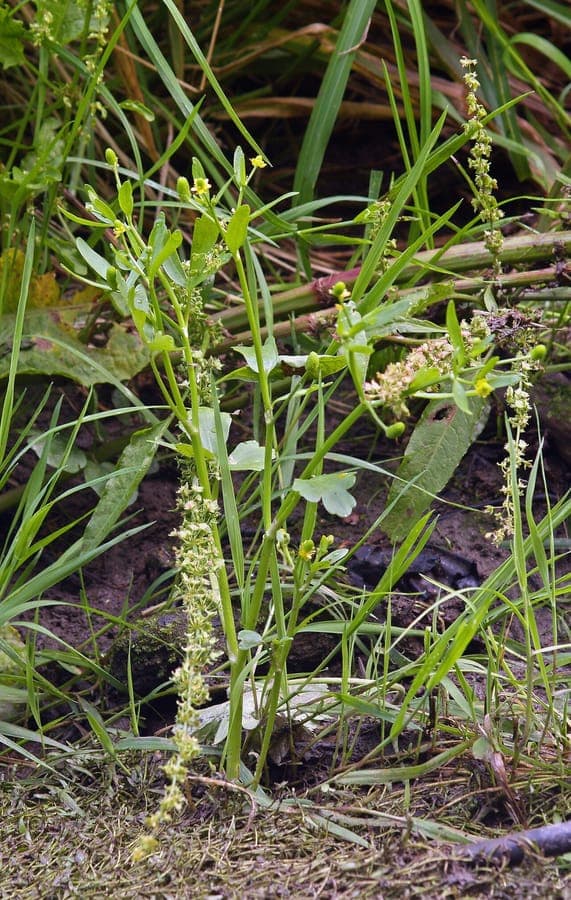
Jörg Hempel / CC BY-SA 2.0 de, via Wikimedia Commons
Celery buttercup: complete guide
Ranunculus sceleratus
¿Quieres ver Celery buttercup: complete guide en tu jardín?
1 minuto, sin tarjeta de crédito
Overview
Celery buttercup (Ranunculus sceleratus) is a fascinating marsh plant native to temperate Eurasia. This plant is known because it is toxic, the name deriving from the Latin word for cursed. This is a short-lived plant that prefers wet, sludgy environments along banks and in marshes. While not suitable for regular gardens, it deserves a place in specialist wetlands and educational collections.
Appearance and bloom
Celery buttercup grows 10-50 centimeters tall and bears deeply lobed, usually trifoliate leaves. The stems are slender and usually hairless. Flowers are small, only about 5 millimeters in diameter, bright yellow with five petals. They appear from May to August in clusters. The plant forms characteristic dense seed heads after flowering. These seed heads are very tightly packed in a cylindrical head.
Ideal location
Celery buttercup grows exclusively in very wet, marsh-like situations. This is a plant for pond banks, ditches, marshes and other water areas. It requires continuous moisture levels. The plant does not grow on normal garden soil. This requires specialist wetland conditions. Protect from strong drinking water flow. Still water or very slow moving water is ideal. This is only suitable for specialist keepers.
Soil
Celery buttercup requires sludgy, very moist soil. The plant grows in marl and boggy bank soil along waters. Organic, moist soil is essential. Heavy silt soil is preferred. Drainage is absolutely forbidden; the plant wants closed moisture levels. The plant does not thrive in normal garden soil. This requires specialist wetland composition.
Diseño gratis
¿Quieres ver Celery buttercup: complete guide en tu jardín? Crea un diseño gratis ahora.
Watering
Celery buttercup wants continuously waterlogged conditions. The plant must grow in water or very sludgy, moist environments. This is not a plant that can be dried out. Continuous moisture levels are absolutely necessary. Growing in pots with continuous wet feet water is an option for specialist enthusiasts.
Pruning
Minimal pruning required. Remove dead or damaged foliage. The plant is short-lived and will bring itself back after flowering. Seed can be left to grow next years. Work carefully around the plant because all parts are toxic.
Maintenance calendar
Spring: Plant in very wet environment. Maintain water continuously. Summer: Let flowers proceed. Autumn: Sow seed for next season. Winter: Plant will die in most locations. This is typically annual to short-lived perennial.
Winter hardiness
Celery buttercup is average hardy but thrives best in temperate zones. In very cold regions, seed from previous season can germinate nearby in next spring. In warmer climates plant can hold itself higher. Protection is not average needed.
Companion plants
Celery buttercup combines with other wetland plants. Group with bulrush, reed and water-flesh. This is only suitable for specialists water-garden composition. Avoid contact with normal garden plants, especially children and pets.
Conclusion
Celery buttercup is a plant for specialist enthusiasts and educational purposes. This requires complete moisture levels and specialist conditions. Because of its toxicity, this plant is not suitable for family gardens with children. Visit gardenworld.app for more specialist plant information.
¿Quieres ver Celery buttercup: complete guide en tu jardín? Crea un diseño gratis ahora.
Sube una foto, elige un estilo y obtén un diseño fotorrealista con lista de plantas en menos de un minuto.
Más de 10.000 jardines diseñados
Sin tarjeta de crédito


Plantas similares
Drummond's anemone: complete guide
Anemone drummondii
Discover Drummond's anemone (Anemone drummondii): a silvery-grey mountain plant for cool rock gardens and alpine troughs.
Korean clematis: complete guide
Clematis serratifolia
Clematis serratifolia is a hardy climber with fragrant yellow bell flowers in August-September. Pruning group 3, location and care tips.
Aquilegia brevistyla: complete guide
Aquilegia brevistyla
Discover Aquilegia brevistyla, the elegant North American columbine. Growing tips, shade tolerance, and design ideas for woodland and shadowed gardens.