
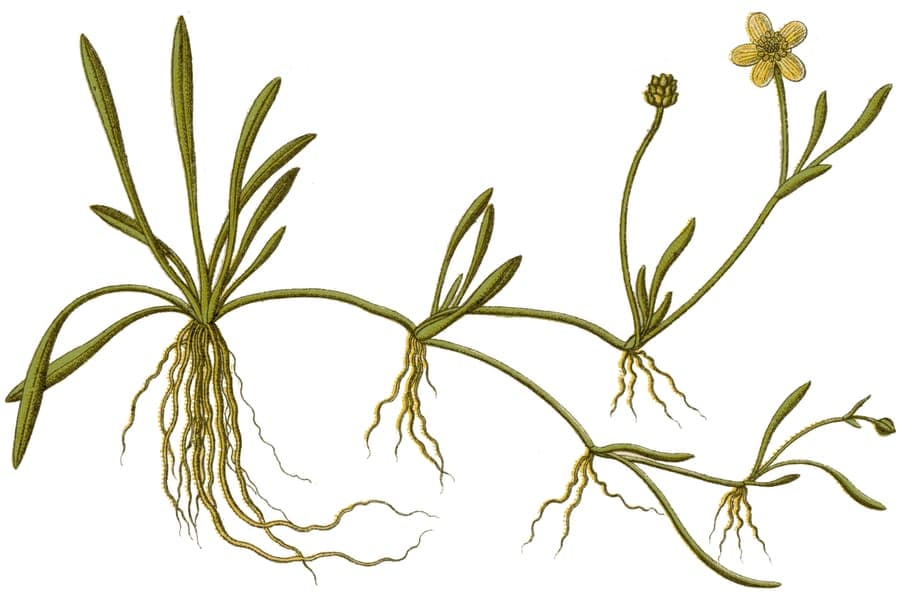
Jacob Sturm & Johann Georg Sturm / Public domain, via Wikimedia Commons
Creeping spearwort: complete guide
Ranunculus reptans
¿Quieres ver Creeping spearwort: complete guide en tu jardín?
1 minuto, sin tarjeta de crédito
Overview
The creeping spearwort (Ranunculus reptans) is a charming, low-growing plant native to subarctic and temperate regions of the northern hemisphere. This plant is known for its yellow flowers and creeping, spreading growth habit. In gardens with moisture-retaining soils and cool conditions, this plant offers excellent groundcover possibilities.
This plant is known by various alternative names, including creeping buttercup and lesser creeping marsh marigold. It is a true water-edge plant that thrives in marginal growing conditions.
Appearance and Bloom
The creeping spearwort is a small, herbaceous plant that grows close to the ground and propagates via horizontal runners. The leaves are small and grass-like. In bloom, yellow flowers appear on short stems, creating an attractive display.
The plant forms dense mats or cushions, making it ideal for groundcover purposes. The growth habit is low and spreading, allowing it to cover large areas.
Ideal Location
The creeping spearwort thrives best in locations with full to partial sun exposure. The plant copes well with shade and is known for its resilience in difficult locations. However, full sun is desirable for optimal blooming.
The plant is tolerant of wind situations and handles exposure well. This makes it suitable for open water edges and marginal growing conditions.
Soil
The creeping spearwort prefers moisture-retaining to wet soils. The plant grows naturally in water edges, wetlands, and other wet habitats. In gardens, care must be taken to maintain regular moisture levels.
The pH can vary widely from acidic to neutral (pH 5.0 to 7.5). The plant is very adaptable and grows in many different soil types.
Diseño gratis
¿Quieres ver Creeping spearwort: complete guide en tu jardín? Crea un diseño gratis ahora.
Watering
The creeping spearwort prefers always moist soils. This is a plant that benefits from constantly moist terrain. During dry periods, supplemental watering is recommended, although the plant can tolerate drought.
For optimal growth, plant this in areas that are naturally moisture-retaining, such as water edges or areas with water seepage.
Pruning
The creeping spearwort requires no formal pruning. The plant grows low and maintains its form naturally. Dead plant parts can be removed in place for neatness.
Maintenance Calendar
April to May: Plant begins to grow after winter.
June to August: Blooming period; check moisture.
September to October: Plant declines after blooming.
November to March: Plant is largely inactive.
Winter Hardiness
The creeping spearwort is extremely frost-hardy and can tolerate temperatures down to -20 degrees Celsius. This makes it suitable for almost all European gardens. Even in harsh winters, the plant survives well.
Companion Plants
The creeping spearwort combines well with other water-edge and wetland plants. Think of associations with reed, aquatic plants, and other moisture-retaining species.
Conclusion
The creeping spearwort is an excellent choice for gardens with moisture-retaining soils, water edges, or marginal growing conditions. With its resilient nature, attractive flowers, and groundcover character, it offers many benefits. You can find this plant at specialized water-edge nurseries. Learn more about water-edge gardening on gardenworld.app and create a sustainable, water-edge-centered garden.
¿Quieres ver Creeping spearwort: complete guide en tu jardín? Crea un diseño gratis ahora.
Sube una foto, elige un estilo y obtén un diseño fotorrealista con lista de plantas en menos de un minuto.
Más de 10.000 jardines diseñados
Sin tarjeta de crédito


Plantas similares
Drummond's anemone: complete guide
Anemone drummondii
Discover Drummond's anemone (Anemone drummondii): a silvery-grey mountain plant for cool rock gardens and alpine troughs.
Korean clematis: complete guide
Clematis serratifolia
Clematis serratifolia is a hardy climber with fragrant yellow bell flowers in August-September. Pruning group 3, location and care tips.
Aquilegia brevistyla: complete guide
Aquilegia brevistyla
Discover Aquilegia brevistyla, the elegant North American columbine. Growing tips, shade tolerance, and design ideas for woodland and shadowed gardens.