
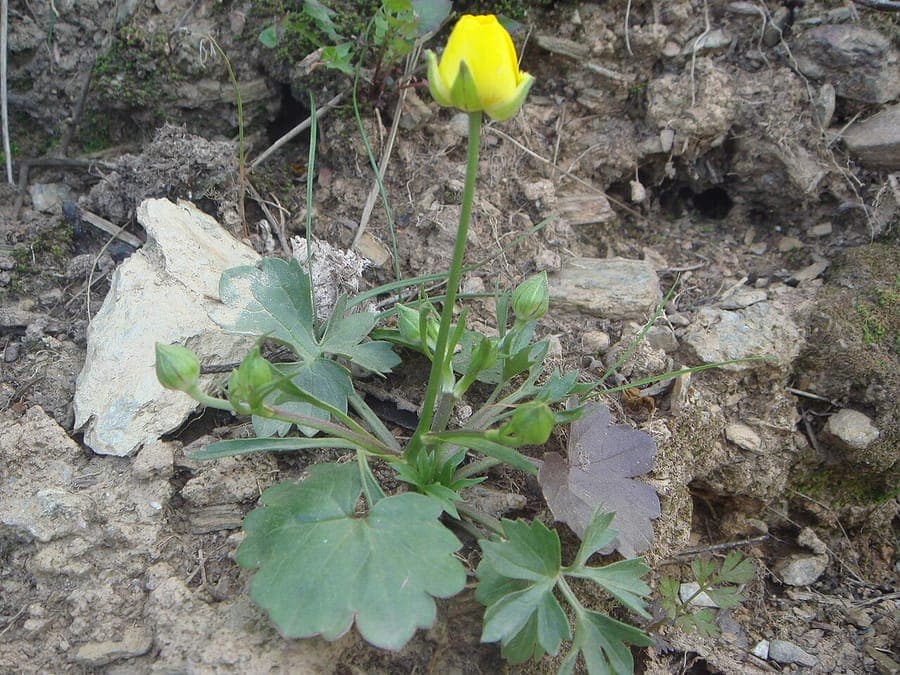
Xemenendura / CC BY 3.0, via Wikimedia Commons
Jersey buttercup: complete guide
Ranunculus paludosus
¿Quieres ver Jersey buttercup: complete guide en tu jardín?
1 minuto, sin tarjeta de crédito
Overview
The Jersey buttercup (Ranunculus paludosus), also known as Chervil buttercup in German or Marsh buttercup in French, is an unusual Mediterranean plant from the Ranunculaceae family. This plant is native to the Channel Islands, North Africa, and the Mediterranean region. It is an early-blooming annual or short-lived perennial that produces yellow flowers from April to June. The plant typically reaches 10 to 40 centimeters in height and is particularly suitable for moist gardens, vegetable gardens, and borders with Mediterranean character.
The Jersey buttercup has fine, finely divided leaves resembling parsley or chervil (hence the German name Chervil buttercup). The flowers are small rosettes approximately 1 to 2 centimeters across in bright to deep yellow. The plant grows best in moist soils and thrives in semi-shaded conditions, though full sun is possible in regions with cooler summers.
Appearance and Bloom
The Jersey buttercup is a compact-growing plant with a fairly branched stem that is slightly flexible. The plant typically reaches 15 to 40 centimeters in height, though under favorable conditions this may be somewhat larger. The stems are thin, green to reddish-tinged, and have fine, short hairs.
The leaves are very characteristic: they are deeply divided into narrow linear segments, giving it a very fine, almost grass-like appearance. Basal leaves may be somewhat larger than stem leaves. All leaves are glossy, deep green, and have soft texture.
Blooming begins in April and continues through June, with flowers growing individually on very thin stalks. The flowers have five yellow petals that are glossy and sometimes have a slight orange tint at the base. After bloom, very small, saw-edged fruits form with characteristic hook points.
Ideal Location
The Jersey buttercup grows best in semi-shaded spots with 2 to 4 hours of indirect sunlight daily, though full sun is possible in cooler climates. In warm Mediterranean-like areas, partial shade is considerably better to prevent plant desiccation. The plant is sensitive to frost and only suitable for moderate to warm climates (approximately USDA zones 7-10).
The plant prefers moist, nearly marshy locations. Planting locations along ponds, in marsh gardens, or in other very moist soil types are ideal. The plant does not thrive in permanently waterlogged conditions, however, so good drainage is needed despite preference for moisture.
Soil
The Jersey buttercup grows optimally in moist to wet, acidic soils with a pH value between 5.0 and 5.5. The plant can grow in widely varying soil types - sand, clay, and humus-rich soils - as long as moisture supply is constant. Adding generous compost and leaf mold helps improve moisture retention in light soils.
The plant has modest nutrient needs and grows well in poor soils. In fact, excessive nutrients may promote lush leaf growth at the expense of flower formation. Organic mulch around the plant helps regulate moisture and maintain soil acidity.
Diseño gratis
¿Quieres ver Jersey buttercup: complete guide en tu jardín? Crea un diseño gratis ahora.
Watering
The Jersey buttercup prefers moist soils and grows best where the water table is relatively high. In normal years with regular rainfall, established plants need no supplemental watering. During dry periods, however, regular watering is essential, as drought will reduce flower formation and cause the plant to wilt prematurely.
Young seedlings from seed or transplants should be watered regularly until well-established. Summer watering should be regular, at least once per week in very dry conditions. Standing water must however be absolutely avoided.
Pruning
The Jersey buttercup requires minimal pruning. Dead foliage can be removed when completely wilted. Seed heads can be removed before ripening if self-seeding in the garden is to be prevented. Since this is an annual or short-lived plant, pruning is mainly directed at space clearing after bloom and seed-set.
Verbose plants can be removed and replaced with fresh seedlings in autumn or early spring.
Maintenance Calendar
October-November: Sow seed directly in moist soil or in pots for preparation. December-February: Young plants grow cautiously, minimal care. March-April: Growth starts, regular moisture provision, preparation for bloom. May-June: Bloom, no active care beyond regular watering. July-August: Seed-set, seed ripening, optional removal of seed heads. September-October: Plant fades, seed collection, preparation for next season.
Winter Hardiness
The Jersey buttercup is not frost-hardy and can only tolerate brief frost periods to about -5 degrees Celsius. In regions with severe winters, the plant must be resown annually or can be grown indoors. In moderate Mediterranean climates, seed may self-sow and flower next season.
In very cold areas, the plant can be sown indoors in February-March and transplanted after the last frost date. Alternatively, seeds can be brought into container pots for greenhouse growing.
Companion Plants
The Jersey buttercup combines well with other early-blooming Mediterranean herbs and plants in marsh or moist plots. Good partners are other Ranunculus species such as Bulbous buttercup, Speedwell (Veronica) spp., and Primrose (Primula) in moist variants.
In moist gardens, they combine well with other marsh herbs like Burnet (Sanguisorba), Queen-of-the-meadow (Filipendula), and native sedges. For ground cover effects, low-growing moisture-loving ground covers such as Bugle (Ajuga replans) and Pennyroyal (Mentha pulegium) can be used.
Closing
The Jersey buttercup is a rare and unusual choice for moist gardens with Mediterranean or natural character. The fine leaf structure and early yellow flowers provide ornamental value from April to June. For gardeners in cooler climates, this plant is an enjoyable challenge for growing in pots or sheltered locations. The combination of botanical interest character and relative rarity makes it a valuable part of diverse gardens.
Garden centres sometimes sell seed of unusual Ranunculus species. GardenWorld can provide advice on specific sowing and care techniques for this Mediterranean plant. GardenWorld also supports cultivation of rare moisture-loving plants.
¿Quieres ver Jersey buttercup: complete guide en tu jardín? Crea un diseño gratis ahora.
Sube una foto, elige un estilo y obtén un diseño fotorrealista con lista de plantas en menos de un minuto.
Más de 10.000 jardines diseñados
Sin tarjeta de crédito


Plantas similares
Drummond's anemone: complete guide
Anemone drummondii
Discover Drummond's anemone (Anemone drummondii): a silvery-grey mountain plant for cool rock gardens and alpine troughs.
Korean clematis: complete guide
Clematis serratifolia
Clematis serratifolia is a hardy climber with fragrant yellow bell flowers in August-September. Pruning group 3, location and care tips.
Aquilegia brevistyla: complete guide
Aquilegia brevistyla
Discover Aquilegia brevistyla, the elegant North American columbine. Growing tips, shade tolerance, and design ideas for woodland and shadowed gardens.