
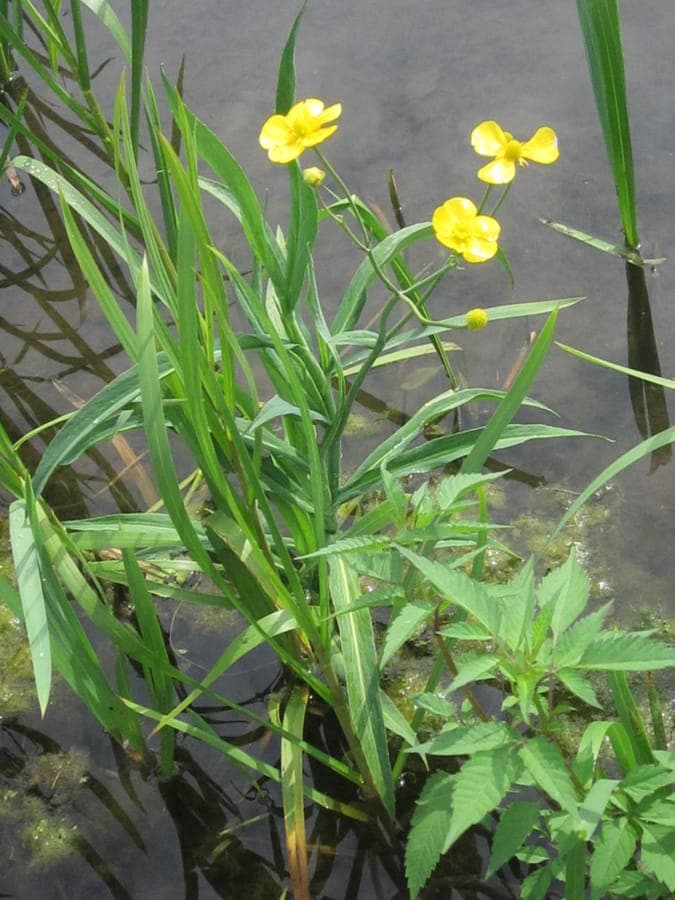
JanB46 / CC BY-SA 4.0, via Wikimedia Commons
Greater Spearwort (Ranunculus lingua): complete guide
Ranunculus lingua
¿Quieres ver Greater Spearwort (Ranunculus lingua): complete guide en tu jardín?
1 minuto, sin tarjeta de crédito
Overview
Greater spearwort (Ranunculus lingua), also known as great marsh buttercup, is an imposing aquatic plant from the Ranunculaceae family. This large buttercup variant thrives in marsh habitats and shallow waters throughout Europe to West Asia. With its striking yellow flowers and long, lance-shaped leaves, greater spearwort forms a dominant landscape element in aquatic gardens.
This versatile plant offers not only visual impact with its large flowers but also serves as food source for bees and other pollinators. Greater spearwort is an excellent choice for larger ponds and wetland zones needing more dramatic plant elements.
Appearance & Bloom
Greater spearwort grows as a strikingly large plant, reaching heights of 30 to 100 centimeters, depending on growing conditions. The long, lance-shaped leaves are bright green and can reach 25 centimeters length. The flowers are large, golden-yellow and reach 2 to 3 centimeters diameter, appearing from June through August in rich clusters.
The plant develops strong, upright stems that rise above the water surface. The large yellow flowers are extremely conspicuous and attract numerous pollinators. This is a true visual anchor point in any water garden.
Ideal Location
Greater spearwort thrives best with full sun exposure, requiring minimum 6 to 8 hours direct sunlight daily. The plant also accepts partial shade, though flowering may be less abundant. Plant in shallow waters or along pond margins where water depth is 10 to 30 centimeters.
Optimal growth occurs along deeper waters where the plant can prevent root diseases. Avoid heavily shaded locations.
Soil
Greater spearwort demands nutrient-rich, muddy or clay-rich soils with pH values from 7.0 to 7.5. The plant accepts heavy soils excellently and thrives even in poorly-drained situations. Aquatic plant soil or heavy garden clay is ideal.
The plant prefers nutrient-rich soils with substantial organic matter. Regular amendment with composted material helps growth significantly.
Diseño gratis
¿Quieres ver Greater Spearwort (Ranunculus lingua): complete guide en tu jardín? Crea un diseño gratis ahora.
Watering
Greater spearwort requires constant underwater planting with water depth of 10 to 30 centimeters. Ensure the plant remains permanently submerged. In containers the plant can be placed in shallow basins.
Regular watering is essential during the growing season. In dry periods supplemental water may be necessary to maintain water levels.
Pruning
Greater spearwort demands minimal pruning. Remove spent flowers during bloom season to encourage continuous flowering. After blooming, carefully cut back to water-line height.
In early spring, previous season stems can be removed. Annual renewal pruning in March is recommended.
Maintenance Calendar
March: Cut previous season dead stems. Remove dead leaves.
April-May: Prepare for growing season. Add fertilizer for rich blooming.
June-August: Observe rich flowering. Regularly remove spent flowers.
August-September: Flowering concludes. Prune dead material.
October-November: Reduce watering. Plant prepares for dormancy.
December-February: Minimal activity. Protect against severe frost.
Winter Hardiness
Greater spearwort is quite winter-hardy, tolerating temperatures to approximately -10 degrees Celsius. In mild climate zones the plant remains evergreen. Severe frost may damage above-ground portions, but the plant reliably regenerates each spring from underwater roots.
In very cold regions, mulch protection with straw may prove beneficial. Ice formation in containers can be damaging.
Companion Plants
Greater spearwort combines beautifully with other aquatic plants like sedges, sweet flag, and water lilies. Purple irises and water mint create attractive visual contrasts.
In wildlife gardens it works well alongside other insect-attracting plants. Combine with lower plants for layered water effects.
Conclusion
Greater spearwort is a dramatic, ecologically-valuable aquatic plant transforming any water garden zone. Its large yellow flowers and imposing height make it a perfect anchor point for water gardens. With straightforward care and maximum pollinator attraction, greater spearwort is essential for expressive water gardens. Discover more aquatic plants on gardenworld.app and design your spectacular pond garden.
¿Quieres ver Greater Spearwort (Ranunculus lingua): complete guide en tu jardín? Crea un diseño gratis ahora.
Sube una foto, elige un estilo y obtén un diseño fotorrealista con lista de plantas en menos de un minuto.
Más de 10.000 jardines diseñados
Sin tarjeta de crédito


Plantas similares
Drummond's anemone: complete guide
Anemone drummondii
Discover Drummond's anemone (Anemone drummondii): a silvery-grey mountain plant for cool rock gardens and alpine troughs.
Korean clematis: complete guide
Clematis serratifolia
Clematis serratifolia is a hardy climber with fragrant yellow bell flowers in August-September. Pruning group 3, location and care tips.
Aquilegia brevistyla: complete guide
Aquilegia brevistyla
Discover Aquilegia brevistyla, the elegant North American columbine. Growing tips, shade tolerance, and design ideas for woodland and shadowed gardens.