
Wikimedia Commons / Public domain, via Wikimedia Commons
Ranunculus acris: complete guide
Ranunculus acris
¿Quieres ver Ranunculus acris: complete guide en tu jardín?
1 minuto, sin tarjeta de crédito
Overview
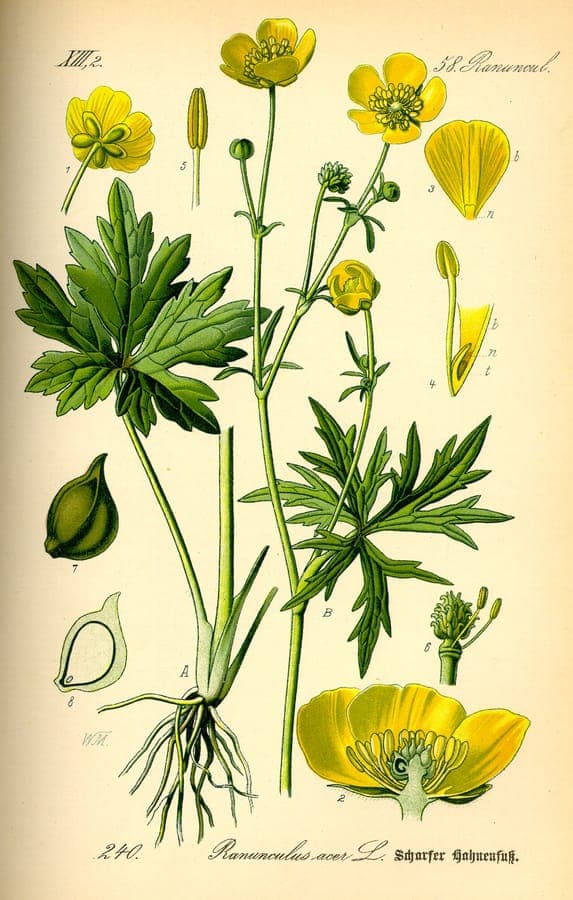
The Meadow buttercup (Ranunculus acris) is a versatile wildflower from the buttercup family (Ranunculaceae) naturally occurring in Europe and northeastern Asia. This vigorous plant is renowned for its shiny yellow flowers and upright, elegant growth pattern. The plant reaches 30-90 centimeters in height and grows in graceful clusters. With its glossy golden flowers, it is a classic choice for natural gardens and wild meadows.
Ranunculus acris is a plant for lovers of natural gardens and wildflowers. This plant grows almost anywhere, requires minimal maintenance, and attracts bumblebees and other insects.
Appearance and bloom
The Meadow buttercup distinguishes itself through its characteristic shiny yellow flowers. The flowers are small to medium-sized, approximately 15-25 mm in diameter, golden-yellow in color with five glossy petals. Flowers appear from May to August in broad, loose panicles. The foliage is deeply lobed and smooth, dark green with fine teeth along the margins.
The plant naturally occurs in moist meadows and along water margins. The plant is highly suitable for pollinators and forms an essential part of meadow ecosystems.
Ideal location
Ranunculus acris grows best in full sun to partial shade. The plant is very flexible and tolerates different light levels well. Choose a spot with modest moisture. The plant grows well in moist meadows, along banks, and in semi-shaded areas. Wind is no problem - this plant is very robust.
The plant adapts well to different environments.
Soil preference
Ranunculus acris grows in virtually all soil types, from acidic to neutral. A pH of 5.0-7.5 is acceptable. The soil may be quite moist, especially in summer. The plant tolerates both wet and slightly dry periods, though moist earth is preferred. No special feeding needed.
This plant is highly adaptive and grows well in poor soils.
Diseño gratis
¿Quieres ver Ranunculus acris: complete guide en tu jardín? Crea un diseño gratis ahora.
Watering
Ranunculus acris is a plant that tolerates moist conditions and blooms particularly well in summer rains. After planting, water regularly. Once established, extra water is usually unnecessary except in very dry summers.
The plant is drought-tolerant once established.
Pruning
Ranunculus acris requires no pruning. Faded flowers can be removed to stimulate further blooming, though this is not essential. After blooming, dead stems can be carefully removed.
Formal pruning is unnecessary.
Maintenance calendar
Spring: Plant grows actively. No maintenance needed. Flowers begin in May. Summer: Blooms during this season, sometimes until August. Enjoy the shiny flowers. Faded flowers can be removed. Fall: Plant begins to decline. Seeds ripen. Allow seed to drop for next year's self-seeding. Winter: Plant is dormant. No maintenance needed.
Winter hardiness
Ranunculus acris is very frost-hardy and grows well in all temperate climates of Europe. The plant tolerates winters without any protection. Native Greenlandic and other arctic regions harbor related populations, demonstrating robustness.
Companion plants
Ranunculus acris combines beautifully with other wild meadow flowers such as daisy, clovers, and harebell. Plant in groups for maximum effect. Grows well with other yellow flowers such as goldenrod.
Conclusion
Ranunculus acris is a classic wildflower that fits into almost any garden. With its shiny yellow flowers and flexible growth habit, it is a great choice for naturally managed gardens. At gardenworld.app, we help you fit this charming wildflower perfectly into your garden plan. With gardenworld.app, you create a bird-rich, insect-friendly garden full of natural beauty.
¿Quieres ver Ranunculus acris: complete guide en tu jardín? Crea un diseño gratis ahora.
Sube una foto, elige un estilo y obtén un diseño fotorrealista con lista de plantas en menos de un minuto.
Más de 10.000 jardines diseñados
Sin tarjeta de crédito


Plantas similares
Drummond's anemone: complete guide
Anemone drummondii
Discover Drummond's anemone (Anemone drummondii): a silvery-grey mountain plant for cool rock gardens and alpine troughs.
Korean clematis: complete guide
Clematis serratifolia
Clematis serratifolia is a hardy climber with fragrant yellow bell flowers in August-September. Pruning group 3, location and care tips.
Aquilegia brevistyla: complete guide
Aquilegia brevistyla
Discover Aquilegia brevistyla, the elegant North American columbine. Growing tips, shade tolerance, and design ideas for woodland and shadowed gardens.