
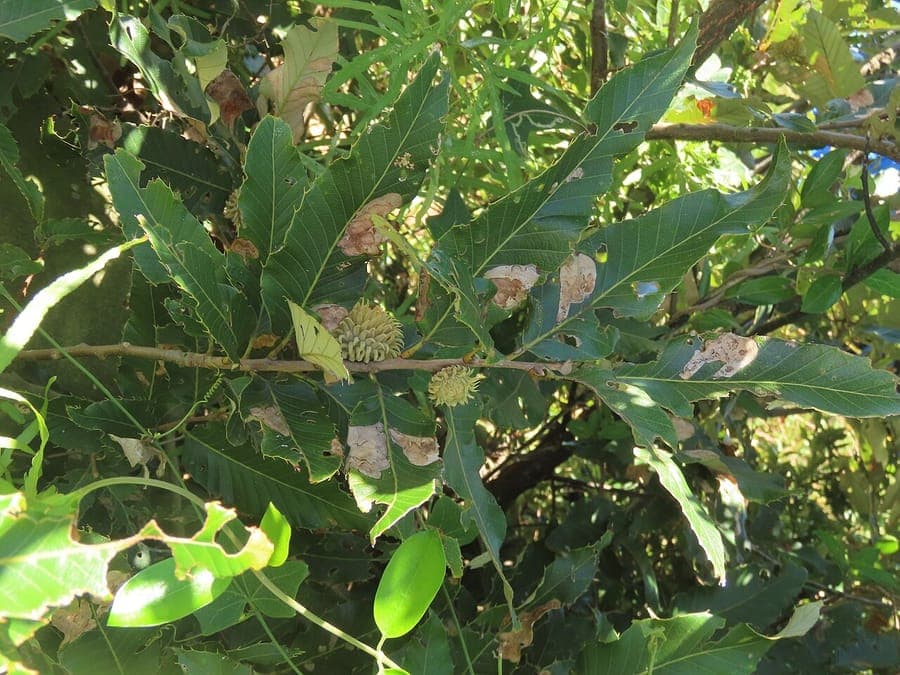
chiuluan / CC BY 4.0, via Wikimedia Commons
Chinese Cork Oak: complete guide
Quercus variabilis
¿Quieres ver Chinese Cork Oak: complete guide en tu jardín?
1 minuto, sin tarjeta de crédito
Overview
Quercus variabilis, known as Chinese cork oak, is an impressive Asian tree distinguished by its thick, ribbed cork-like bark. This tree belongs to the Fagaceae family and originates from China, Japan, Korea, and Taiwan. The Chinese cork oak reaches heights of 15 to 25 meters and forms a broad crown suitable for larger gardens and parklands.
This tree is valuable for its decorative bark and tolerance to various growing conditions. The Chinese cork oak provides year-round interest with its distinctive tree structure.
Appearance and Bloom
The Chinese cork oak features attractive deeply lobed leaves reaching up to 12 cm in length. Foliage displays bright green appearance throughout the growing season. In autumn, leaves turn golden to brown.
The most characteristic feature is the thick, ribbed, cork-like bark that is robust and decorative, making it visually interesting year-round. Flowers are inconspicuous, typical for oaks. Acorns are moderate-sized, growing in cups with fine scales.
Ideal Location
Quercus variabilis thrives in full sun with at least 6 hours of direct sunlight daily. The tree can also grow in partial shade, though growth will be less vigorous. Plant in an open location for optimal light and air circulation.
Provide sufficient space for the tree's broad crown.
Soil
The Chinese cork oak grows in well-drained, fertile soil. The tree is tolerant regarding soil type and can grow in both acidic and neutral to slightly alkaline soil. A pH of 6.0 to 7.5 is ideal.
Enhance heavy clay soils with organic material. Avoid very wet, waterlogged soil.
Diseño gratis
¿Quieres ver Chinese Cork Oak: complete guide en tu jardín? Crea un diseño gratis ahora.
Watering
Until the tree becomes well-established (approximately 2 years), water regularly. Once established, Quercus variabilis is extremely drought-tolerant and requires minimal supplemental watering except during very hot periods.
Deep watering encourages deep roots better equipped to handle drought.
Pruning
The Chinese cork oak requires minimal pruning. Remove only dead or damaged branches during dormancy. The tree naturally develops an attractive form.
Avoid severe pruning as it may lead to fungal infections.
Maintenance Calendar
Maintaining Quercus variabilis is straightforward. Regularly inspect for diseases and pests. The tree is relatively self-maintaining once established. Enjoy the distinctive bark year-round.
Fertilization is usually unnecessary for mature trees.
Winter Hardiness
Quercus variabilis is winter-hardy and suitable for hardiness zones 6 to 9. The tree tolerates temperatures to approximately -20degC.
Companion Planting
The Chinese cork oak combines well with other Asian trees. Plant in combination with Acer palmatum (Japanese maple) for aesthetic contrast. Underplant with shade-tolerant plants for low-level interest.
Closing
Quercus variabilis is a unique and valuable addition for those seeking something different from classic oaks. With its distinctive cork-like bark and tolerant growth, this tree offers year-round visual interest. Plant today and enjoy this special Asian tree.
Find Quercus variabilis at specialty retailers: Intratuin (Netherlands) and Gamma (Belgium).
¿Quieres ver Chinese Cork Oak: complete guide en tu jardín? Crea un diseño gratis ahora.
Sube una foto, elige un estilo y obtén un diseño fotorrealista con lista de plantas en menos de un minuto.
Más de 10.000 jardines diseñados
Sin tarjeta de crédito


Plantas similares
Lucombe oak: complete guide
Quercus crenata
Lucombe oak (Quercus crenata): a majestic semi-evergreen giant with corky bark, perfect for large gardens, parks, and country estates.
Blue oak: complete guide
Quercus douglasii
Discover the blue oak, a drought-tolerant Californian shade tree with striking blue-green foliage, ideal for large, climate-resilient gardens.
Quercus montana: complete guide
Quercus montana
Quercus montana, the chestnut oak, is a rugged American shade tree with deeply furrowed bark and large acorns, well suited to dry, rocky, spacious gardens.