
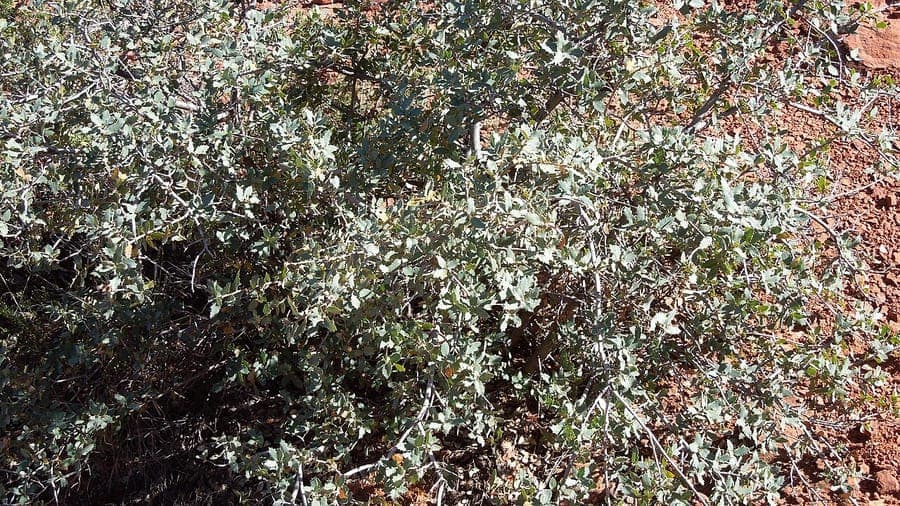
Boboaktree / CC BY-SA 4.0, via Wikimedia Commons
Sonoran scrub oak: complete guide
Quercus turbinella
¿Quieres ver Sonoran scrub oak: complete guide en tu jardín?
1 minuto, sin tarjeta de crédito
Overview
The Sonoran scrub oak (Quercus turbinella), also known as turbinella oak, scrub oak, or desert scrub oak, is an evergreen shrub-tree native to southern Arizona, southern California, southern Nevada, New Mexico, southeast Utah, and Mexico (Baja California, Sonora, and Chihuahua). This tree is one of the most adaptive xerophytic plants in the Sonoran Desert and grows on dry slopes, rocky terraces, and desert flats at elevations of 1,000 to 5,000 feet.
The Sonoran scrub oak reaches a height of 10 to 25 feet and forms a dense, compact shrub to small tree. This is an excellent choice for hedges, screens, and natural landscape contours.
Appearance & Bloom
The Sonoran scrub oak distinguishes itself with very small, gray-green leaves, only 0.5 to 1.5 inches long. These leaves are thick and leathery, adapted to extreme drought and heat. The tree is evergreen and retains foliage year-round, making it valuable for privacy and windscreen.
The flowers are small and inconspicuous, in catkins in early spring. The acorns are small, about 0.4 inches, in a deep, bumpy cup. These are food sources for wildlife in the desert.
The bark is dark brown to gray, rough and furrowed, giving the tree interesting texture.
Ideal Location
The Sonoran scrub oak grows best in full sun. At least 6 to 8 hours of direct sunlight daily is necessary. This tree grows well on slopes, plateaus, flat terrain, and even on rocky or irregular ground. The compact form makes it very versatile in the landscape.
In the landscape, place this tree best in groups of 3 to 5 for naturalistic effect, or as a continuous hedge or screen. It also works well as a specimen plant.
Soil
The Sonoran scrub oak is very tolerant of diverse soil types:
- Rocky, rocky soils
- Sandy soils
- Clayey soils
- Extremely nutrient-poor soils
- pH from 6.5 to 8.5
The tree accepts even the most marginal soils where few other plants grow. This is one of its most remarkable characteristics.
Watering
Once established, the Sonoran scrub oak is incredibly drought-resistant.
At planting: Water well the first two weeks, then gradually reduce as the tree roots in.
First growing season: Ensure soil doesn't completely dry out, but don't keep it wet.
Established trees: After two years, this tree needs virtually no water. This is one of its strongest points.
In extreme drought: You can water once a month, but it's not necessary.
Diseño gratis
¿Quieres ver Sonoran scrub oak: complete guide en tu jardín? Crea un diseño gratis ahora.
Pruning
The Sonoran scrub oak can be pruned for form, but also likes to maintain its natural form.
- For hedges or screens: prune in late spring after bloom
- For natural growth: minimal pruning
- Remove only dead or damaged branches
- The tree tolerates heavy pruning well and will resprout
- Pruning helps maintain the compact form
Maintenance Calendar
Spring (March-May): Prune for form if desired. Water young trees regularly until established. Add mulch around recently planted trees.
Summer (June-August): Rarely need water for established trees. Check young trees for drought stress, especially in the first year.
Fall (September-October): No special care needed. The tree retains its full foliage.
Winter (November-February): No maintenance needed. The tree is fully dormant but evergreen.
Winter Hardiness
The Sonoran scrub oak is frost-sensitive at lower limits. It thrives in USDA zones 8a to 10b. In zone 8a, hard winters can damage young plant material. The tree can suffer frost damage at temperatures below 20 degrees Fahrenheit.
The tree is exceptionally heat-tolerant and does not scorch even in extreme desert heat.
Companion Plants
The Sonoran scrub oak combines well with:
- Other shrubs: Creosote bush, Palo verde, Mesquite, Esperanza, Rosemary
- Groundcovers: Damianita, Desert marigold, Lantana, Salvia
- Succulents: Agaves, Yuccas, Ocotillo
- Ornamental grasses: Sideoats grama, Blue grama
This combination creates an authentic, low-water desert landscape.
Closing
The Sonoran scrub oak is one of the most valuable choices for xeriscaping in hot, dry climates. With its small leaves, evergreen appearance, extraordinary drought tolerance, and flexible growth (shrub to small tree), it offers year-round beauty with zero maintenance. It is a tree that actually prefers to be left alone.
On gardenworld.app, find more information about choosing native shrubs and trees for desert landscapes.
Intratuin and Gamma offer Sonoran scrub oak plant material.
¿Quieres ver Sonoran scrub oak: complete guide en tu jardín? Crea un diseño gratis ahora.
Sube una foto, elige un estilo y obtén un diseño fotorrealista con lista de plantas en menos de un minuto.
Más de 10.000 jardines diseñados
Sin tarjeta de crédito


Plantas similares
Lucombe oak: complete guide
Quercus crenata
Lucombe oak (Quercus crenata): a majestic semi-evergreen giant with corky bark, perfect for large gardens, parks, and country estates.
Blue oak: complete guide
Quercus douglasii
Discover the blue oak, a drought-tolerant Californian shade tree with striking blue-green foliage, ideal for large, climate-resilient gardens.
Quercus montana: complete guide
Quercus montana
Quercus montana, the chestnut oak, is a rugged American shade tree with deeply furrowed bark and large acorns, well suited to dry, rocky, spacious gardens.