
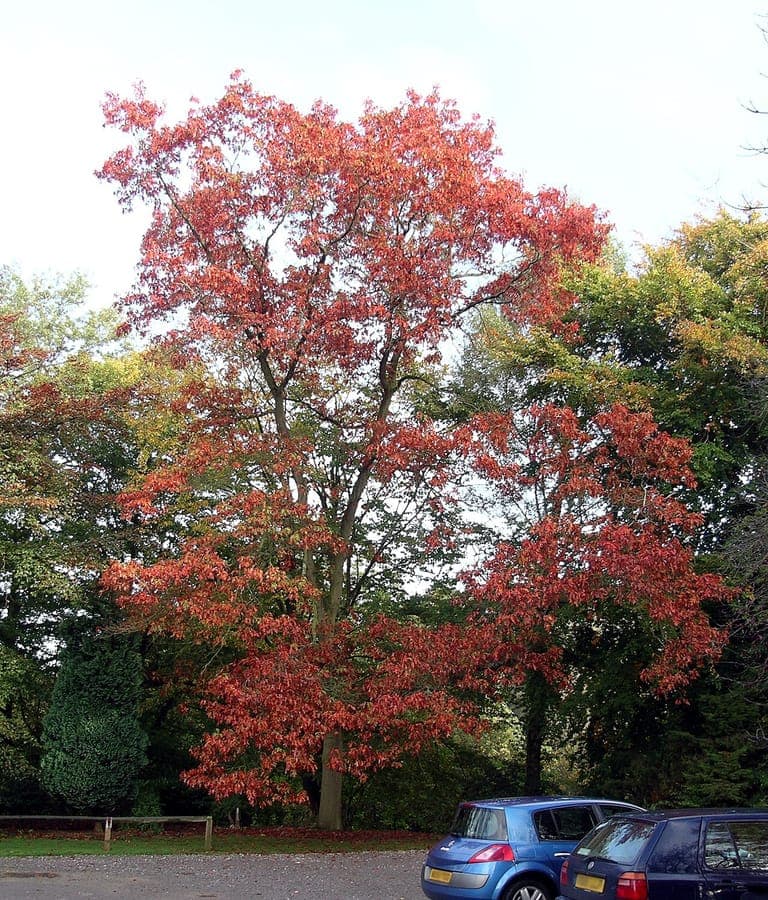
No machine-readable author provided. Velela assumed (based on copyright claims). / Public domain, via Wikimedia Commons
Northern red oak: complete guide
Quercus rubra
¿Quieres ver Northern red oak: complete guide en tu jardín?
1 minuto, sin tarjeta de crédito
Overview
The northern red oak (Quercus rubra) is an impressive American tree that has established itself splendidly as an immigrant to Europe. Unlike its European cousin, this tree grows considerably faster - 20-25 metres in 50-60 years - making it popular among modern gardeners with less patience.
What truly distinguishes this tree is its spectacular autumn display. Leaves transform from green to deep red, crimson, and purple tones in October, lasting for weeks. This makes the northern red oak a beloved choice for landscapes where colour and drama are desired.
Appearance & bloom cycle
The northern red oak is recognizable by its grey bark (not as deeply furrowed as the pedunculate oak) and much more deeply cut leaves. The leaves are 12-20 centimetres long, with sharp pointed lobes that are characteristic. Small bristles at lobe tips distinguish it from European oaks.
Flowers appear in May; male catkins are yellow and drooping, female flowers remain small and discrete. The acorns are larger than pedunculate oak acorns (2.5-3.5 centimetres), greenish-brown, barely enclosed by a tiny cupule. Autumn colouring begins in September and peaks in October with deep red and purple tones lasting weeks.
Ideal location
The northern red oak thrives in full sun with minimum six hours direct sunlight. Partial shade is tolerated but results in slower growth and thinner canopies. Plant it at least 12 metres from buildings, as it can reach 20-25 metres tall at maturity with crown diameters of 15-18 metres.
This tree is highly wind-resistant and performs excellently at altitude. Its deep root system makes it drought-resistant once established. Avoid plantings near drainage or sewer pipes.
Soil requirements
The northern red oak is highly soil-tolerant and grows on varied soil types from sand to heavy clay. Ideal pH is 5.5-7.5 (slightly acidic to neutral). This is less critical than for the pedunculate oak - northern red oaks thrive even on poor soils.
Better growth occurs when organic matter is incorporated; add 15-20% well-rotted compost at planting. The tree tolerates dry soils well and is excellent for marginal ground conditions. Prolonged waterlogged soil should be avoided.
Watering
Young northern red oaks need regular water during their first growing season. Water twice weekly, approximately 20 litres per tree during dry spells. After the first year, supplemental watering is usually unnecessary thanks to the fast-growing, deep root system.
During exceptional drought (>4 weeks without rain), supplemental water can help young trees. Established specimens are extremely drought-tolerant and require virtually no irrigation.
Diseño gratis
¿Quieres ver Northern red oak: complete guide en tu jardín? Crea un diseño gratis ahora.
Pruning
The northern red oak requires minimal pruning work. Remove only dead, diseased, or damaged branches during winter months (November-January). This tree naturally grows in a neat, rounded form without formal pruning.
Young trees can be gently shaped by removing competing leaders. Above 4-5 metres height, let the natural crown form develop. Heavy pruning is not recommended - this is a tree that prefers to determine its own shape.
Maintenance calendar
March-April: Beginning of growth period. Inspect for winter damage. Start monthly feeding if young tree.
May-June: Bloom season; inconspicuous flowers. Check young trees for water needs. Acorn set begins.
July-August: Peak growth period. Watering essential for younger trees during dry spells.
September-October: Autumn colour period - the most beautiful time! Monitor acorn set; acorns begin falling from September.
November-December: Pruning work; winter preparation. Remove accumulated leaf-fall around the tree.
Winter hardiness
The northern red oak is highly winter-hardy, tolerating winters to USDA zone 4 (-30°C) without damage. This tree is even hardier than many European oaks because its native habitat had severe winters and hot summers.
In zone 5 and northward, very young trees (first year) may experience slight frost damage but recover quickly. Mulch newly planted trees 10 centimetres deep in October for extra insulation.
Companion plants
Underplant with shade-tolerant species that tolerate heavy leaf-fall:
- Acer palmatum (Japanese maple): contrasting autumn colour (orange against red)
- Ilex verticillata (Winterberry): red fruit supports red autumn theme
- Cornus alba (Red dogwood): red winter stems complement red foliage
- Helleborus: remains beneath dormant tree in winter
The northern red oak produces abundant leaf-fall, so accept this as an advantage. Dense foliage and deep roots make dense underplanting near the stem non-ideal - keep 1-1.5 metres free.
On gardenworld.app, see how northern red oaks are used in modern landscapes for rapid, impactful autumn colour. This is ideal for gardens wanting maximum impact without 100 years' patience.
Closing remarks
The northern red oak is a smart choice for those wanting oak grandeur without long waits. With 30-50 centimetres annual growth, you'll see results within your lifetime.
The unique advantage is autumn colour - week after week of deep red autumn glory. This is the tree for those with autumn as their favourite season. On gardenworld.app, find inspiration for seasonal garden designs that fully utilize northern red oaks.
¿Quieres ver Northern red oak: complete guide en tu jardín? Crea un diseño gratis ahora.
Sube una foto, elige un estilo y obtén un diseño fotorrealista con lista de plantas en menos de un minuto.
Más de 10.000 jardines diseñados
Sin tarjeta de crédito


Plantas similares
Lucombe oak: complete guide
Quercus crenata
Lucombe oak (Quercus crenata): a majestic semi-evergreen giant with corky bark, perfect for large gardens, parks, and country estates.
Blue oak: complete guide
Quercus douglasii
Discover the blue oak, a drought-tolerant Californian shade tree with striking blue-green foliage, ideal for large, climate-resilient gardens.
Quercus montana: complete guide
Quercus montana
Quercus montana, the chestnut oak, is a rugged American shade tree with deeply furrowed bark and large acorns, well suited to dry, rocky, spacious gardens.