
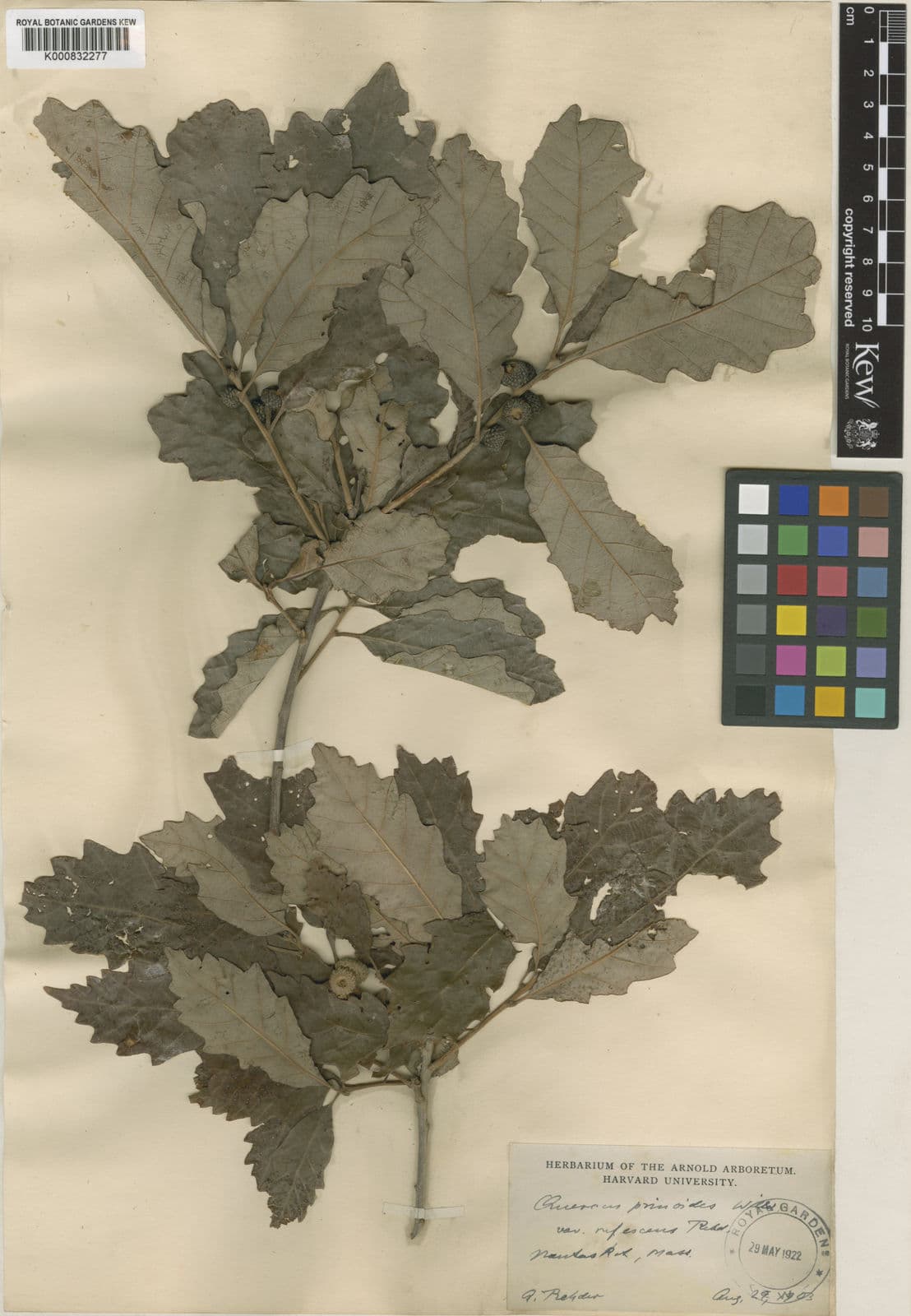
Dwarf chinkapin oak: complete guide
Quercus prinoides
¿Quieres ver Dwarf chinkapin oak: complete guide en tu jardín?
1 minuto, sin tarjeta de crédito
Overview
Dwarf chinkapin oak (Quercus prinoides) is a remarkable, low-growing oak species from North America that naturally grows as a dense, multi-stemmed shrub rather than the stately tree we associate with most oaks. The species is native from Ontario deep into the eastern and midwestern United States, including Alabama, Illinois, Michigan, New York, and Virginia, where it typically grows on dry, sandy or rocky ground in open oak savannas and on ridgetops. On gardenworld.app, this species is a great recommendation for anyone building a native, wildlife-friendly garden with a compact footprint and low maintenance demands.
What truly sets this oak apart is its speed: while most oaks take decades before producing acorns, dwarf chinkapin oak can bear its first fruit after just two to three years, a rarity in the oak family.
Native peoples across North America gathered the acorns of this species for centuries as a food source, thanks to their mildly sweet flavor compared with the often bitter acorns of larger oak species. Today the plant is mostly appreciated by native-plant gardeners and wildlife enthusiasts, though it remains a relatively obscure find in mainstream nurseries.
Appearance and bloom
This shrub typically grows 1 to 4 meters tall, forming a dense, rounded shape with a tendency to spread via root suckers into small, natural thickets. The foliage is obovate, 8 to 15 centimeters long, coarsely toothed with prominent, outward-pointing teeth reminiscent of chestnut leaves (hence the common name), dull green above and softly downy grey-green beneath. In autumn, the foliage turns yellow to reddish-bronze, a subdued but attractive display. Bloom, as in all oaks, consists of inconspicuous, hanging catkins in April and May. The acorns are relatively large for the shrub's size, about 1.5 to 2 centimeters, and rank among the sweetest of all North American oaks, with little to no bitter tannin. They mature within a single season, unlike many other oak species that take two years.
Ideal location
Dwarf chinkapin oak loves full sun, at least 6 to 8 hours daily, and naturally grows in open, dry locations without competition from tall trees. Plant this shrub on a sunny slope, in a gravel garden, or as a low, informal hedge along a property line. Give the plant about 1 to 2 meters of space, depending on whether you want a single shrub or a natural cluster to develop through root suckering. On gardenworld.app, we frequently use this species in native planting schemes where drought tolerance and low maintenance are the priority.
Soil
This species is exceptionally well adapted to poor, sandy, or rocky ground with a pH between 5.0 and 7.0, from slightly acidic to neutral. Rich, moist garden soil is unnecessary and can even lead to weaker, less characteristic growth. Good drainage is essential; the plant does not tolerate permanently wet feet. In sandy soils, such as those found in coastal dunes or river terraces, this oak feels completely at home without any soil amendment.
The shrub pairs well with other pioneer species that naturally grow on poor, dry ground, which is why it is also regularly used in ecological restoration projects and slope erosion control. In an ordinary garden setting, this means you will almost never need to fertilize the plant.
Diseño gratis
¿Quieres ver Dwarf chinkapin oak: complete guide en tu jardín? Crea un diseño gratis ahora.
Watering
Young plants need regular watering during the first and second year after planting to establish a strong root system. After that, dwarf chinkapin oak is exceptionally drought tolerant, thanks to its adaptation to dry, sandy habitats, and rarely needs supplemental water even during extended droughts. Avoid overwatering; this species is actually more sensitive to too much water than too little.
Pruning
Pruning is usually limited to removing dead or damaged wood, preferably in late winter. Since the shrub naturally spreads via root suckers, you can cut back unwanted young shoots at the edge of the cluster to control its spread, or leave them in place to let a natural thicket develop. For a more compact, shrubby shape, lightly cut back young plants after their first few growing seasons to encourage branching.
Maintenance calendar
- January: dormant period; no action needed
- February: good time to remove dead wood
- March: first buds swell
- April: catkin bloom begins
- May: bloom ends; foliage fully expands
- June: check young shoots for aphids
- July: drought check; watering usually unnecessary
- August: acorns begin forming
- September: acorns ripen and drop
- October: foliage colors to yellow and reddish-bronze
- November: leaf drop; collect acorns for sowing if desired
- December: dormant period; no fertilizing
Winter hardiness
Dwarf chinkapin oak is exceptionally cold hardy, down to USDA zone 4, tolerating temperatures to -34 degrees C. This cold tolerance makes the species suitable for nearly any European climate, including cold, continental interior regions where many other ornamental shrubs struggle. Even after a harsh winter with sustained frost, the shrub leafs out again in spring without any trouble, without needing any winter protection at all.
Companion plants
Pair dwarf chinkapin oak with other drought-loving, native-inspired plants such as little bluestem (Schizachyrium scoparium), butterfly weed (Asclepias tuberosa), or New Jersey tea (Ceanothus americanus). This combination creates a natural, prairie-like scene that is also excellent for pollinators and birds. On gardenworld.app, we love designing ecological corners with this oak, where wildlife value and low water demand go hand in hand.
For a complete native North American theme, you can also add Amelanchier species or low-growing junipers, which tolerate the same dry, sunny conditions and together form a varied, low-growing landscape that offers structure year round.
Closing
Dwarf chinkapin oak is a hidden gem for anyone seeking a compact, native, and remarkably cold-hardy shrub that also bears fruit early. Its sweet acorns attract birds and small mammals, while its modest size makes it suitable for smaller gardens where a full-sized oak would simply be too large. Young plants are mostly found at specialty nurseries carrying native North American species; ask about availability when ordering through a specialized tree nursery. Once planted, this shrub delivers decades of character, wildlife value, and a surprisingly fast result for an oak. Gardeners who care about biodiversity will notice this oak quickly becomes a surprisingly busy spot in the garden, visited by acorn-hunting jays, foraging squirrels, and early pollinators drawn to the spring catkins alike.
¿Quieres ver Dwarf chinkapin oak: complete guide en tu jardín? Crea un diseño gratis ahora.
Sube una foto, elige un estilo y obtén un diseño fotorrealista con lista de plantas en menos de un minuto.
Más de 10.000 jardines diseñados
Sin tarjeta de crédito


Plantas similares
Lucombe oak: complete guide
Quercus crenata
Lucombe oak (Quercus crenata): a majestic semi-evergreen giant with corky bark, perfect for large gardens, parks, and country estates.
Blue oak: complete guide
Quercus douglasii
Discover the blue oak, a drought-tolerant Californian shade tree with striking blue-green foliage, ideal for large, climate-resilient gardens.
Quercus montana: complete guide
Quercus montana
Quercus montana, the chestnut oak, is a rugged American shade tree with deeply furrowed bark and large acorns, well suited to dry, rocky, spacious gardens.