
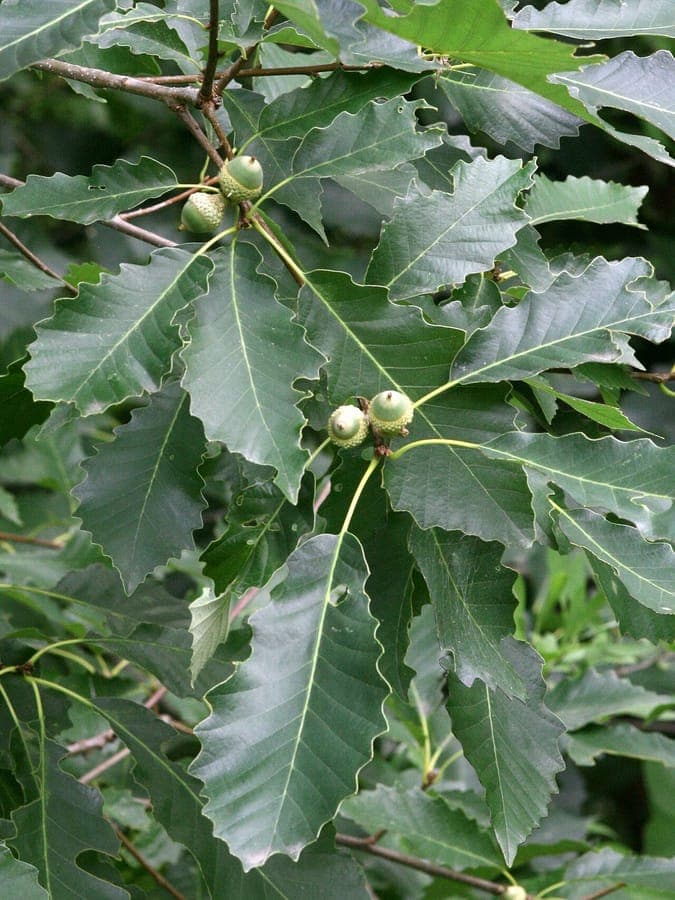
Vojtěch Zavadil / CC BY-SA 3.0, via Wikimedia Commons
Chinkapin Oak: Complete Growing Guide
Quercus muehlenbergii
¿Quieres ver Chinkapin Oak: Complete Growing Guide en tu jardín?
1 minuto, sin tarjeta de crédito
Overview
The Chinkapin oak (Quercus muehlenbergii), also known as yellow chestnut oak, is a majestic North American tree with distinctive foliage and pleasant appearance. This oak naturally occurred throughout eastern North America and is renowned for its preference for alkaline soils. With its robust growth and fine foliage, the Chinkapin oak provides excellent shade and aesthetic value in gardens.
Appearance and Bloom
The Chinkapin oak forms a medium to large tree reaching 15-25 meters in height with a broad, rounded crown. The leaves are narrow, elongated, and somewhat resemble chestnut leaves. They measure 8-13 cm long and display fine green coloration. In autumn, leaves turn gold to brown tones. The tree produces characteristic acorns that are small (about 1.5 cm) and ripen in fall. The bark is light, nearly white-gray.
Ideal Location
Chinkapin oak grows best in full sun with at least 6 hours of direct sunlight. This tree can survive in partially shaded conditions but grows better in full sun. Choose sheltered locations where strong winds are limited. The tree tolerates dry conditions once established.
Soil
Chinkapin oak prefers neutral to alkaline soils (pH 7.0-8.0), which is unusual for oaks. This makes it suitable for chalky soils. The tree tolerates various soil types including clay, sand, and loam. Good drainage is important. In acidic soils, it grows less well.
Diseño gratis
¿Quieres ver Chinkapin Oak: Complete Growing Guide en tu jardín? Crea un diseño gratis ahora.
Watering
Once established, Chinkapin oak is drought-tolerant. Young trees need regular watering in the first year. Water when soil feels dry to 5 cm depth. Mature trees require watering only in extreme drought.
Pruning
Minimal pruning is needed. Remove dead, damaged, or diseased branches. In the first couple of years, you can gently shape your young tree by removing asymmetrical branches. Avoid aggressive pruning.
Maintenance Calendar
- Spring: Apply nutrients, remove dead wood
- Summer: Water as needed, remove weeds
- Autumn: Clean fallen leaves, add mulch
- Winter: Minimal maintenance
Winter Hardiness
Chinkapin oak is very winter-hardy and tolerates temperatures to -35 degrees Celsius. This makes it suitable for cold states and Canada.
Companion Plants
Pair Chinkapin oak with other native trees and shrubs such as red maple, cottonwood, and dogwood. This creates natural woodland habitat teeming with biodiversity. Perfect for bird gardens.
Closing Thoughts
Chinkapin oak is a valuable tree for North American gardens that respect their natural heritage. With its beauty, resilience, and support for wildlife, it forms an essential element of sustainable gardens. Perfect for gardenworld.app users wanting to integrate native trees into their garden designs.
Once planted, your Chinkapin oak will endure for centuries and provide shelter for generations to come.
¿Quieres ver Chinkapin Oak: Complete Growing Guide en tu jardín? Crea un diseño gratis ahora.
Sube una foto, elige un estilo y obtén un diseño fotorrealista con lista de plantas en menos de un minuto.
Más de 10.000 jardines diseñados
Sin tarjeta de crédito


Plantas similares
Lucombe oak: complete guide
Quercus crenata
Lucombe oak (Quercus crenata): a majestic semi-evergreen giant with corky bark, perfect for large gardens, parks, and country estates.
Blue oak: complete guide
Quercus douglasii
Discover the blue oak, a drought-tolerant Californian shade tree with striking blue-green foliage, ideal for large, climate-resilient gardens.
Quercus montana: complete guide
Quercus montana
Quercus montana, the chestnut oak, is a rugged American shade tree with deeply furrowed bark and large acorns, well suited to dry, rocky, spacious gardens.