
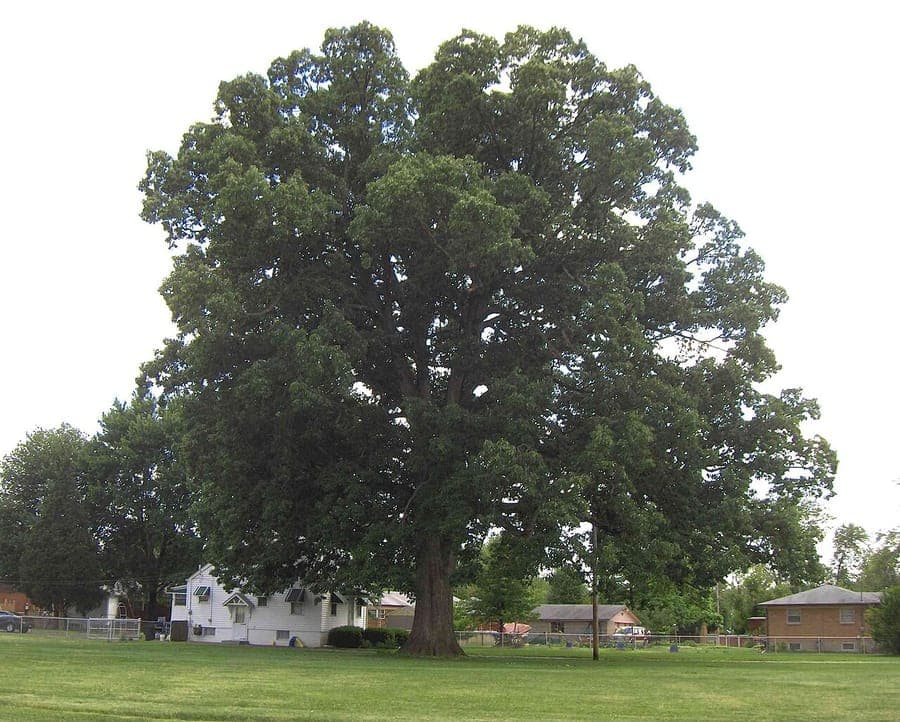
Jaknouse at English Wikipedia / Public domain, via Wikimedia Commons
Quercus michauxii: complete guide
Quercus michauxii
¿Quieres ver Quercus michauxii: complete guide en tu jardín?
1 minuto, sin tarjeta de crédito
Overview
Quercus michauxii, commonly called Basket Oak or Swamp Chestnut Oak, is a majestic American oak native to the southeastern United States. This impressive tree ranges from Florida to Texas and north to Pennsylvania and Illinois. With its large leaves, strong branching, and rich fall color, it stands as a classic landscape specimen for spacious gardens and parks.
This oak belongs to the Fagaceae family and is renowned for its robust structure and excellent shade-casting ability. In Europe, it increasingly appears in large gardens, parks, and estates where room for growth permits.
Appearance and Growth
Quercus michauxii grows into a large tree, typically 20 to 30 meters tall, with an impressive crown and strong branching structure. The trunk becomes thick, developing dark brown to grey bark with deep fissures.
Leaves are large, reaching 20 centimeters long, with wavy or lobed margins. They are dark green in summer, transforming in autumn to soft shades of gold, brown, and red. Foliage persists longer than many oak species, providing extended seasonal interest.
Fruit development results in large, reddish-brown acorns, approximately 2 to 3 centimeters long. These serve as food for wildlife and birds.
Ideal Location
Quercus michauxii performs best in full sun to light partial shade. Position it where it receives at least 6 to 8 hours of direct sunlight daily. As a mature tree, it creates its own shaded zone, making this less critical for established specimens.
This is a tree for larger gardens and landscapes. It requires ample space for its extensive root system and crown spread. Avoid placing close to buildings or obstructions.
Soil
Quercus michauxii thrives in diverse soil types. Despite its name referencing wetland habitat, it grows equally well in normal to dry soils. Ideal pH ranges between 4.5 and 6.5 (slightly acidic to neutral).
The tree tolerates sandy, loamy, and clay soils. In highly compacted soils, improve drainage by incorporating compost or organic matter. When young, invest effort in soil preparation; mature trees prove far more forgiving.
Diseño gratis
¿Quieres ver Quercus michauxii: complete guide en tu jardín? Crea un diseño gratis ahora.
Watering
Water newly planted trees regularly, at least through the first year. Deep watering twice weekly proves ideal. As the tree matures, water less frequently. Established large trees typically require only natural rainfall in temperate climates.
During drought conditions, provide supplemental water, especially in the first years. Avoid waterlogging.
Pruning
Quercus michauxii requires minimal pruning if properly planted while young. In early years, remove weak or crossing branches and develop a central stem. Remove dead or damaged wood annually.
For mature trees, prune minimally. Large cuts invite disease. Pruning best occurs in late summer or early autumn.
Maintenance Calendar
Spring (March-May): Growth period. Monitor moisture in young trees. Remove winter-damaged branches.
Summer (June-August): Water young trees during dry spells. Scout for pests and diseases.
Autumn (September-November): Enjoy fall foliage display. Oak galls and diseases may appear. Clear fallen leaves.
Winter (November-February): Dormancy. Minimal maintenance. Protect young trees against heavy snow that may break branches.
Winter Hardiness
Quercus michauxii is extremely cold-hardy, tolerating temperatures to minus 20 to minus 25 degrees Celsius. This is a tree for permanent landscapes, a strong investment in your grounds.
Companion Trees
Quercus michauxii pairs beautifully with other American trees and shrubs. Plant alongside other deciduous trees with varied canopy heights for visual depth. In larger landscapes, it forms the structural foundation for surrounding plantings.
Underplanting with shade-tolerant perennials creates natural, stratified gardens. Ferns, bergenia, and asperula prove excellent companions.
Closing
Quercus michauxii is a monumental tree for those with space and patience. With its large leaves, autumn glory, and strong structure, it brings generations of beauty to your landscape. Plant young, water well in early years, and enjoy decades of shade and seasonal splendor.
Visit gardenworld.app for more landscape inspiration. Discover how trees structure gardens. Consult our experts for placement guidance via gardenworld.app.
¿Quieres ver Quercus michauxii: complete guide en tu jardín? Crea un diseño gratis ahora.
Sube una foto, elige un estilo y obtén un diseño fotorrealista con lista de plantas en menos de un minuto.
Más de 10.000 jardines diseñados
Sin tarjeta de crédito


Plantas similares
Lucombe oak: complete guide
Quercus crenata
Lucombe oak (Quercus crenata): a majestic semi-evergreen giant with corky bark, perfect for large gardens, parks, and country estates.
Blue oak: complete guide
Quercus douglasii
Discover the blue oak, a drought-tolerant Californian shade tree with striking blue-green foliage, ideal for large, climate-resilient gardens.
Quercus montana: complete guide
Quercus montana
Quercus montana, the chestnut oak, is a rugged American shade tree with deeply furrowed bark and large acorns, well suited to dry, rocky, spacious gardens.