
Wikimedia Commons / Public domain, via Wikimedia Commons
Overcup Oak: complete guide
Quercus lyrata
¿Quieres ver Overcup Oak: complete guide en tu jardín?
1 minuto, sin tarjeta de crédito
Overview
Overcup Oak, scientifically known as Quercus lyrata, is an impressive American oak species native to the eastern and central United States. This tree was scientifically described as early as 1788. The name "lyrata" refers to the lyre-shape of the leaves - indeed, the leaves resemble the strings of a musical lyre. For landscape gardeners, this tree offers an opportunity to integrate a true American classic into the garden.
The Overcup Oak belongs to the beech family (Fagaceae) and is a deciduous tree that can grow 20 to 30 meters tall. In its natural habitat it grows in swamps and along rivers in America, from south New Jersey to Texas. This makes it a tree that can tolerate moist soil and periodic water inundation.
Appearance and Growth
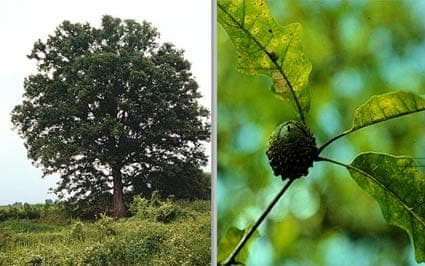
The Overcup Oak is a very distinctive tree especially due to its characteristic leaves. The leaves are large (8 to 15 centimeters long) and have a very striking lyre-shape - the leaf is deeply lobed with a very broad top and narrower base. The lobes give the leaf an almost lyre-like shape, perfectly describing the common name. The color is glossy green in summer, changing to yellow-brown to crimson red in fall.
The tree growth is regular and fairly upright. The tree reaches in Dutch conditions probably 18 to 24 meters, which is very impressive. The bark is grayish-brown and wrinkled, characteristic of oaks. The branch structure is robust and looks decorative even when bare in winter.
The fruits are acorns approximately 1 to 1.5 centimeters large, with a half-enclosing cup covering most of the acorn - hence "overcup oak" in English. These acorns appear in fall and provide nourishment for squirrels and birds.
Ideal Location
The Overcup Oak thrives best in a location with plenty of sun to half-shade. Minimum four to five hours direct sunlight daily is sufficient. The tree also grows in shadier conditions, but will then grow less compactly.
For placement: this tree is very large so don't place it right next to your house or other vital buildings. Ensure at least 5 to 10 meters distance from the tree to foundation. The tree also cannot be directly next to pipes or sewers. An open spot in the landscape is ideal.
The tree is very wind-tolerant, meaning exposed locations are fine. In fact, wind exposure strengthens the tree.
Soil
The Overcup Oak originally grows in wetland areas, so it accepts much moister soil than most oaks. Heavy clay soil is not a problem. However, excellent: well-draining, nutrient-rich soil is best.
Mix your own planting bed (for young trees): 50% garden soil, 30% heavy clay and 20% compost. This creates heavy, nutrient-rich, moisture-holding mixture the tree likes. pH can be neutral to slightly acidic (pH 6.5-7.5).
Once established (after three to four years), the Overcup Oak needs much less feeding. Natural forest floor formation (falling leaves, rotting wood) provides most nutrition.
The tree can also tolerate fairly wet soil - many oaks cannot tolerate periodic flooding, but the Overcup Oak can (up to approximately 20% of the year).
Diseño gratis
¿Quieres ver Overcup Oak: complete guide en tu jardín? Crea un diseño gratis ahora.
Watering
In the first and second growing seasons, water the young tree regularly. Check weekly: does the top 5 centimeters of soil feel dry? Then water. Ensure water infiltrates well - no water excess.
Once established (year 3+), your tree needs little artificial water. The tree is very drought-tolerant once its root system is established (to 1.5 meters deep).
If you live in an exceptionally dry region: in very dry years you can water your tree. But normally: no extra water needed.
Pruning
The Overcup Oak naturally forms a beautiful tree structure so much pruning isn't needed. In the first years you can do some pruning:
End of winter (February-March): remove branches that cross or grow downward. Keep the tree open and airy. This promotes good air circulation and prevents disease.
During growth: gently remove lower branches (to about 3-4 meters height) so you can walk under the tree. This also provides better sight.
After the first ten years: minimal pruning. Only remove dead or diseased branches.
If damage occurs: cut damaged branches straight off, just above the collar (the thickened area where branch meets tree). Always use sharp pruners.
Maintenance Calendar
February-March: Pruning young tree. Check branch structure. Fertilize (organic tree fertilizer).
April-May: Leaf emergence. Water young tree regularly if dry. Check for pest insects.
June-July: Full growth. Summer pruning (optional) for shaping. Water much less frequently.
August-September: Growth slows. Water almost not at all. Acorns begin ripening.
October-November: Fall color. Leaf drop. Acorns fall. No extra care needed.
December-January: Rest. No water, no feeding needed.
Winter Hardiness
The Overcup Oak is very winter hardy to USDA zone 4 (down to -30 degrees Celsius). Throughout Dutch and Belgian regions it grows fine outdoors. No winter protection needed.
Young trees (first winter): protect against strong frost-and-thaw wind by a wooden windscreen. But frost protection (burlap) is not needed.
Long-term: once mature, this is one of the hardiest trees for Dutch winters.
Companion Plants
The Overcup Oak combines nicely with:
- Other American oaks such as Quercus alba (white oak)
- American beech (Fagus grandifolia)
- Rowan (Sorbus) for higher branch structure
- Hawthorn (Crataegus) for understory
- White willow (Salix alba) for contrast
Landscape garden composition: Overcup Oak as dominant tree, supported by lower shrubs and ground covers.
Final Thoughts
The Overcup Oak is a tree for the patient gardener willing to wait. In the first ten years the tree doesn't grow very quickly, but by his twenty-fifth birthday he is massive, impressive and worthwhile.
This is a tree you probably won't see in full maturity in your whole lifetime. But that's precisely the beauty of old trees - they grow for generations after us. It's a legacy.
Looking for Overcup Oak? Many large tree nurseries stock young trees. Make sure you buy a seed-grown specimen (not wild-collected) for best growth in Dutch context.
On gardenworld.app you'll find more large trees and landscape design tips. Visit for inspiration at large scale!
¿Quieres ver Overcup Oak: complete guide en tu jardín? Crea un diseño gratis ahora.
Sube una foto, elige un estilo y obtén un diseño fotorrealista con lista de plantas en menos de un minuto.
Más de 10.000 jardines diseñados
Sin tarjeta de crédito


Plantas similares
Lucombe oak: complete guide
Quercus crenata
Lucombe oak (Quercus crenata): a majestic semi-evergreen giant with corky bark, perfect for large gardens, parks, and country estates.
Blue oak: complete guide
Quercus douglasii
Discover the blue oak, a drought-tolerant Californian shade tree with striking blue-green foliage, ideal for large, climate-resilient gardens.
Quercus montana: complete guide
Quercus montana
Quercus montana, the chestnut oak, is a rugged American shade tree with deeply furrowed bark and large acorns, well suited to dry, rocky, spacious gardens.