
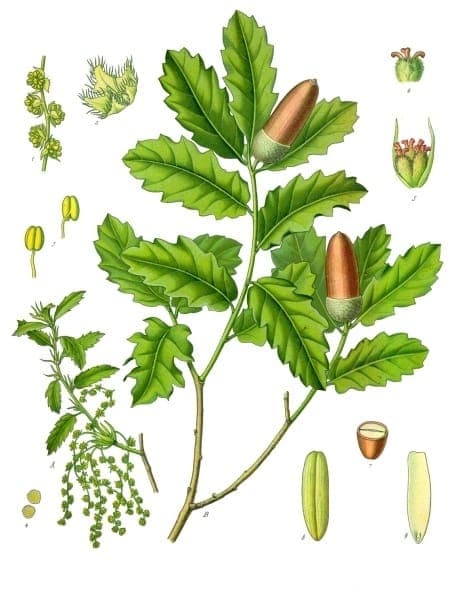
Franz Eugen Köhler, Köhler's Medizinal-Pflanzen / Public domain, via Wikimedia Commons
Portuguese Oak: complete guide
Quercus lusitanica
¿Quieres ver Portuguese Oak: complete guide en tu jardín?
1 minuto, sin tarjeta de crédito
Overview
The Portuguese Oak, scientifically known as Quercus lusitanica, is a beautiful deciduous tree from the Fagaceae family. This Mediterranean oak is prized for its elegant foliage and compact form, making it ideal for southern gardens and arid landscapes. Native to Portugal, Spain, and Morocco, this climate-adaptable species thrives in warm, dry regions.
Appearance and Bloom
The Portuguese Oak grows to 4-6 meters tall with a broad crown and grayish-brown bark. Leaves are small, bright green, sometimes grayish beneath, with characteristic serrated edges. Spring brings male catkins and female flowers, followed by small acorn cups in autumn. The tree presents a graceful appearance year-round.
Ideal Location
Plant the Portuguese Oak in full sun exposure. Perfect for south-facing slopes, garden corners, and Mediterranean plant schemes. Thrives in warm temperatures but tolerates heat extremes. Avoid cold, waterlogged sites with stagnant conditions.
Soil
Choose well-draining, calcareous soils. Thrives in poor, dry soils with low moisture levels. Enriching with sand or gravel aids growth. Avoid heavy clay soils promoting waterlogging.
Diseño gratis
¿Quieres ver Portuguese Oak: complete guide en tu jardín? Crea un diseño gratis ahora.
Watering
Water regularly during first year establishment. Once established, water requirements reduce significantly. Highly drought tolerant after root systems develop. Water only during extreme drought after maturity.
Pruning
Minimal pruning needed after establishment. Remove dead branches and damaged parts. Shape young trees for desired silhouette through careful trimming.
Maintenance Calendar
Spring: prepare planting areas, water during establishment. Summer: no maintenance for established specimens. Autumn: observe acorn production. Winter: dormancy, no care required.
Winter Hardiness
Partially hardy to fully hardy depending on cultivar. Tolerates temperatures down to -10°C. Protect young plants against frost and ice storms.
Companion Plants
The Portuguese Oak pairs naturally with Lavender, Rosemary, and Mediterranean plants. Stands well as a solitary specimen. Creates dappled shade favoring special underplanting possibilities.
Closing
The Portuguese Oak offers elegance for southern European gardens with minimal care requirements. Due to drought resistance and adaptability, this tree flourishes in warm, dry environments. Visit gardenworld.app for more tree selections. Discover gardenworld.app for garden design inspiration!
¿Quieres ver Portuguese Oak: complete guide en tu jardín? Crea un diseño gratis ahora.
Sube una foto, elige un estilo y obtén un diseño fotorrealista con lista de plantas en menos de un minuto.
Sin tarjeta de crédito


Plantas similares
Lucombe oak: complete guide
Quercus crenata
Lucombe oak (Quercus crenata): a majestic semi-evergreen giant with corky bark, perfect for large gardens, parks, and country estates.
Blue oak: complete guide
Quercus douglasii
Discover the blue oak, a drought-tolerant Californian shade tree with striking blue-green foliage, ideal for large, climate-resilient gardens.
Quercus montana: complete guide
Quercus montana
Quercus montana, the chestnut oak, is a rugged American shade tree with deeply furrowed bark and large acorns, well suited to dry, rocky, spacious gardens.