
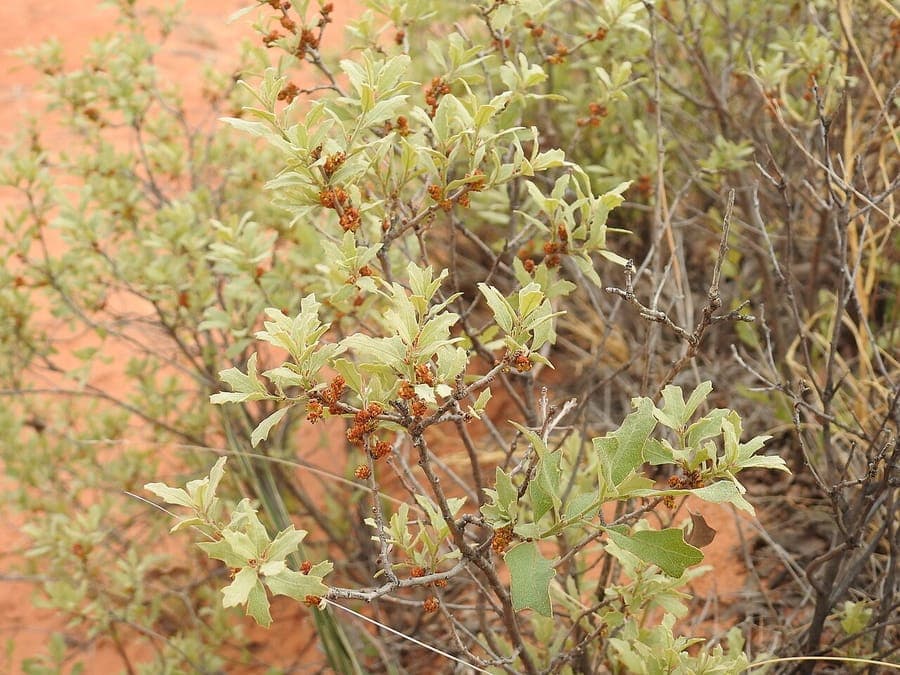
bobnieman / CC BY 4.0, via Wikimedia Commons
Quercus havardii: complete guide
Quercus havardii
¿Quieres ver Quercus havardii: complete guide en tu jardín?
1 minuto, sin tarjeta de crédito
Overview
Havard oak (Quercus havardii), also known as shin oak or sand shinnery oak, is an exceptionally drought-tolerant shrub to small tree from the American Southwest. This plant naturally grows in extreme conditions - sandy flats and dry, alkaline soils in New Mexico, Texas, and Oklahoma. For those seeking absolute minimal maintenance and living in a drier climate zone, this is a fascinating choice.
Appearance and bloom
Havard oak typically grows as a shrub to small tree, with height varying from 1-4 meters, though under excellent conditions larger forms can develop. The leaves are very narrow, approximately 2-4 centimeters long, with deep green color that can turn reddish-brown in autumn. It is usually deciduous, though some foliage may persist in milder winters. The bark is gray with deep furrows. Flowers appear in early spring as delicate catkins, followed by small acorns about 1 centimeter in diameter.
Ideal location
This is absolutely a sun-loving plant that requires full sun - at least 8 hours daily is needed for healthy growth. This is not a plant for shady corners. The tree tolerates intense, direct sun and windy conditions better than almost any other plant. Ideal for rooftops, sandy banks, or other hot, open locations. Don't protect it - it thrives on harshness.
Soil
Havard oak is very tolerant of sandy, nutrient-poor soils. In fact, it thrives best in very poor soils where many other plants would perish. It also accepts alkaline to highly alkaline soil extremely well. Heavy clay is its weak point - without excellent drainage, the tree will suffer or die. Add sand and ensure perfect drainage. Adding nutrients is unnecessary; this plant thrives in the worst conditions.
Watering
Once fully established, this tree is a true drought champion that can survive months without rain. In the first year after planting, provide water but much less than other trees - only when the soil surface is completely dry. Excessive water is often lethal. After the second year, you can almost stop watering; only in extreme drought situations give supplemental water.
Diseño gratis
¿Quieres ver Quercus havardii: complete guide en tu jardín? Crea un diseño gratis ahora.
Pruning
Havard oak naturally grows in a neat, compact form requiring little pruning. Remove dead branches as you notice them. If you wish to control the form, prune lightly in early spring. Heavy pruning is not needed and can damage the tree. This oak is tough - it tolerates rough handling better than careful nurturing.
Maintenance calendar
- Spring (March-May): Check for frost damage from previous winter. Remove dead wood. Light pruning if needed.
- Summer (June-August): Water only in extreme dry periods.
- Autumn (September-November): No special care needed.
- Winter (December-February): Tree is dormant; no pruning after November.
Winter hardiness
Havard oak is frost-hardy to approximately -15 to -20 degrees Celsius. This means it is reasonably winter-hardy for many parts of the Netherlands, Germany, and France, though it grows better in warmer, drier zones. In very wet, cold winters, frost damage can occur, especially on young plants. In southern France and Germany, it thrives excellently.
Companion plants
Havard oak combines excellently with other extreme drought plants. Plant it with desert shrubs, agaves, yuccas, and other succulent-like plants. Rock gardens are ideal for this tree. It also grows well with other Southwestern oaks and in native grass meadows. Avoid moist companions - this will create conflict.
Conclusion
Havard oak is for specialists planting extreme drought zones. This is not a tree for moist, western European gardens, but for those living in dry regions or wanting to create an extreme drought corner, it is fascinating. This is robust work, not delicate, but sturdy drought-tolerant vegetation. Available in America directly; in Europe, sourcing is challenging.
Fun fact: The name "havardii" honors Valery Havard, a 19th-century American botanist and scientist who studied the flora of the Southwest.
¿Quieres ver Quercus havardii: complete guide en tu jardín? Crea un diseño gratis ahora.
Sube una foto, elige un estilo y obtén un diseño fotorrealista con lista de plantas en menos de un minuto.
Más de 10.000 jardines diseñados
Sin tarjeta de crédito


Plantas similares
Lucombe oak: complete guide
Quercus crenata
Lucombe oak (Quercus crenata): a majestic semi-evergreen giant with corky bark, perfect for large gardens, parks, and country estates.
Blue oak: complete guide
Quercus douglasii
Discover the blue oak, a drought-tolerant Californian shade tree with striking blue-green foliage, ideal for large, climate-resilient gardens.
Quercus montana: complete guide
Quercus montana
Quercus montana, the chestnut oak, is a rugged American shade tree with deeply furrowed bark and large acorns, well suited to dry, rocky, spacious gardens.