
Franz Xaver / CC BY-SA 3.0, via Wikimedia Commons
Strandzha oak: complete guide
Quercus hartwissiana
¿Quieres ver Strandzha oak: complete guide en tu jardín?
1 minuto, sin tarjeta de crédito
Overview
The Strandzha oak or Hartwiss oak (Quercus hartwissiana) is a majestic, semi-evergreen oak from the mountain regions of Bulgaria, Turkey, and the Caucasus. This large tree is highly valued for its architecturally interesting foliage and robust constitution. With its imposing form and slow growth, the Strandzha oak makes an excellent choice for large landscape gardens and wooded areas.
The Strandzha oak is a valuable specimen for modern landscapers seeking monumental structure and biological value. The tree provides shelter and nutrition for numerous birds and insects, making it an ecologically important plant.
Appearance
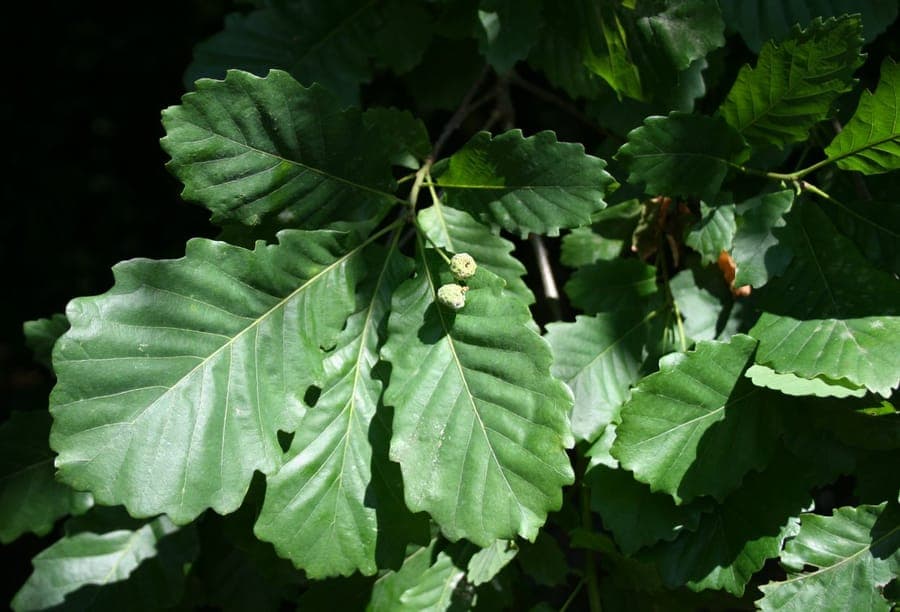
The Strandzha oak is a large, vigorous-growing tree that can reach 20 to 30 meters tall, with a broad, dense crown. The trunk is thick and strong, often with characteristic rough-barked appearance. The foliage consists of large, elongated leaves that can reach 5 to 12 centimeters in length.
The leaves are semi-evergreen, meaning they retain their foliage in mild winters but can drop their leaves in severe winters. The foliage color is deep green during the growing season, sometimes with light velvety undersides. In autumn, the leaves color brownish before falling.
Male and female flowers are highly inconspicuous - yellowish-green catkins appear in spring. Subsequently, the characteristic acorns develop in clustered groups, first green and becoming brown in autumn. Each acorn sits in a scaly cup.
Ideal Location
The Strandzha oak thrives best in full sun to light shade locations. Ideally at least 4 to 6 hours of direct sunlight daily. In deep shade it will grow poorly. This is a tree for open, light-rich positions.
The tree tolerates wind well and becomes increasingly stronger as it grows larger. This makes it suitable for windy locations and open terrain. In very sheltered situations, branches may become less strong.
For height and space: this is a large tree needing considerable space. Not suitable for small gardens. Plant it at least 8-10 meters away from buildings.
Soil
The Strandzha oak prefers well-draining soils with neutral to slightly acidic pH (6.0 to 7.5). This is a flexible tree regarding soil type. It can grow on sandy, calcareous, or clayey soils, as long as drainage exists.
Heavy clay soils can function, but water stagnation must be avoided. The tree tolerates dry periods well once established, due to its deep root system.
Nutrition: this is not a nutrition-demanding tree. Natural forest soil with some organic matter is sufficient. Annual supplemental feeding is rarely necessary.
Diseño gratis
¿Quieres ver Strandzha oak: complete guide en tu jardín? Crea un diseño gratis ahora.
Watering
The Strandzha oak must receive regular water during the first 2-3 years after planting, especially in dry periods. However, once well-established, this is a highly drought-tolerant tree, thanks to its deep root system.
In the first growing season, regular moisture is important. Water when the top 10 centimeters of soil feel dry. This helps strong root system development.
Once mature, the tree can survive several months without rain. Watering in very hot, dry summers can, however, reduce leaf-fall and promote growth.
Pruning
The Strandzha oak requires very little pruning. The tree grows naturally into a strong, symmetrical form. Dead branches can be removed any season.
Heavy pruning of living branches must be avoided, as oaks respond poorly to heavy pruning and can become susceptible to disease. Light shaping in youth can be done, but is rarely necessary.
In youth, some competing stems can be removed to promote a strong, single trunk. This should be done in the first 5 years.
Maintenance Calendar
APRIL-MAY: Leaf emergence. Flowering. Growing period begins. Water as needed. JUNE-SEPTEMBER: Rapid growth. Acorn ripening. Minimal maintenance. Water in drought. OCTOBER-NOVEMBER: Leaf-fall (in severe climates). Acorns fall. Growth slows. DECEMBER-MARCH: Winter dormancy. No maintenance. Spring preparation.
Winter Hardiness
The Strandzha oak is hardy to approximately -15 to -20 degrees Celsius, making it suitable for most of the Netherlands and Belgium, and certainly for Germany. This is a USDA zone 5-7 plant.
In northern climates, rapid freeze-thaw cycles can be damaging, but this is rarely a problem for mature trees. Young trees can use some protection from severe frosts in the first year.
Mulching around the base in the first winter helps protect root zones.
Companion Plants
The Strandzha oak works well as a solitary tree, but in woodland planting can be used together with:
- Other Quercus species - autumn color combinations
- Beeches - structural contrast
- Birch trees - textural difference
- Understory ferns - for forest floor effect
- Rhododendrons - in more acidic soils
This is a dominant, standing tree that has more impact as a solitary specimen.
Closing
The Strandzha oak (Quercus hartwissiana) is a majestic, winter-hardy tree for large landscape gardens and wooded areas throughout Europe. With its imposing growth, ecological value, and robust nature, it deserves more attention in landscape design planning.
For young trees, we recommend specialized tree nurseries. For more large tree inspiration and oak guides, visit gardenworld.app. Enjoy creating long-lasting, monumental landscapes with gardenworld.app!
¿Quieres ver Strandzha oak: complete guide en tu jardín? Crea un diseño gratis ahora.
Sube una foto, elige un estilo y obtén un diseño fotorrealista con lista de plantas en menos de un minuto.
Más de 10.000 jardines diseñados
Sin tarjeta de crédito


Plantas similares
Lucombe oak: complete guide
Quercus crenata
Lucombe oak (Quercus crenata): a majestic semi-evergreen giant with corky bark, perfect for large gardens, parks, and country estates.
Blue oak: complete guide
Quercus douglasii
Discover the blue oak, a drought-tolerant Californian shade tree with striking blue-green foliage, ideal for large, climate-resilient gardens.
Quercus montana: complete guide
Quercus montana
Quercus montana, the chestnut oak, is a rugged American shade tree with deeply furrowed bark and large acorns, well suited to dry, rocky, spacious gardens.