
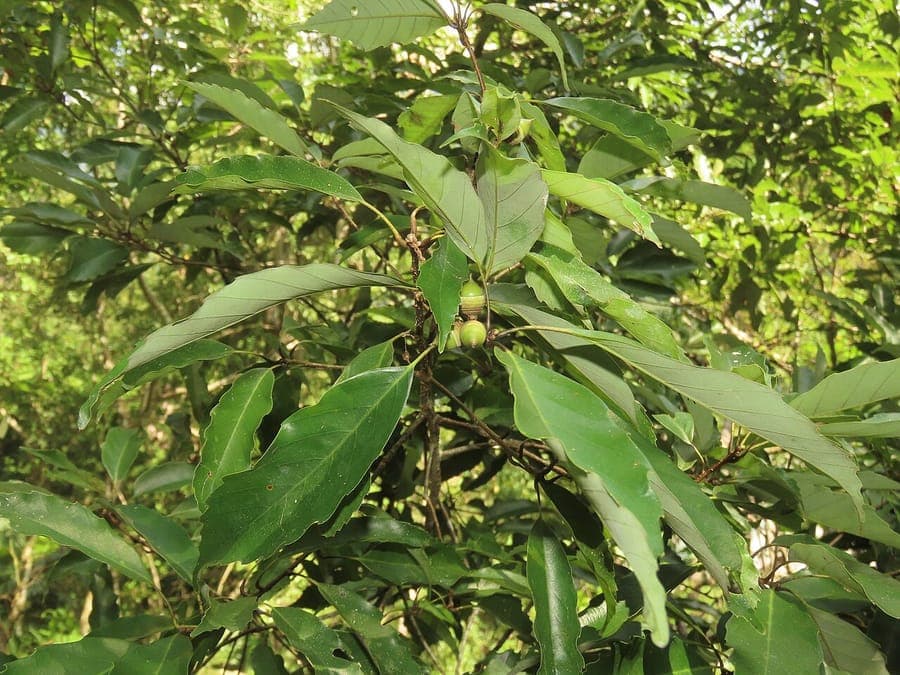
chiuluan / CC BY 4.0, via Wikimedia Commons
Quercus glauca: complete guide
Quercus glauca
¿Quieres ver Quercus glauca: complete guide en tu jardín?
1 minuto, sin tarjeta de crédito
Overview
Quercus glauca, commonly known as ring-cup oak, bamboo-leaved oak, or Japanese blue oak, is an elegant evergreen tree native to Himalayan highlands. This tree grows naturally from Assam to Japan, with distribution across Nepal, Myanmar, Taiwan, and China. In its native habitat, it grows in forests at various elevations.
The tree is renowned for its elegant, fine foliage and permanent green color year-round. With its subtle characteristics, it's a perfect choice for garden design seeking something Asian and refined.
Appearance and bloom
The ring-cup oak is recognizable by its long, linear to lance-shaped leaves with a grayish, glaucous (waxy) coating, giving it its name. Leaves are 5-12 cm long, with leathery texture and dark green upper surface.
In spring, inconspicuous yellow-green male and female catkins appear. The acorns are relatively small and round, encased in cups with characteristic ring-shaped scales - hence the name "ring-cup oak". Acorns mature in the second year.
The tree grows to about 15-20 meters height and forms an elegant, pyramidal to columnar form. The evergreen foliage provides year-round garden interest.
Ideal location
Quercus glauca grows best in full sun to light partial shade. While it tolerates shade, it will grow less densely in full shade. Ensure at least 4-6 hours of direct sunlight daily.
Also choose a sheltered location where the tree isn't exposed to strong winds. While fairly hardy, heavy storms can damage young branches. A location with good air circulation helps prevent moisture-related diseases.
This tree works perfectly as a specimen tree, shade tree, or part of mixed woodland planting.
Soil
Quercus glauca thrives on:
- Well-draining sandy to loamy soil
- Slightly acidic to neutral (pH 5.5-7.0)
- Nutrient-rich soil with organic matter
- Deep enough for roots - at least 50-60 cm
The tree thrives on poor soils too, but grows faster and healthier with adequate nutrition. Add compost or leaf mold when planting.
Avoid heavy, clay-rich soils without drainage. If your soil contains heavy clay, loosen it by adding sand and organic matter.
Watering
Once established, Quercus glauca is quite drought tolerant. In the first year after planting, water regularly, especially during dry periods.
Ensure water penetrates deeply, to about 30-40 cm. This promotes deep root penetration and strong tree structure. Avoid frequent shallow watering.
During very dry summers, supplemental water may help, particularly for young trees. In winter, the tree needs much less water - natural rainfall is usually sufficient.
Diseño gratis
¿Quieres ver Quercus glauca: complete guide en tu jardín? Crea un diseño gratis ahora.
Pruning
Quercus glauca doesn't need much pruning. The tree naturally grows in an attractive form. In youth, you can light prune to encourage one strong central leader.
Remove dead or diseased branches in late winter. This aids disease prevention. Avoid heavy pruning, especially during the growing season, as it can cause stress.
The tree recovers slowly from pruning wounds, so be careful and conservative in your pruning approach.
Maintenance calendar
Spring: Check water needs of young trees. Remove frost-damaged branches. Inspect for diseases.
Summer: Provide regular water during dry periods. Monitor pests like caterpillars and aphids.
Fall: Enjoy persistent green foliage. Remove dead leaves that accumulate.
Winter: Perform necessary pruning work. Check tree stability under heavy snow.
Winter hardiness
Quercus glauca is fairly winter hardy in temperate climates. The tree tolerates temperatures of about -10C to -15C. In very severe winters, leaf tips may suffer frost damage, but the tree recovers in the next growing season.
Ensure young trees are well established (first 1-2 years) before experiencing extreme winters. A thick mulch layer around the root zone provides protection.
In Mediterranean and temperate coastal climates, the tree grows without special winter protection.
Companion plants
Pair Quercus glauca with:
- Other Asian trees: Acer palmatum, Cryptomeria japonica
- Conifers: Ilex crenata, Taxus baccata
- Ornamental grasses: Miscanthus, Festuca
- Foliage plants: Heuchera, Hakonechloa
- Shrubs: Ilex, Viburnum
Ensure companion plants share the same moisture needs and full-sun preference.
Closing thoughts
Quercus glauca is an excellent choice for garden owners seeking something from Asian highlands with permanent visual interest. With its elegant foliage and hardy nature, it offers unparalleled value.
While it grows slower than many deciduous oaks, the patience pays off with a tree of true beauty. If you're looking for something unique and refined, this is your tree.
Visit gardenworld.app for more inspiration on Asian gardens and special tree plantings. For more species and starters, check garden centers. Good luck with your Japanese blue oak!
Want an elegant evergreen tree? Read more on gardenworld.app for personal advice and garden design.
¿Quieres ver Quercus glauca: complete guide en tu jardín? Crea un diseño gratis ahora.
Sube una foto, elige un estilo y obtén un diseño fotorrealista con lista de plantas en menos de un minuto.
Más de 10.000 jardines diseñados
Sin tarjeta de crédito


Plantas similares
Lucombe oak: complete guide
Quercus crenata
Lucombe oak (Quercus crenata): a majestic semi-evergreen giant with corky bark, perfect for large gardens, parks, and country estates.
Blue oak: complete guide
Quercus douglasii
Discover the blue oak, a drought-tolerant Californian shade tree with striking blue-green foliage, ideal for large, climate-resilient gardens.
Quercus montana: complete guide
Quercus montana
Quercus montana, the chestnut oak, is a rugged American shade tree with deeply furrowed bark and large acorns, well suited to dry, rocky, spacious gardens.