
Wikimedia Commons / Public domain, via Wikimedia Commons
Quercus falcata: complete guide
Quercus falcata
¿Quieres ver Quercus falcata: complete guide en tu jardín?
1 minuto, sin tarjeta de crédito
Overview
The Spanish oak (Quercus falcata), also known as the Southern red oak, is an impressive American deciduous tree native to the southeastern United States. This robust oak is renowned for its distinctive falcate (sickle-shaped) lobed leaves and powerful structural form. The tree reaches a considerable height and develops a dense, spreading crown that provides abundant shade. With its deeply lobed foliage that transforms into glowing red tones in autumn, this tree is a true showstopper in any landscape.
The Spanish oak naturally occurs in mixed forest ecosystems and is perfectly suited for larger gardens and parks. This is not a tree for cramped urban gardens, but if you seek a long-term green investment, the Spanish oak is an excellent choice.
Appearance and bloom
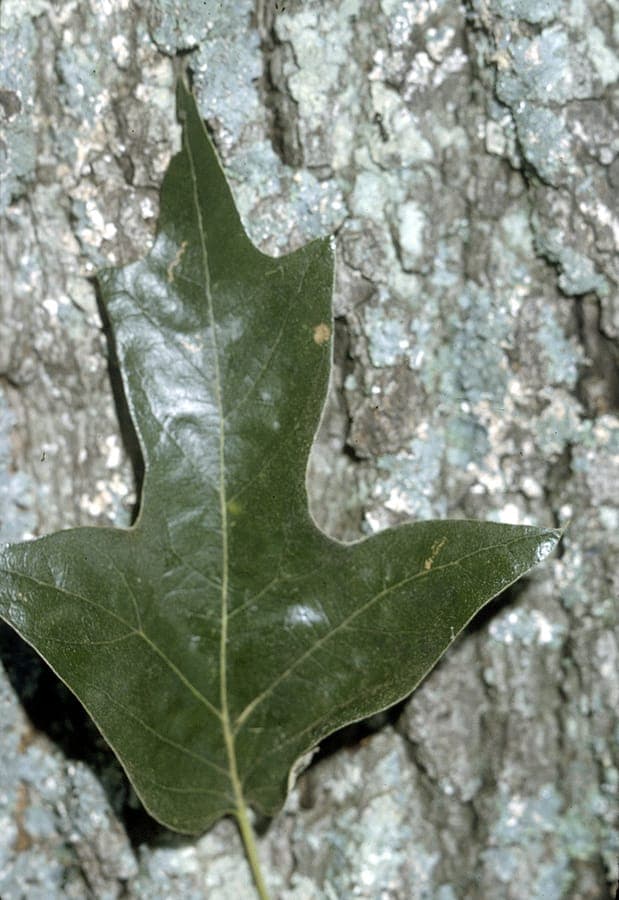
The Spanish oak distinguishes itself through its unique leaf morphology. The leaves are deeply lobed with characteristic falcate points, which explains the scientific name falcata. The foliage has a coarse texture and deep green coloring during the growing season. Male flowers appear as graceful pendulous catkins in spring, typically yellow-green in color. Female flowers are far more inconspicuous.
The fruits are modest-sized acorns, approximately 1-1.5 cm, concealed in a shallow cup. The bark is thick-walled, dark gray to black-brown, becoming increasingly furrowed with age. The winter silhouette is imposing, with strong branch structure that provides considerable ornamental value even when leafless.
Ideal location
The Spanish oak thrives best in a sunny location, requiring at least 6-8 hours of direct sunlight daily. The tree is extremely frost-hardy and grows well in temperate climates. Choose a location with ample space, as this oak can reach spreads of 15-20 meters. Avoid areas with strong winds that might damage the long branches.
Preferably plant the Spanish oak in a spot where it has room to develop its natural form. The tree can grow in full sun or partial shade, though color development will be superior in full sun.
Soil preference
The Spanish oak is not particularly fussy about soil composition but performs optimally in well-draining soil. The pH may range between 4.8 and 7.0. Acidic soils are better tolerated than calcareous soils. The tree grows well in sandy to loamy soils, provided they contain sufficient nutrients.
Enriching the soil with organic matter at planting helps, especially in poor soils. After the first growing season, additional feeding is usually unnecessary thanks to the tree's deep root system.
Diseño gratis
¿Quieres ver Quercus falcata: complete guide en tu jardín? Crea un diseño gratis ahora.
Watering
After planting, regular watering is essential for the first two growing seasons. Give the tree 1-2 substantial waterings per week, especially during dry periods. A thick mulch layer of approximately 5-10 cm helps retain soil moisture and suppresses weeds.
Once established, the Spanish oak rarely needs supplemental water except during exceptional droughts. The deep root system makes this tree highly drought-tolerant. Excess water can damage roots, so ensure good drainage.
Pruning
The Spanish oak requires minimal pruning if you shape it when young. Remove only dead, diseased, or obstructive branches. This is best done in late winter or early spring. Avoid heavy pruning as it disrupts the natural form.
Formal pruning is unnecessary - allow the tree to develop its natural shape. If branches grow too low, you can carefully remove them, but be cautious with height reduction on an oak.
Maintenance calendar
Spring: Inspect the tree for winter damage. Water if soil feels dry. Dead branches can be removed in March. Summer: Water during dry periods. Monitor for pests and diseases. Fall: Enjoy the spectacular autumn colors. No maintenance needed. Winter: The tree is completely dormant. No action required.
Winter hardiness
The Spanish oak is extremely frost-hardy and thrives to USDA zone 5 and higher (down to minus 29 degrees Celsius). In the Netherlands and Belgium, frost hardiness is therefore no concern. Young trees may benefit from protection against very late frost events, but mature trees are completely self-sufficient.
Companion plants
Underplanting beneath a Spanish oak is challenging due to dense shade and surface roots. Choose shade-tolerant species such as Vinca minor, polystichum ferns, and liriope. Avoid grass directly under the tree due to competition for water and nutrients.
Conclusion
The Spanish oak is an excellent choice for those seeking an imposing, long-living deciduous tree. With its unique lobed foliage, beautiful fall colors, and robust constitution, this oak grows reliably with minimal maintenance. At gardenworld.app, we can help you plan how this magnificent tree fits perfectly into your garden design. With gardenworld.app, you effortlessly create a green oasis that lasts for generations.
¿Quieres ver Quercus falcata: complete guide en tu jardín? Crea un diseño gratis ahora.
Sube una foto, elige un estilo y obtén un diseño fotorrealista con lista de plantas en menos de un minuto.
Más de 10.000 jardines diseñados
Sin tarjeta de crédito


Plantas similares
Lucombe oak: complete guide
Quercus crenata
Lucombe oak (Quercus crenata): a majestic semi-evergreen giant with corky bark, perfect for large gardens, parks, and country estates.
Blue oak: complete guide
Quercus douglasii
Discover the blue oak, a drought-tolerant Californian shade tree with striking blue-green foliage, ideal for large, climate-resilient gardens.
Quercus montana: complete guide
Quercus montana
Quercus montana, the chestnut oak, is a rugged American shade tree with deeply furrowed bark and large acorns, well suited to dry, rocky, spacious gardens.