
Josep Gesti / CC BY-SA 4.0, via Wikimedia Commons
Kermes oak: complete guide
Quercus coccifera
¿Quieres ver Kermes oak: complete guide en tu jardín?
1 minuto, sin tarjeta de crédito
Overview
Quercus coccifera, commonly known as kermes oak, is a Mediterranean shrubby oak from the Fagaceae family. This small evergreen oak is native to the Mediterranean basin and grows on dry, stony slopes. Historically important for the kermes insects that lived on its leaves and produced red dye.
The plant grows as a dense, spiny shrub reaching 1-3 meters in height. In favorable climates, it can reach 6 meters. It is ideal for Mediterranean gardens, dry borders, and coastal settings where it is salt-tolerant.
Appearance & Bloom Cycle
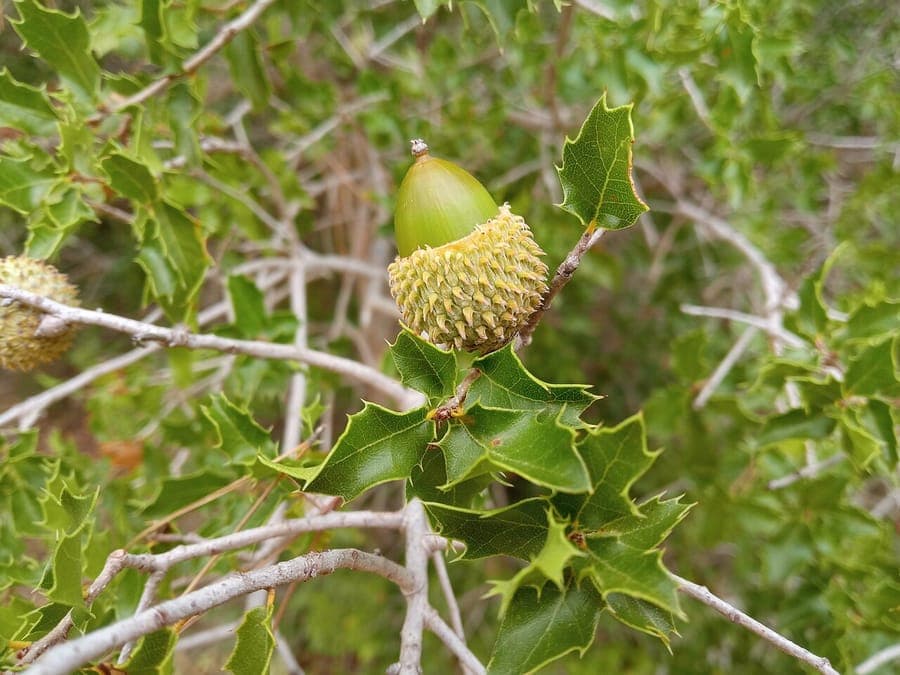
Quercus coccifera is an evergreen oak with small, spiny, glossy green leaves. The foliage is thick and leathery, with sharp-pointed margins - an adaptation to the dry Mediterranean climate.
The plant flowers in April-May with inconspicuous, yellow-green catkins. Male flowers are pendant-like structures; female flowers are nearly invisible.
The fruits are characteristic acorn cups that are rough and cup-shaped. They ripen in the second year and give the plant its botanical name 'coccifera' (bearing scarlet dye).
The foliage remains attractive year-round with its deep green color and glossy appearance.
Ideal Location
Choose a location in full sun. Minimum 6-8 hours of direct daily sunlight is essential. The plant tolerates shade poorly and becomes tall and lax.
Wind-resistant; this oak is perfect for coastal settings with salt and wind. Open, well-ventilated locations help prevent fungal diseases.
Soil Requirements
Quercus coccifera grows best in lean, rocky soils. It tolerates very dry ground and even grows on chalky, stony terrain. Good drainage is essential; stagnant water is fatal.
Neutral to slightly alkaline (pH 7.0-8.5) is ideal. In acidic climates, add some lime. The plant grows better on lean soil than rich soils.
Watering
Quercus coccifera is very drought-tolerant once established. Regular watering during the first season aids root development. Thereafter, supplemental water is unnecessary.
Avoid waterlogged conditions, especially in winter. In wet seasons, root rot can occur. This is a plant for dry climates; excessive moisture is unfavorable.
Diseño gratis
¿Quieres ver Kermes oak: complete guide en tu jardín? Crea un diseño gratis ahora.
Pruning
Pruning is not required. The plant naturally grows as a dense, compact shrub. Dead branches can be removed in spring.
Heavy pruning may be needed to keep the plant compact, but this is best done after flowering.
Maintenance Calendar
March-April: Plant in prepared, well-drained soil. Water after planting. Begin regular watering in first season.
May: Flowering period. Normal maintenance; water only in very dry spells.
June-September: Mature growth. Minimal maintenance. Water only in severe drought.
October-February: Dormancy. Plant is evergreen but grows minimally. No water needed except rainfall.
Winter Hardiness
Quercus coccifera is winter-hardy to USDA zone 8 (-12°C). In the Netherlands, this is typically planted in warm coastal regions and sheltered urban areas. In cold inland areas, susceptible to severe frost damage.
In very cold climates, grow in containers and protect in winter. In maritime climate, usually evergreen without protection.
Companion Plants
Quercus coccifera combines beautifully with other Mediterranean plants such as rosemary, lavender, cistus, and myrtle. Also good with slow-growing genista and helianthemum.
Perfect in Mediterranean gardens with other oaks and shrubs. Good planted in groups for density. Avoid vigorous plants that would overshadow it.
Availability & Purchase
Quercus coccifera is harder to obtain than many native oaks. Available through specialized Mediterranean nurseries. Not stocked in standard Dutch garden centers.
Look for young plants in 15-30 cm pots. Quality is important; select healthy plants without disease signs. Plant quality varies considerably.
Summary
Quercus coccifera is a valuable evergreen oak for warm, dry regions. Mediterranean in character, salt- and wind-tolerant, and very drought-tolerant, it deserves a place in coastal gardens and Mediterranean settings. Ideal for coastal protection and sustainable landscapes.
Once established, this oak grows very reliably with minimal maintenance and water. Perfect for modern, dry landscapes. Explore more Mediterranean plant advice on gardenworld.app.
¿Quieres ver Kermes oak: complete guide en tu jardín? Crea un diseño gratis ahora.
Sube una foto, elige un estilo y obtén un diseño fotorrealista con lista de plantas en menos de un minuto.
Más de 10.000 jardines diseñados
Sin tarjeta de crédito


Plantas similares
Lucombe oak: complete guide
Quercus crenata
Lucombe oak (Quercus crenata): a majestic semi-evergreen giant with corky bark, perfect for large gardens, parks, and country estates.
Blue oak: complete guide
Quercus douglasii
Discover the blue oak, a drought-tolerant Californian shade tree with striking blue-green foliage, ideal for large, climate-resilient gardens.
Quercus montana: complete guide
Quercus montana
Quercus montana, the chestnut oak, is a rugged American shade tree with deeply furrowed bark and large acorns, well suited to dry, rocky, spacious gardens.