
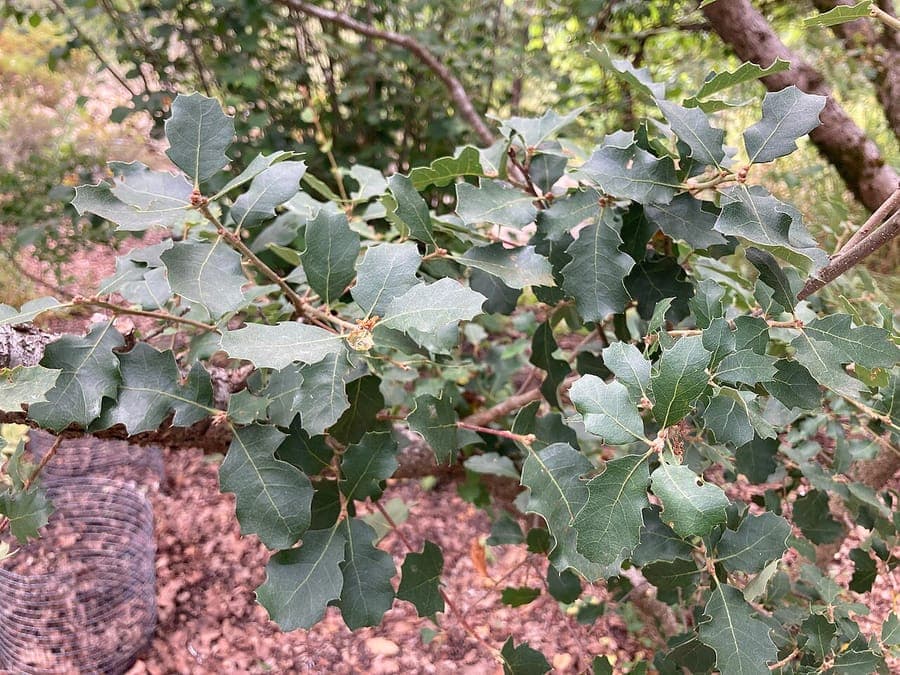
Awinch1001 / CC0, via Wikimedia Commons
California Scrub Oak: complete guide
Quercus berberidifolia
¿Quieres ver California Scrub Oak: complete guide en tu jardín?
1 minuto, sin tarjeta de crédito
Overview
Quercus berberidifolia, commonly known as California Scrub Oak or Coastal Sage Scrub Oak, is a remarkable evergreen oak native to the chaparral and coastal sage scrub ecosystems of California and Baja California. While not a typical oak for European gardens, for Mediterranean climate enthusiasts and xeriscaping devotees, it presents spectacular opportunities. The plant grows as an elegant, densely branched shrub with fine, glossy foliage perfectly adapted to sun-drenched, arid sites. For gardens in southern France, southern Spain, or Mediterranean regions of southern Europe, this is a genuinely valuable choice.
Appearance and bloom cycle
California Scrub Oak grows as a compact, densely branched shrub, typically 1 to 2 meters tall, though under favorable conditions it may reach 4 meters. The foliage is small, approximately 1-2 cm long, glossy green, sometimes with fine serrations along leaf margins - hence the botanical name referencing Berberis (barberry). Leaf surfaces are smooth and lustrous, helping minimize water loss in arid environments. Male flowers appear in pendant catkins (March-April), while female flowers form discrete clusters. Acorns are small, roughly 1 cm, often in small clusters, maturing in October-November, highly valued by birds and squirrels.
Ideal location
California Scrub Oak thrives in full sun on warm, dry sites, with a minimum of 6-8 hours direct sunlight daily. This is the plant for gardens where others surrender - rock outcrops, gravel fields, heat-trapping wall bases, or south-facing slopes. It dislikes shade; even partial shade may slow growth. This is not a plant for rainy climates; in temperate regions outside the Mediterranean, it can prove problematic. USDA zones 9-10 (minimum temperature -7 to -1 degrees Celsius).
Soil requirements
California Scrub Oak prefers well-draining, rocky, sandy, or gravelly soils. pH can range from neutral to slightly acidic (pH 6.0-7.5). Moderately fertile soil works fine; excessive nutrients promote lush growth at the expense of flowering. This oak tolerates extremely dry soils without issue - it's adapted to annual rainfall of just 25-50 cm. Heavy clay with poor drainage is its enemy; improve drainage or plant in raised zones.
Diseño gratis
¿Quieres ver California Scrub Oak: complete guide en tu jardín? Crea un diseño gratis ahora.
Watering
Once established (after 2-3 growing seasons), California Scrub Oak is exceptionally drought-tolerant. No watering is needed except in extreme droughts exceeding 6 months of rainlessness. In the young establishment phase (first two seasons), watering during dry spells aids root development, but once established, supplemental water becomes unnecessary. Excessive water, especially in winter, can cause root rot and fungal issues - avoid this strictly.
Pruning
California Scrub Oak requires minimal pruning. Gentle shaping in spring (March-April) is acceptable - for example, removing crossing branches or undesired growth. Severe pruning is usually unnecessary and may reduce flowering. Remove dead wood annually. Avoid pruning after July, as this may stimulate tender new growth vulnerable to frost.
Maintenance calendar
January-February: Check for frost damage, prune dead wood. March-April: Gentle shaping of silhouette, start of growing season. May-June: Monitor for drought stress, water only if essential. July-August: Accept drought, enjoy warm, sunny weather. September-October: Harvest possible acorns, prepare for fall. November-December: Cold season, no maintenance required.
Winter hardiness
California Scrub Oak is hardy in USDA zones 9-10 (minimum -7 to -1 degrees Celsius). In core Europe (zones 7-8), it becomes problematic; protection from cold wind and frost is essential. In strong freezes (below -10 degrees Celsius), foliage may drop or branches freeze-kill, but the plant usually regenerates. In Mediterranean zones (zone 9), it's completely safe. Do not plant in zones 6 or colder.
Companion plants
Excellent companions are other Mediterranean, drought-tolerant plants: Arbutus unedo (strawberry tree), Cistus spp. (rock rose), Lavandula spp. (lavender), Rosmarinus officinalis (rosemary), Leucophyllum spp., and Rhamnus alaternus. For wildlife feeding, combine with native shrubs producing berries. Avoid pairing with plants demanding significant water.
Closing remarks
California Scrub Oak is a fascinating plant for European Mediterranean-zone gardens, perfect for dry, sunny sites where conventional vegetation fails. It offers long-lasting ornamental value, wildlife feed, and maintenance-free growth. Plant it in southern Spain, southern France, or climatically comparable southern European regions. Find it at specialized nurseries offering Mediterranean species; consult gardenworld.app for helpful supplier contacts. California Scrub Oak is an excellent long-term investment in authentic Mediterranean garden aesthetics.
¿Quieres ver California Scrub Oak: complete guide en tu jardín? Crea un diseño gratis ahora.
Sube una foto, elige un estilo y obtén un diseño fotorrealista con lista de plantas en menos de un minuto.
Más de 10.000 jardines diseñados
Sin tarjeta de crédito


Plantas similares
Lucombe oak: complete guide
Quercus crenata
Lucombe oak (Quercus crenata): a majestic semi-evergreen giant with corky bark, perfect for large gardens, parks, and country estates.
Blue oak: complete guide
Quercus douglasii
Discover the blue oak, a drought-tolerant Californian shade tree with striking blue-green foliage, ideal for large, climate-resilient gardens.
Quercus montana: complete guide
Quercus montana
Quercus montana, the chestnut oak, is a rugged American shade tree with deeply furrowed bark and large acorns, well suited to dry, rocky, spacious gardens.