
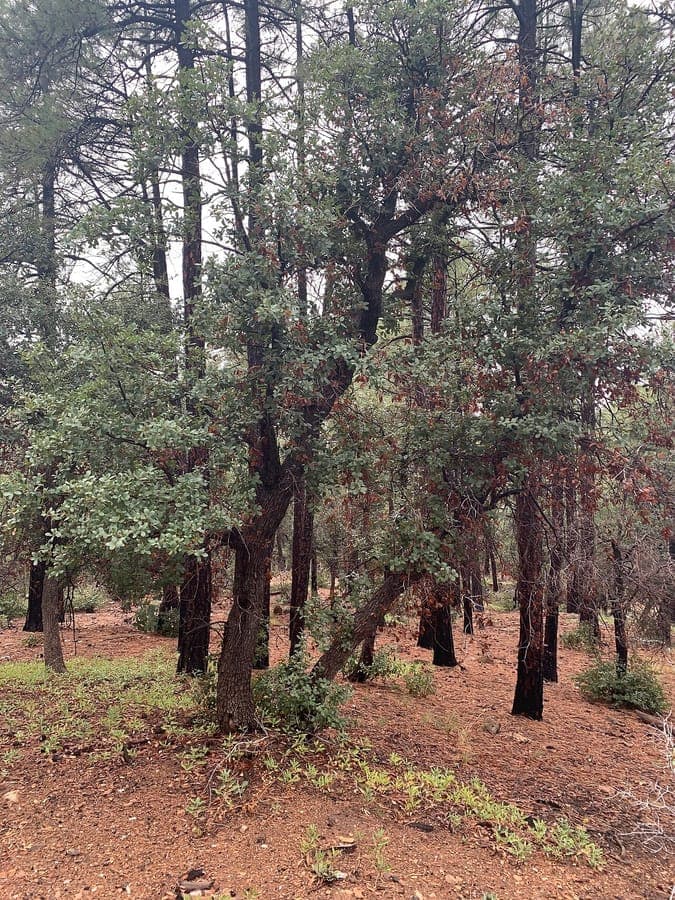
Billy Aguirre / CC0, via Wikimedia Commons
Arizona White Oak: complete guide
Quercus arizonica
¿Quieres ver Arizona White Oak: complete guide en tu jardín?
1 minuto, sin tarjeta de crédito
Overview
The Arizona White Oak, botanically known as Quercus arizonica, is an impressive and steadfast tree naturally occurring in the dry mountain regions of Arizona, New Mexico, Texas, and northwestern Mexico. This tree belongs to the Fagaceae family, the same family as all oaks and beeches, and represents one of the most drought-adaptive oaks for arid, warm climates. While not winter-hardy in northern regions, this tree offers beautiful characteristics for warm zones, Mediterranean gardens, and large landscape designs. The tree is renowned for its exceptional drought tolerance and can thrive for years without supplemental water once established.
For gardens in Mediterranean zones or warm regions, the Arizona White Oak can be a spectacular tree choice. At gardenworld.app, you can create garden designs that align perfectly with such robust, landscape-scale trees, where water and maintenance are minimal. This is the ideal tree for those wanting to create a sustainable, ecologically responsible garden.
Appearance & Bloom Cycle
The Arizona White Oak is a medium to large tree that can reach 15 to 25 meters in its natural habitat, though usually slightly smaller in cultivation. The tree develops an impressive, broad crown with dense branch structure. Its most characteristic feature is the evergreen foliage. The leaves are relatively small, about 3 to 7 centimeters long, with a leathery texture and grayish-green color that is highly ornamental. Young foliage can appear reddish or golden before turning green.
The bark is thick, dark gray to black, and deeply furrowed, giving the tree considerable character, especially in winter landscapes. The flowers are inconspicuous (male catkins and female flowers), but the female flowers develop into decorative acorns. These acorns are small to medium, about 1 to 2 centimeters long, and bear a characteristic deep cupule (the "cup" of the acorn).
Ideal Location: Sun, Shade, or Partial Shade
The Arizona White Oak is absolutely a sun-lover. In its natural habitat, it grows in open, dry mountain regions with full exposure to direct sunlight. A minimum of 6 to 8 hours of direct sun daily is ideal, and more is even better. In partial shade, the tree will grow less densely and may become taller rather than broad. The tree tolerates very high temperatures and full southern exposure.
The tree performs poorly in heavily shaded locations or areas with constantly moist microclimates. For urban or garden settings, place it where it receives sun and is highly visible, such as a solitary specimen in lawn or as a major accent in dry stone gardens.
Soil & Underground Requirements
The Arizona White Oak thrives in dry, well-draining soils and actually performs poorly in very fertile soils. Ideally, sandy to rocky soils with pH 6.0 to 8.0 are suitable, thus rather neutral to alkaline. This is a tree that must avoid fertile, wet garden soils. The tree develops deep roots that can reach water layers deep in the soil, so shallow rooting is not an issue.
For garden planting, soil amendments should be minimal. Add sand, gravel, or other drainage improvers to heavy soils, but add no rich manure or compost. The tree actually prefers poor, mineral-rich soils. This makes cultivation in northern Europe challenging due to higher rainfall, so always ensure excellent drainage locations.
Diseño gratis
¿Quieres ver Arizona White Oak: complete guide en tu jardín? Crea un diseño gratis ahora.
Watering: When and How Much
Once the Arizona White Oak is established (after 2-3 years), this tree can endure lengthy drought periods without supplemental water. This is one of its greatest advantages. For young, newly planted trees, however, regular watering is essential during the first growing season. In the first year, water when the top 5 centimeters of soil feel dry.
As the tree matures, gradually reduce watering frequency. Mature trees require virtually no additional water except in exceptionally dry years. In Mediterranean climates, the tree thrives on rainfall alone. Over-irrigation can be more harmful than insufficient water, as it can cause root rot and fungal diseases. Always ensure excellent drainage.
Pruning: When and How
Pruning the Arizona White Oak requires minimal attention. The tree has a natural, attractive form and grows in a balanced manner. Only dead, damaged, or crossing branches should be removed. This is best done in late winter or early spring before new growth begins.
Do not add much to the tree's structure; let it determine its own form. If suckers or water sprouts appear (new branches growing from the trunk), remove them immediately. For young trees, you can gently remove some lower side branches to create a clean trunk, but avoid heavy pruning that could damage the tree.
Maintenance Calendar
- January - February: Check for storm-damaged branches. Perform careful pruning as needed, especially dead or diseased branches.
- March - April: Spring is the growth period. Ensure very young trees receive regular water; mature ones only during extreme drought.
- May - June: The tree grows actively. Replace damaged branches. Monitor for insect damage (usually no serious issues).
- July - August: Peak growing season in warm regions. Minimal maintenance needed. Apply water to very young trees only if absolutely dry.
- September - October: Reduce watering for young trees as the season progresses. Prepare for autumn and winter.
- November - December: No special care needed. The tree is fully evergreen and low-maintenance.
Winter Hardiness & Protection
The Arizona White Oak is not winter-hardy in colder climates. The tree tolerates temperatures to about -10 to -5 degrees Celsius, but prolonged frost or repeated freeze-thaw cycles can be fatal. Therefore, this tree is really reserved for Mediterranean regions in Europe with mild winters. In the Netherlands and Belgium, winter protection is impractical and ineffective.
If planted in south-central France, southern Spain, the Italian Riviera, or protected microclimates in southern Netherlands, young trees can be protected with jute wrapping in very severe winters, but this has limited effectiveness.
Companion Plants & Combinations
The Arizona White Oak combines beautifully with other drought-loving, Mediterranean plantings:
- Olea europaea (Olive Tree): Creates a classic Mediterranean landscape together with Arizona Oak.
- Arbutus unedo (Strawberry Tree): Another evergreen tree with beautiful bark and fruits.
- Pistacia lentiscus (Mastic): Shrubby crowns of the same region with interesting structure.
- Rosmarinus officinalis (Rosemary): Shrub with aromatic foliage that combines well.
- Salvia officinalis (Common Sage): Low accent with blue flowers.
Check local garden centers for availability. gardenworld.app can help you create Mediterranean garden designs with these beautiful combinations.
Conclusion
The Arizona White Oak (Quercus arizonica) is a spectacular, sustainable tree for Mediterranean and arid climates. With its evergreen foliage, impressive trunk, and excellent drought tolerance, this is an ideal choice for those wanting to create an ecologically responsible, low-maintenance garden in warm regions. This tree represents the future of gardens where water is scarce and sustainability matters.
¿Quieres ver Arizona White Oak: complete guide en tu jardín? Crea un diseño gratis ahora.
Sube una foto, elige un estilo y obtén un diseño fotorrealista con lista de plantas en menos de un minuto.
Más de 10.000 jardines diseñados
Sin tarjeta de crédito


Plantas similares
Lucombe oak: complete guide
Quercus crenata
Lucombe oak (Quercus crenata): a majestic semi-evergreen giant with corky bark, perfect for large gardens, parks, and country estates.
Blue oak: complete guide
Quercus douglasii
Discover the blue oak, a drought-tolerant Californian shade tree with striking blue-green foliage, ideal for large, climate-resilient gardens.
Quercus montana: complete guide
Quercus montana
Quercus montana, the chestnut oak, is a rugged American shade tree with deeply furrowed bark and large acorns, well suited to dry, rocky, spacious gardens.