
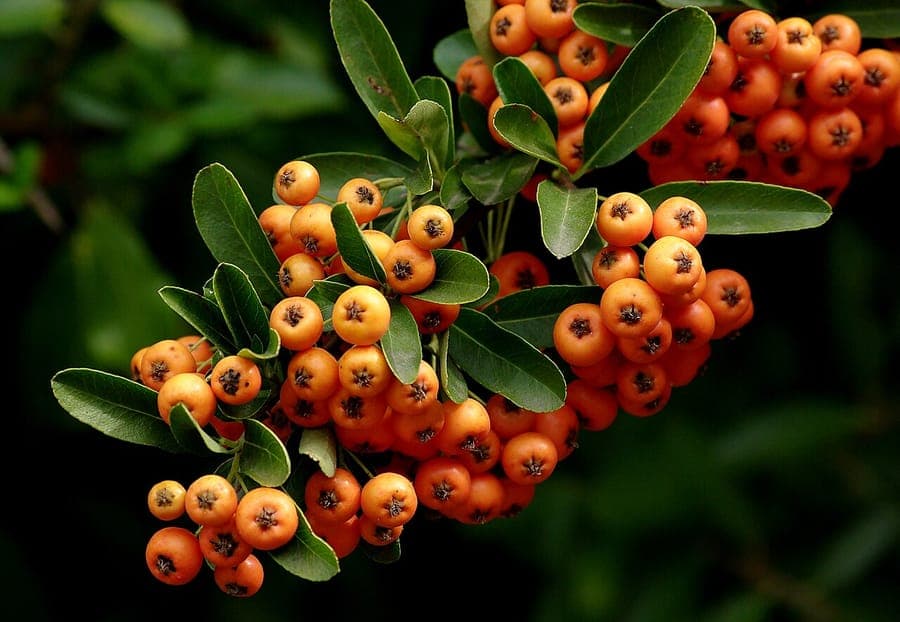
JLPC / CC BY-SA 3.0, via Wikimedia Commons
Narrowleaf firethorn: complete guide
Pyracantha angustifolia
¿Quieres ver Narrowleaf firethorn: complete guide en tu jardín?
1 minuto, sin tarjeta de crédito
Overview
Narrowleaf firethorn (Pyracantha angustifolia), also known as orange firethorn or yellow firethorn, is a semi-evergreen shrub from Tibet and South China. This dense-growing, thorn-laden shrub naturally inhabits mountain slopes. With its fine, lance-shaped leaves, white spring flowers, and spectacular orange-yellow berries in fall, this natural accent delivers both beauty and living space for birds.
Appearance and bloom
Narrowleaf firethorn forms a dense, shrubby growth with dark green, oblong lance-shaped foliage. The plant reaches 2-3 meters height with broad spread. From May through June, numerous small, flat-white flowers appear in densely-packed cyme clusters. Bees visit. Fruits ripen in September-October to small, orange-yellow berries approximately 1 centimeter diameter, persisting long into winter.
Ideal location
Narrowleaf firethorn thrives best in full sunlight, although partial shade is also acceptable. Plant against south-/west-facing wall as espalier or wall decoration, or as free-standing shrub in border zones. Protect from strong, wind-exposed locations. Excellent for bird gardens.
Soil
Prepare well-draining, moderately fertile soil. Sandy loam to loamy soils acceptable. Acidic to neutral pH (6-7.5) preferred. In heavy clay, supplement with sand and organic matter.
Diseño gratis
¿Quieres ver Narrowleaf firethorn: complete guide en tu jardín? Crea un diseño gratis ahora.
Watering
Keep moderately moist during growing period. After establishment, extremely drought-tolerant. Water in dry summers, but never waterlog. Reduce winter watering.
Pruning
Narrowleaf firethorn is pruning-tolerant. Shape young shrubs by pruning for full form. Mature shrubs need minimal pruning; remove only dead wood and disease. Light pruning after bloom encourages denser growth. Watch for thorns!
Maintenance calendar
- February-March: shape young shrubs
- April-May: bloom start
- May-June: full bloom
- July-August: fruit development
- September-October: fruits ripen; bird attraction
- November-December: fruits persistent
- January: late winter pruning preparation
Winter hardiness
Narrowleaf firethorn is hardy (zones 6-10) to minus 12 degrees Celsius. In cold climates, north-side protection recommended. Semi-evergreen character; leaves may drop in extremely cold winters, but recover in spring.
Companion plants
Combine with other bird plants: ilex species, cotoneaster, prunus, and flex bamboo varieties.
In conclusion
Narrowleaf firethorn is the ultimate winter-interest, bird-food delivery shrub. With minimal care and maximum life function, it delivers both decoration and bird support. Find plants at garden centers across Europe.
Want to explore more bird-friendly plants? Visit gardenworld.app/en for wildlife garden ideas!
¿Quieres ver Narrowleaf firethorn: complete guide en tu jardín? Crea un diseño gratis ahora.
Sube una foto, elige un estilo y obtén un diseño fotorrealista con lista de plantas en menos de un minuto.
Más de 10.000 jardines diseñados
Sin tarjeta de crédito


Plantas similares
Siberian crab apple: complete guide
Malus x robusta
Complete guide to the Siberian crab apple (Malus x robusta): location, soil, pruning, winter hardiness and the best companion plants for your garden.
Chinese flowering crabapple (Malus x spectabilis): complete guide
Malus x spectabilis
Meet the Chinese flowering crabapple (Malus x spectabilis): a classic spring bloomer with carmine buds and pink blossom.
Potentilla crassinervia: complete guide
Potentilla crassinervia
Potentilla crassinervia, the Corsican cinquefoil, grows wild on Corsica and Sardinia's peaks. Discover how to grow this hardy alpine rock garden gem.