
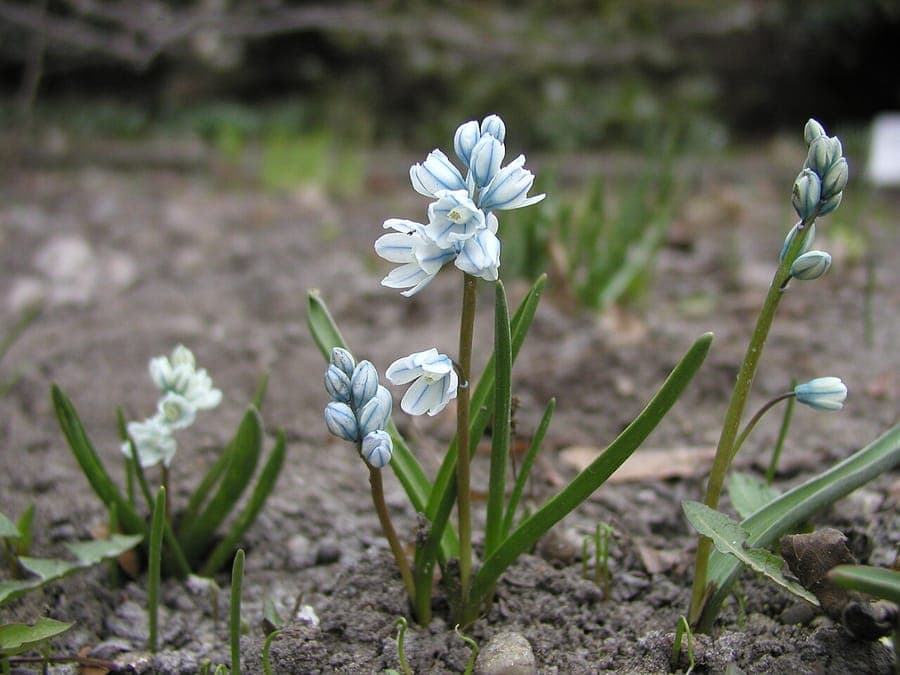
Barbara Wrzesińska / CC BY-SA 2.5, via Wikimedia Commons
Puschkinia scilloides: complete guide
Puschkinia scilloides
¿Quieres ver Puschkinia scilloides: complete guide en tu jardín?
1 minuto, sin tarjeta de crédito
Overview
Puschkinia scilloides, commonly called striped squill or porcelain hyacinth, is a delicate spring bulb native to the mountainous regions of Turkey, Lebanon, and the Caucasus. This refined plant offers fresh springtime charm with its pale blue-violet flowers and distinctive fine striping. Though diminutive, it impresses with elegant growth habit and exceptionally early blooming.
In gardens, Puschkinia scilloides gains growing popularity as a refined alternative to more common spring bulbs. It forms perfect groupings in rock gardens, beneath shrubs, or in containers where its soft blue coloring achieves maximum impact.
Appearance and Bloom
Puschkinia scilloides grows as a compact plant reaching merely 15-20 centimeters tall. Narrow, lance-shaped green leaves surround the flower stem, forming elegant, tight tufts. The overall plant architecture is fine and delicate.
Flowering in March through April is the plant's highlight. Vertical racemes develop, bearing numerous small, pale blue-violet flowers with darker striped center stripes. Individual flowers measure just 5-8 millimeters across, yet collectively they create a soft, poetic tableau against dark soil. Fragrance is subtle and pleasing.
Ideal Location
Puschkinia scilloides thrives in full sun to partial shade locations. The plant appreciates cooler growing conditions and regular moisture. In southern Europe, partial shade may be preferable. In northern Europe, full sun is preferred.
This bulb excels in rock gardens, beneath deciduous trees (where it enjoys cooler subsurface conditions), along borders, in alpine troughs, and in containers. It integrates beautifully with other early spring bulbs such as Chionodoxa and small tulips.
Soil
Puschkinia scilloides requires well-draining soil. Heavy, waterlogged earth leads to rotting. A mixture of garden soil, potting compost, sand, and small quantities of grit provides ideal growing conditions. A pH between 6.0 and 7.5 is optimal.
The plant is not nutrient-demanding. Standard garden soil enriched with potting compost suffices. Excess fertilizer leads to lush growth with fewer flowers.
Diseño gratis
¿Quieres ver Puschkinia scilloides: complete guide en tu jardín? Crea un diseño gratis ahora.
Watering
Puschkinia scilloides needs moist soil during the growing season (October-May). Following planting, keep soil regularly moist without waterlogging. Watering one week after planting is critical for root establishment.
During blooming (March-April), ensure regular watering without saturation. After flowering and as leaves begin yellowing (May-June), progressively reduce water. During summer dormancy (July-August), maintain minimal watering.
Pruning
Puschkinia scilloides requires no pruning. Allow spent flowers to mature and set seed, which aids natural reproduction. Remove completely dead foliage only when the plant is fully dormant (June-July).
Maintenance Calendar
March-April: Blooming peak. Water regularly. Remove spent flower stems for neatness, but leave some for seed development.
May-June: Foliage yellows. Progressively reduce watering. Allow seed ripening.
July-August: Dormancy season. Plant rests underground. No water or care needed.
September-October: Bulbs enter deep dormancy. Planting preparation begins late September.
November-February: Bulbs develop roots underground. No visible activity. Protect against extreme frost and snow.
Winter Hardiness
Puschkinia scilloides is hardy to climate zone 3 (-35 degrees Celsius). Throughout the Netherlands, Belgium, France, and Germany, it overwinters reliably. Frost, snow, and ice pose no problems. This bulb tolerates the mountain climate where it naturally grows.
Companion Plants
Puschkinia scilloides pairs beautifully with other early spring bulbs:
- Chionodoxa luciliae (glory of the snow) - similar color scheme with simultaneous flowering
- Scilla siberica (Siberian squill) - deeper blue with taller flower stems
- Muscari armeniacum (grape hyacinth) - complementary blue color with slightly later bloom
- Crocus vernus (spring crocus) - similar height and timing
- Pulmonaria saccharata (lungwort) - autumn foliage with blue flowers
Conclusion
Puschkinia scilloides is a precious addition to spring gardens that value delicate color and elegant form. With its winter dormancy and early March blooming, this bulb offers hope and beauty just when other plants still slumber. For rock garden enthusiasts and lovers of miniature bulbs, this striped squill is essential. Plant it in generous drifts for maximum impact and enjoy this elegant springtime display.
¿Quieres ver Puschkinia scilloides: complete guide en tu jardín? Crea un diseño gratis ahora.
Sube una foto, elige un estilo y obtén un diseño fotorrealista con lista de plantas en menos de un minuto.
Más de 10.000 jardines diseñados
Sin tarjeta de crédito


Plantas similares
Narrow-leaved dracaena: complete guide
Dracaena angustifolia
Everything about Dracaena angustifolia - the narrow-leaved dracaena: location, care, overwintering and use as a houseplant or patio plant.
Chaparral yucca: complete guide to Hesperoyucca whipplei
Hesperoyucca whipplei
Hesperoyucca whipplei (Our Lord's candle) is a dramatic rosette-forming plant from California that produces a towering flower spike, ideal for dry and gravel gardens.
False lily-of-the-valley: complete guide
Maianthemum dilatatum
Everything about Maianthemum dilatatum, the false lily-of-the-valley. Care, shade location, propagation and garden combinations for this popular shade ground cover.