
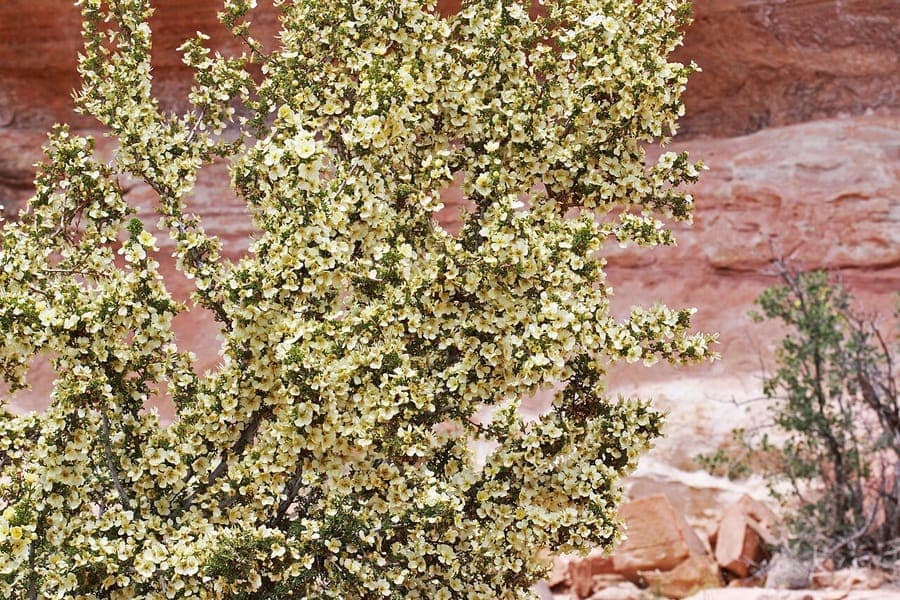
Andrey Zharkikh from Salt Lake City, USA / CC BY 2.0, via Wikimedia Commons
Purshia stansburiana: complete guide
Purshia stansburiana
¿Quieres ver Purshia stansburiana: complete guide en tu jardín?
1 minuto, sin tarjeta de crédito
Overview
Purshia stansburiana, commonly known as Stansbury cliffrose or antelope bitterbrush, is a striking deciduous to semi-evergreen shrub belonging to the Rosaceae family. Native to the arid and semi-arid regions of the southwestern United States - including Utah, Nevada, Arizona, Colorado, and New Mexico - and extending into northern Mexico, this plant thrives in desert shrub communities, dry chaparral, and rocky canyon slopes at elevations ranging from roughly 1,000 to 2,500 metres. Mature plants typically reach between 1 and 3 metres in height and spread, forming an arching, open-branched structure with a distinctive wild character. The species is named after Howard Stansbury, the nineteenth-century American explorer and topographer best known for his survey of the Great Salt Lake region. It was long classified as Cowania stansburiana before being reassigned to Purshia. At gardenworld.app you can explore garden design concepts built around drought-adapted shrubs like Purshia stansburiana, ideal for low-maintenance, climate-resilient front yards and gravel gardens.
Appearance and bloom
The foliage of Purshia stansburiana consists of small, wedge-shaped, three-lobed leaves with a deep green upper surface and a grey-woolly underside. The leaves are intensely aromatic - crush them between your fingers and you release a resinous, almost cedar-like scent that pervades the area around the plant. This fragrance is strongest on warm, sunny days. From mid-spring to early summer, typically April through June depending on elevation and latitude, the plant erupts into a spectacular display of cream-white to pale yellow flowers. Each individual flower measures roughly 1 cm across and carries five rounded petals arranged in a rosette typical of the rose family, surrounding a central cluster of numerous stamens that give the flower a full, brush-like appearance. The fragrance is sweet and pervasive, drawing pollinators in large numbers - bees, hoverflies, and butterflies are regular visitors. After flowering, small achene-like fruits develop topped with long, feathery tails that persist decoratively on the shrub through autumn and into winter, providing a second season of ornamental interest comparable to the seed heads of Clematis.
Ideal location
Full sun is non-negotiable for Purshia stansburiana. The plant requires at least six to eight hours of direct sunlight daily to flower reliably and maintain its compact, healthy form. In its natural habitat it colonises dry, exposed south- or west-facing slopes and rocky outcrops where nothing blocks the sun for any significant portion of the day. It handles intense heat with complete ease and thrives in conditions that would stress most garden shrubs. Shade or excess moisture leads to etiolated growth, poor flowering, and vulnerability to fungal issues including powdery mildew. Good air circulation around the plant is also beneficial; still, humid air encourages disease. For garden designs aiming at a xeriscape or prairie aesthetic, this shrub is an excellent structural choice for sunny borders, rock gardens, or gravel beds. A position against a south-facing wall or on a raised slope gives the plant both the sun exposure and the free drainage it needs to thrive in northern European climates.
Soil
Purshia stansburiana is supremely well adapted to poor, sharply draining soils. In the wild it grows in shallow, stony, sandy, or gravelly substrates with a soil pH in the range of 7.0 to 8.5 - slightly alkaline to decidedly basic. Rich, moisture-retentive garden soils are actually detrimental: they produce lush leafy growth at the expense of flowers and can dramatically shorten the plant's lifespan through root rot. When preparing a planting site, work in generous quantities of coarse grit, pea gravel, or crushed stone to ensure rapid drainage after rain. Avoid adding compost or fertiliser to the planting hole. A grit or gravel mulch over the root zone further improves drainage and keeps the crown dry, reducing disease risk significantly. The species also forms beneficial root associations with nitrogen-fixing soil microorganisms, reducing its nutritional requirements still further and making it a genuinely self-sufficient garden plant once established. If your garden soil is heavy clay, a raised bed filled with a lean, gritty mix is the best solution.
Watering
Few garden shrubs match Purshia stansburiana for drought endurance once established. Its deep, wide-ranging root system enables it to access moisture reserves far below the surface that shallow-rooted plants cannot reach, allowing it to survive prolonged dry spells with ease. During the first growing season after planting, water once a week to encourage deep root development - always allow the soil to dry almost completely between waterings, never leaving the root zone continuously moist. From the second year onward, most planted specimens in temperate climates need no supplemental watering at all except during extreme, prolonged heat waves exceeding two or three weeks without rainfall. When irrigation is necessary, deep, infrequent soakings are far preferable to light, frequent sprinkles; the latter encourage shallow rooting and dependency on artificial water supply. Overwatering is the single most common cause of failure with this plant in cultivation: waterlogged roots quickly succumb to Phytophthora and other root pathogens. Drip irrigation directed to the root zone, rather than overhead sprinklers, is the preferred method if supplemental water is needed.
Diseño gratis
¿Quieres ver Purshia stansburiana: complete guide en tu jardín? Crea un diseño gratis ahora.
Pruning
Purshia stansburiana has a naturally pleasing, arching form and requires minimal pruning intervention to look its best. A light trim immediately after flowering - cutting back the flowered shoots by about one-third - helps maintain a tidy, compact habit and encourages the development of strong new growth that will carry next year's flower buds. Remove any dead, diseased, or crossing branches in early spring before growth resumes, using clean cuts at a slight angle just above a healthy bud. Avoid hard rejuvenation pruning into old wood; unlike many shrubs in the rose family, Purshia does not regenerate reliably from bare, aged wood. On young plants, pinching out the leading shoot tips once or twice during the first summer promotes a bushier, more branched structure that pays dividends in subsequent flowering seasons. Always use sharp, clean secateurs to avoid crushing stems or introducing pathogens; disinfect tools between plants during pruning sessions.
Maintenance calendar
January and February: inspect for winter damage and remove frost-killed wood with clean cuts. Apply a dry gravel mulch if soil tends to stay wet. March and April: apply a 3 to 5 cm layer of fine gravel mulch around the root zone, avoiding contact with the stem. Plant new specimens now in well-prepared gritty soil so they establish before the summer heat. May and June: enjoy the peak flowering display and the intense sweet fragrance. Check for spider mite infestations during hot, dry spells; control with a targeted miticide if needed. June and July: carry out light post-bloom pruning when flowers have fully faded. Water deeply if an unusual heat wave has lasted more than two weeks. August and September: minimal maintenance required; the plant is entering its summer semi-dormancy and handles dry conditions without attention. October and November: optional light shaping cut to improve the winter silhouette. December: no active growth; in marginal frost zones protect the root zone with a dry gravel or coarse sand mulch to prevent deep frost penetration.
Winter hardiness
Purshia stansburiana is rated hardy to USDA Zone 5, corresponding to minimum temperatures around -28 degrees Celsius in the most cold-tolerant forms, though most cultivated material performs best and most reliably in Zones 6 to 9. The plant is adapted to continental climates with cold, dry winters - quite different from the mild, wet maritime winters common in much of Western Europe. The key limiting factor in temperate European gardens is not cold itself but the combination of winter moisture and poor drainage, which together create exactly the conditions this plant most dislikes. Given a sharply draining, gritty soil and a sheltered, sunny aspect, the plant survives the winters of the British Isles, the Benelux, and northern France without difficulty. Young plants benefit from a dry mulch of gravel over the root zone in their first winter while roots consolidate and the plant builds resilience. Established specimens of three years or more are generally robust across northwestern Europe.
Companion plants
In naturalistic or xeriscape designs, Purshia stansburiana associates beautifully with a broad range of drought-tolerant companions. Artemisia tridentata shares its natural range and provides a similar silver-grey aromatic quality, creating a coherent Southwestern American palette when the two are planted together. Penstemon strictus and Penstemon eatonii contribute tall spikes of blue and scarlet-red flowers that extend the display well into summer. Low ornamental grasses such as Bouteloua gracilis or Festuca idahoensis weave through the shrub layer and add fine textural contrast at ground level. Erigeron speciosus brings soft lavender daisy flowers in midsummer. For European-climate gardens where true Southwestern species may be harder to source, Cistus species, Phlomis fruticosa, and Salvia officinalis offer comparable drought-hardiness and complement Purshia's pale flowers effectively. At gardenworld.app you can see how these combinations translate into actual planting designs for real front gardens and visualise the effect before committing to a planting scheme.
Closing thoughts
Purshia stansburiana is a quietly exceptional shrub that deserves far wider recognition in temperate garden culture. As European summers grow progressively hotter and drier due to shifting climate patterns, its combination of ornamental appeal - cascading white flowers, aromatic silver-green foliage, and feathery decorative fruits - with outstanding ecological value for pollinators and wildlife, nitrogen-fixing root associations, and near-zero water requirements makes it an increasingly important garden plant. It asks for almost nothing beyond a sunny spot, free-draining alkaline soil, and the patience to let it establish. The rewards - reliable annual flowering, extraordinary fragrance, winter fruit interest, and minimal maintenance for decades - are substantial. For those planning a water-wise, climate-adapted, wildlife-friendly front yard, this species belongs firmly on the shortlist. Explore curated design ideas featuring plants like Purshia stansburiana at gardenworld.app, where every garden design is tailored to your specific site conditions, climate zone, and aesthetic vision.
¿Quieres ver Purshia stansburiana: complete guide en tu jardín? Crea un diseño gratis ahora.
Sube una foto, elige un estilo y obtén un diseño fotorrealista con lista de plantas en menos de un minuto.
Más de 10.000 jardines diseñados
Sin tarjeta de crédito


Plantas similares
Siberian crab apple: complete guide
Malus x robusta
Complete guide to the Siberian crab apple (Malus x robusta): location, soil, pruning, winter hardiness and the best companion plants for your garden.
Chinese flowering crabapple (Malus x spectabilis): complete guide
Malus x spectabilis
Meet the Chinese flowering crabapple (Malus x spectabilis): a classic spring bloomer with carmine buds and pink blossom.
Potentilla crassinervia: complete guide
Potentilla crassinervia
Potentilla crassinervia, the Corsican cinquefoil, grows wild on Corsica and Sardinia's peaks. Discover how to grow this hardy alpine rock garden gem.