
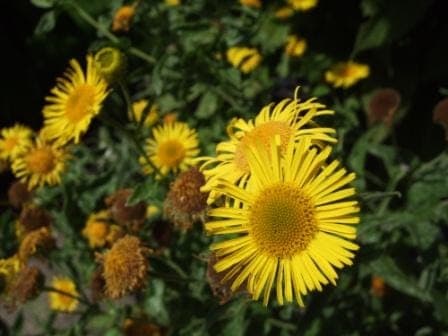
DDennisM / CC BY 3.0, via Wikimedia Commons
Pulicaria dysenterica: complete guide
Pulicaria dysenterica
¿Quieres ver Pulicaria dysenterica: complete guide en tu jardín?
1 minuto, sin tarjeta de crédito
Overview
Pulicaria dysenterica, commonly known as common fleabane or meadow false fleabane, is an elegant asteraceae plant naturally distributed across Europe to Central Asia and the West Himalaya. This herb holds centuries of medicinal tradition while making an excellent ornamental addition to natural gardens. With delicate yellow flowers and remarkable tolerance for wet conditions, it offers both beauty and practical value.
Historically growing on wet meadows, marsh margins, and scrubland, this plant now occupies a special place in wildlife gardens and ecological restoration projects. Its appeal to pollinators and beneficial insects makes it invaluable for supporting garden ecosystems.
Appearance and Bloom
Pulicaria dysenterica develops as a loosely branched shrublet reaching 40-80 centimeters tall. Small, green, slightly textured leaves give the plant its characteristic organic appearance. Rather than assuming a formal shape, it grows naturally and informally, which is part of its charm.
Flowering from July to September is the absolute highlight. Numerous delicate yellow flowers cluster into profuse, cheerful umbels throughout the plant. While individually small (just a few centimeters across), the collective effect proves sunny and uplifting. Flowers attract butterflies, bees, and numerous beneficial insects. After flowering, small feathered seeds add decorative interest and wildlife value.
Ideal Location
Pulicaria dysenterica thrives in bright locations. Full sun (6+ hours direct daily sunlight) produces compact, floriferous growth and maximum flowering. The plant tolerates partial shade but produces fewer flowers in shadier conditions.
This is an ideal plant for wet-habitat gardens: along canal and ditch margins, in wildlife gardens, in borders where water regularly collects, and in natural garden settings. It integrates beautifully with other moisture-lovers such as Juncus species, Filipendula, and other wetland inhabitants.
Soil
Pulicaria dysenterica strongly prefers moist to wet soils. It grows optimally in poorly drained or waterlogged ground - conditions most garden plants avoid. A pH between 7.5 and 8.0 is ideal. Soil fertility is less critical; average nutrient levels suffice.
The plant fails on dry sites. In normal garden soils, create deliberately wet areas where water can persist, or grow it in containers with consistently moist compost.
Diseño gratis
¿Quieres ver Pulicaria dysenterica: complete guide en tu jardín? Crea un diseño gratis ahora.
Watering
Pulicaria dysenterica is the ideal plant for locations where others would drown. It thrives with regular inundation. In naturally moist soils, supplemental watering is barely necessary. Only during abnormally dry periods would you consider adding water to create wetter conditions.
In containers, maintain consistently moist growing media; never allow soil to dry completely. The plant rapidly declines under dry conditions.
Pruning
Most gardeners allow Pulicaria dysenterica to grow naturally. After flowering, dead flower heads can be removed for neater appearance. In spring (March-April), remove overwintered dead material and cut the plant back to a few centimeters above soil, which stimulates vigorous new growth.
Remove faded flowers continuously throughout the season to encourage extended flowering and extend bloom until the first frost.
Maintenance Calendar
March-April: Cut back overwintered material. Plant regrows vigorously. No fertilizing needed in moist locations.
May-June: Plant in active growth. Water management less critical. Weed control as needed.
July-August: Maximum flowering. Remove spent flowers for continuous blooms. Maintain moist soil conditions.
September-October: Flowering diminishes. Leave seed heads for bird food and winter appeal.
November-February: Dormancy. No treatment required.
Winter Hardiness
Pulicaria dysenterica survives climate zone 5 (-20 degrees Celsius) with no winter protection needed. Throughout the Netherlands, Belgium, France, and Germany, the plant overwinters reliably and returns vigorously each spring.
Companion Plants
Pulicaria dysenterica harmonizes beautifully with other moisture-lovers:
- Juncus effusus (soft rush) - similar moisture preference with textural contrast
- Filipendula ulmaria (meadowsweet) - greater height with pink-white flowers
- Lythrum salicaria (purple loosestrife) - purple flowers with matching moisture needs
- Iris sibirica (Siberian iris) - elegant forms with blue-violet flowers
- Eupatorium (Joe-Pye weed) - tall growth with pink flowers
Conclusion
Pulicaria dysenterica proves versatile, useful, and historically valuable. For gardeners seeking to fill wet, challenging locations, this golden-flowered herb provides both practical and ornamental solutions. Its preference for waterlogged soils makes it essential in wildlife gardens and ecological restoration. With minimal care and abundant native charm, common fleabane deserves a place in every European garden with regular moisture.
¿Quieres ver Pulicaria dysenterica: complete guide en tu jardín? Crea un diseño gratis ahora.
Sube una foto, elige un estilo y obtén un diseño fotorrealista con lista de plantas en menos de un minuto.
Más de 10.000 jardines diseñados
Sin tarjeta de crédito


Plantas similares
Calendula stellata: complete guide
Calendula stellata
Complete guide to Calendula stellata, the star-flowered marigold from Sicily: location, soil, watering and companion planting tips.
Korean chrysanthemum: complete guide
Chrysanthemum x rubellum
Chrysanthemum x rubellum is a hardy autumn perennial with single pink to copper flowers from August to November. Care and combinations.
Helianthus divaricatus: complete guide
Helianthus divaricatus
Helianthus divaricatus is a North American woodland sunflower with yellow summer blooms, ideal for naturalistic borders and shady edges.