
Wikimedia Commons / CC BY-SA 3.0, via Wikimedia Commons
Psilotum nudum: complete guide
Psilotum nudum
¿Quieres ver Psilotum nudum: complete guide en tu jardín?
1 minuto, sin tarjeta de crédito
Overview
Psilotum nudum, commonly known as whisk fern or skeleton fork fern, is one of the most primitive ferns on Earth. This fascinating plant thrives in warm, subtropical regions worldwide. It distinguishes itself with its unique, skeletal appearance featuring thin, greenish branches without true leaves.
This fern dates back over 400 million years in evolutionary history, proving that simplicity can be beautiful. In the wild, they grow epiphytically - on trees or rocks - giving them a captivating look when grown in gardens.
Appearance and bloom
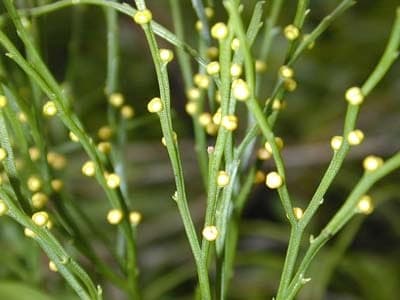
The whisk fern is recognizable by its characteristic branched, greenish-brown stems that resemble thin threads. It lacks true leaves but features small scale-like structures and sporangia (spore cases) at the branch tips.
Instead of flowers, the plant produces yellow-green spore cases that form groups of three (synangium). These are tiny structures located at stem ends. The plant typically grows 15 to 30 cm tall and forms attractive, dense clumps.
Despite its primitive nature, Psilotum nudum offers an extraordinary aesthetic element to indoor and shade gardens. The woven, hair-like appearance is truly unique and found nowhere else in typical gardens.
Ideal location
This fern feels most at home in warm, humid spots. Choose a place with indirect to dappled light - full shade works too, though the plant will be less vigorous.
In gardens, a protected location is essential, as this plant cannot tolerate cold or wind. Usually it's grown in greenhouses, interior gardens, or container displays. Ensure high humidity: above 60% is ideal.
The plant also thrives as an epiphyte if you have a tree trunk or mangrove roots where it can attach itself, mimicking its natural growth pattern.
Soil
Psilotum nudum lacks true roots but has rhizoids for nutrient uptake. Therefore, standard potting soil is unsuitable. Use an air-permeable medium instead, such as:
- Tree bark or orchid bark
- A mixture of leaf mold and sand
- Coconut fiber mixed with perlite
- Moss fiber blends
The soil must retain moisture while draining well. Add organic material regularly to improve water-holding capacity. A pH between 5.5 to 6.5 is ideal.
Watering
Water the whisk fern frequently, especially during the growing season (spring and summer). The soil shouldn't dry out but shouldn't be waterlogged either - this can cause root rot.
Mist the plant regularly with fine water spray. This supports the higher humidity the plant needs. Misting two to three times weekly helps optimally.
In winter, you can water slightly less but the soil must remain moist. Always use room-temperature water and avoid hard water with high lime content - this damages the plant.
Diseño gratis
¿Quieres ver Psilotum nudum: complete guide en tu jardín? Crea un diseño gratis ahora.
Pruning
Psilotum nudum doesn't need traditional pruning. Simply remove dead or damaged branches carefully with sterile scissors.
The plant grows slowly and naturally develops an attractive form. If it becomes too large or needs shaping, you can gently remove some branches. This promotes branching and creates a more compact growth pattern.
Collect pruned pieces and lay them on moist sphagnum moss - many will root and grow into young plants.
Maintenance calendar
Spring: Begin moderate watering after dormancy. Check for fungal growth. Inspect for pests.
Summer: Increase watering and misting frequency. Ensure sufficient humidity. Apply weak fertilizer monthly.
Fall: Gradually reduce watering. Extend light days if needed with grow lights.
Winter: Give minimal water but maintain high humidity. Lower temperature to 12-15C for dormancy if possible.
Winter hardiness
Psilotum nudum is absolutely not winter hardy and cannot tolerate frost. It grows in tropical and subtropical regions where temperatures rarely drop below 10C.
In temperate climates, this plant must be grown indoors, in a greenhouse or warm humid room. Ensure nighttime temperatures don't fall below 12C.
In very warm Mediterranean regions (with warm, protected locations), it can grow outdoors but requires frost protection in winter.
Companion plants
Pair Psilotum nudum beautifully with other humidity-loving ferns and tropical plants, such as:
- Other ferns: Adiantum species, Nephrolepis (sword ferns)
- Low herbaceous plants: Peperomia, Syngonium
- Epiphytic ferns: Platycerium (staghorn fern)
- Moisture-loving groundcovers: Soleirolia (baby tears), maranta
- Small araceae: Anthurium clarinervium, Scindapsus pictus
Ensure all companion plants share the same needs for warmth, humidity, and indirect light.
Closing thoughts
Psilotum nudum is a true treasure for plant enthusiasts wanting to grow something truly unique. With its primitive, skeletal appearance and minimal requirements, it offers a fascinating perspective on plant evolution.
While it requires patience - particularly regarding temperature and humidity - it's worth the effort. If you want to experiment with something complex and different, this fern is perfect.
Visit gardenworld.app for more plant advice and design tips. You'll find more ferns there too, or check garden centers for starters. Happy growing with your whisk fern!
Is the whisk fern right for you? Read more on gardenworld.app for personalized advice and custom designs.
¿Quieres ver Psilotum nudum: complete guide en tu jardín? Crea un diseño gratis ahora.
Sube una foto, elige un estilo y obtén un diseño fotorrealista con lista de plantas en menos de un minuto.
Sin tarjeta de crédito


Plantas similares
Acer pycnanthum: complete guide
Acer pycnanthum
Acer pycnanthum, the Japanese swamp maple, is a fast-growing tree with early red flowers and brilliant autumn color, ideal for damp garden settings.
Freeman maple: complete guide
Acer × freemanii
Everything about the Freeman maple (Acer x freemanii): a fast-growing shade tree with spectacular autumn colour for large gardens.
Silver vine: complete guide
Actinidia polygama
Discover silver vine (Actinidia polygama): a hardy climbing plant with silvery foliage, loved by gardeners and cats alike.