
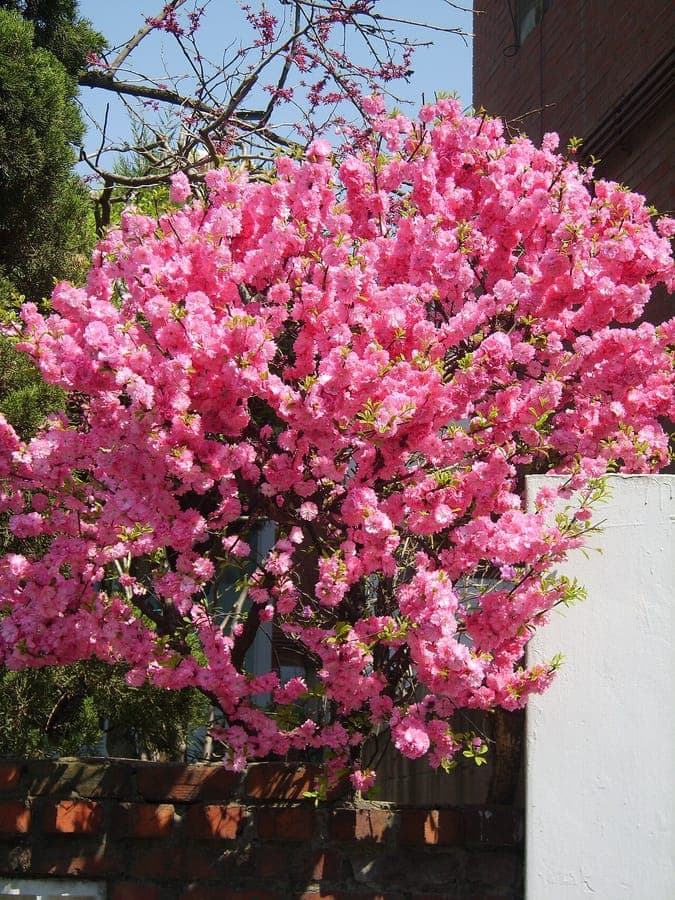
Dalgial / CC BY-SA 3.0, via Wikimedia Commons
Prunus triloba: complete guide
Prunus triloba
¿Quieres ver Prunus triloba: complete guide en tu jardín?
1 minuto, sin tarjeta de crédito
Overview
Prunus triloba, commonly known as the flowering almond or flowering plum, is a stunning ornamental tree native to China and Korea. This deciduous tree is celebrated for its spectacular double pink flowers that emerge at the beginning of spring, before the foliage appears. It serves as an excellent focal point in gardens, providing early season color when few other plants are in bloom.
Appearance and Bloom
The flowering almond is a compact tree typically reaching 3-6 meters in height, depending on variety and growing conditions. The trunk displays characteristic gray to brown bark with distinctive lenticels. The leaves are lance-shaped, approximately 5-8 cm long, with glossy green foliage that transforms to yellow and orange in autumn.
The flowers are the showstopping feature of this tree. Appearing in March through April, they densely clothe the branches before leaves emerge. Double varieties produce 20-30 petals per flower in shades of pink or white. The blooms emit a subtle sweet fragrance and attract numerous pollinators.
Ideal Location
Place Prunus triloba in full sun (minimum 6 hours direct sunlight daily) for optimal flowering. The tree tolerates partial shade but blooms less profusely in shaded locations. Provide protection from harsh, cold-dry spring winds that can damage emerging flowers and tender growth.
Soil
Prunus triloba thrives in well-draining, moderately fertile soil with a pH between 6.0 and 7.5. The tree is not particular about soil type and grows well in sandy, silty, or loamy soils, provided excess moisture is prevented. Heavy clay soils should be amended with compost and sand to improve drainage.
Amend planting areas initially by incorporating 5-10 cm of compost into the planting hole. This promotes healthy root development and establishes nutrient availability. After planting, apply 5-7 cm of organic mulch around the base while maintaining several centimeters clearance from the trunk.
Diseño gratis
¿Quieres ver Prunus triloba: complete guide en tu jardín? Crea un diseño gratis ahora.
Watering
During the first growing season, the tree requires consistent moisture. Water deeply 1-2 times weekly, depending on rainfall and temperature. Once the root system is established (typically after 12-18 months), the tree becomes fairly drought-tolerant and requires supplemental watering only during extended dry periods.
Throughout the growing season in spring and summer, maintain consistent moisture while avoiding waterlogging. Drip irrigation or soaker hoses are ideal methods. Avoid overhead sprinkler irrigation to minimize fungal disease risk.
Pruning
Pruning is not strictly necessary but can be performed immediately after flowering (April-May). Remove dead or weak branches, crossing branches, and growth that disrupts the tree's form. The tree can be trained to a single-stem or multi-stem form according to preference.
Avoid aggressive pruning, as this limits flowering production. If formal shaping is desired, develop it gradually over multiple years. Disinfect pruning tools with 10% bleach solution to prevent disease transmission between cuts.
Maintenance Calendar
March: First frost protection if needed; light fertilizer application can begin. April-May: Peak flowering; prune after blooms fade. June-August: Foliage expansion; regular watering. September-October: Autumn color; winter preparation. November-February: Dormancy; damage inspection.
Winter Hardiness
Prunus triloba is winter-hardy to approximately -20°C (USDA zones 5-8), though varieties may differ. In colder climates, first-year protection may be necessary. Shield against cold, dry winds through mulching and possible jute wrapping during severe winters.
Companion Plants
Excellent spring-flowering companions include early bloomers such as snowdrops (Soldanella), hellebores (Helleborus), and crocuses. These create staggered color progression. For under-planting, incorporate shade-tolerant ground covers like ivy or periwinkle beneath the canopy.
Closing
The flowering almond transforms the spring garden with pink blossoms and promises of warmer days ahead. With proper placement, drainage, and maintenance, this tree will provide years of ornamental beauty. Available at major garden retailers. Learn more at gardenworld.app/en and gardenworld.app/nl.
¿Quieres ver Prunus triloba: complete guide en tu jardín? Crea un diseño gratis ahora.
Sube una foto, elige un estilo y obtén un diseño fotorrealista con lista de plantas en menos de un minuto.
Más de 10.000 jardines diseñados
Sin tarjeta de crédito


Plantas similares
Siberian crab apple: complete guide
Malus x robusta
Complete guide to the Siberian crab apple (Malus x robusta): location, soil, pruning, winter hardiness and the best companion plants for your garden.
Chinese flowering crabapple (Malus x spectabilis): complete guide
Malus x spectabilis
Meet the Chinese flowering crabapple (Malus x spectabilis): a classic spring bloomer with carmine buds and pink blossom.
Potentilla crassinervia: complete guide
Potentilla crassinervia
Potentilla crassinervia, the Corsican cinquefoil, grows wild on Corsica and Sardinia's peaks. Discover how to grow this hardy alpine rock garden gem.