
Usien / CC BY-SA 3.0, via Wikimedia Commons
Prunus sargentii: complete guide
Prunus sargentii
¿Quieres ver Prunus sargentii: complete guide en tu jardín?
1 minuto, sin tarjeta de crédito
Overview
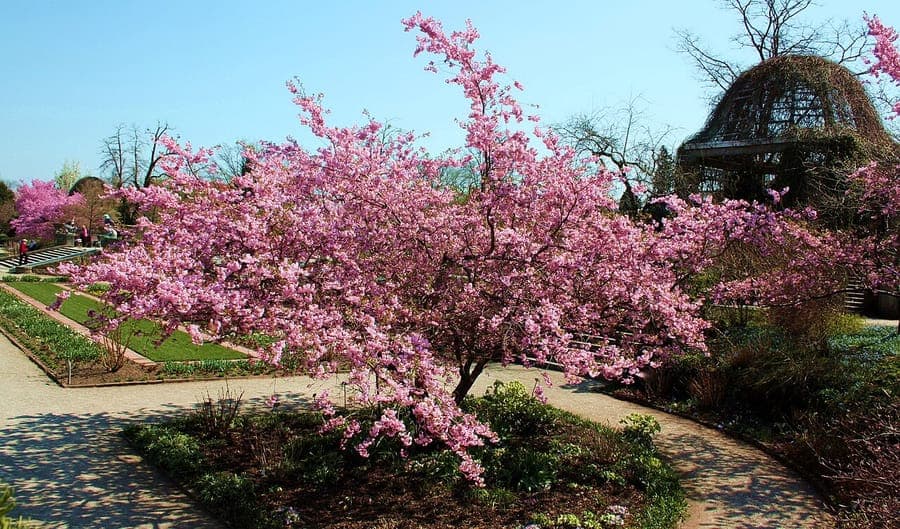
Prunus sargentii, known as Sargent's cherry or Hill cherry, is a magnificent Japanese ornamental tree that serves as an absolute showstopper in many gardens. This tree from the Rosaceae family is renowned for its extremely abundant, pink flowers that transform trees into a sea of color in spring.
The tree grows to 10 to 15 meters and forms a compact, rounded crown. After the spectacular blooming passes, the tree exhibits another highlight: in autumn, the leaves color spectacularly deep red to purple. This transition from spring-pink to autumn colors makes Sargent's cherry one of the most decorative specimens year-round.
This is ideal for those seeking a dramatic flower display and subsequently appreciating beautiful autumn colors. The tree is winter hardy and well-suited to temperate climates.
Appearance and bloom
The Sargent's cherry shines particularly through its spring flower display. From April to May, numerous deep pink to reddish flowers appear in dense clusters along all branches. These flowers are larger than those of many other Prunus species and give the tree an unusually full, flower-rich appearance.
The leaves are relatively large, thin and glossy dark green. They provide a lovely background for the flowers. In autumn, they undergo a spectacular transformation: they become fuchsia to dark purple, sometimes with orange nuances. This autumn coloring can last for weeks and forms another highlight of the growing year.
After flowering, small red stone fruits appear that gradually turn purple to black. These are attractive to birds and add nutritional value to the garden.
Ideal location
The Sargent's cherry thrives best in a sunny location. Ensure at least 6 to 8 hours of sunlight per day. Good illumination ensures maximum flower blooming and beautiful autumn colors.
Choose a location where the tree is protected from strong, turbulent wind. While the tree is winter hardy, strong winds can damage flowers. A spot within a larger plant group or close to garden structures can help.
Ensure there is sufficient space around the tree for air circulation, as this helps prevent disease. Do not plant the tree in low points where water stagnates.
Soil
Prunus sargentii thrives best in well-draining, fertile soil with a pH of about 6.0 to 7.0. However, the tree is not very fussy and can grow in various soil types.
Good soil preparation is important. Work organic material such as compost when planting. This improves water mobility and nutrient delivery. Sandy soils can better retain water thanks to organic matter.
Avoid heavy clay soils or soils where water stagnates. These can cause root rot. If necessary, you can add drainage material to improve drainage.
Diseño gratis
¿Quieres ver Prunus sargentii: complete guide en tu jardín? Crea un diseño gratis ahora.
Watering
During the first growing year, water regularly. Keep the soil moist but not waterlogged. This helps roots establish firmly.
Once well planted and established, Prunus sargentii is reasonably drought tolerant. Provide extra water during dry spells and extreme summer heat. A mulch layer of organic material helps retain moisture.
During moisture stress, you can provide extra watering during growth and flowering periods. This ensures better flower quality and adds nutritional value.
Pruning
The Sargent's cherry requires minimal pruning and naturally grows into a beautiful form. Shape pruning should occur during the juvenile stage to develop a strong, symmetrical crown.
Remove dead, damaged or diseased branches as you see them. This can occur in spring or autumn, though winter is ideal. Make cuts just above a bud.
Be careful with heavy pruning cycles. The tree recovers quickly from gentle pruning but does not respond positively to drastic interventions.
Maintenance Calendar
Winter: Check the tree for frost damage. Perform light pruning cycles. Add mulch for protection.
Spring: Enjoy the blooming. Begin fertilizing. Ensure adequate water while buds swell.
Summer: Provide regular water during dry periods. Monitor plant health. Observe growth and fruit set.
Autumn: Observe autumn coloring. Collect fallen leaves. Perform light pruning cycles. Prepare for winter.
Winter: Admire the leafless structure of the tree. Protect against snow/ice.
Winter hardiness
Prunus sargentii is highly winter hardy and suitable for temperate climates to very cold regions. The tree can withstand temperatures down to -25 degrees Celsius.
Young trees should be protected with a mulch layer around the base during their first winter. This prevents frost damage to shallow roots.
Companion plants
In the understory of the tree, shade-tolerant plants such as hepatica and helleborus can grow well. For more summer color add impatiens or astilbe.
As companions around the tree, use other early-flowering species such as amelanchier or cercis. This extends the season of flower bloom.
Closing thoughts
Prunus sargentii is a versatile and spectacular tree that adds full value to any cultivated garden. With its abundant pink spring blooming and dramatic autumn coloring, it offers two seasons full of beauty. With minimal maintenance, this tree will provide decades of pleasure.
Available at major UK garden centers and nurseries.
¿Quieres ver Prunus sargentii: complete guide en tu jardín? Crea un diseño gratis ahora.
Sube una foto, elige un estilo y obtén un diseño fotorrealista con lista de plantas en menos de un minuto.
Más de 10.000 jardines diseñados
Sin tarjeta de crédito


Plantas similares
Siberian crab apple: complete guide
Malus x robusta
Complete guide to the Siberian crab apple (Malus x robusta): location, soil, pruning, winter hardiness and the best companion plants for your garden.
Chinese flowering crabapple (Malus x spectabilis): complete guide
Malus x spectabilis
Meet the Chinese flowering crabapple (Malus x spectabilis): a classic spring bloomer with carmine buds and pink blossom.
Potentilla crassinervia: complete guide
Potentilla crassinervia
Potentilla crassinervia, the Corsican cinquefoil, grows wild on Corsica and Sardinia's peaks. Discover how to grow this hardy alpine rock garden gem.