
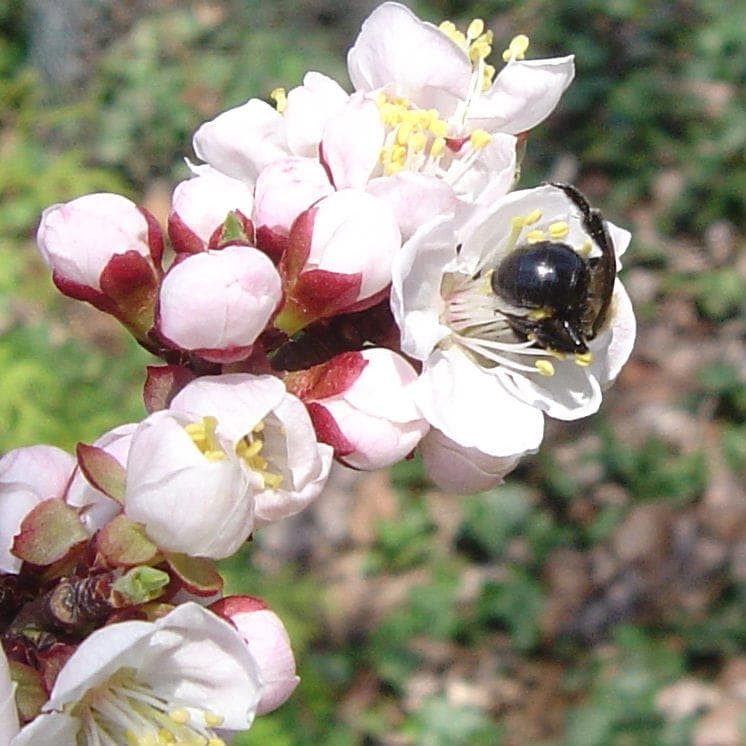
Sminthopsis84 / CC BY-SA 3.0, via Wikimedia Commons
Manchurian Apricot (Prunus mandshurica): complete guide
Prunus mandshurica
¿Quieres ver Manchurian Apricot (Prunus mandshurica): complete guide en tu jardín?
1 minuto, sin tarjeta de crédito
Overview
Prunus mandshurica, the Manchurian Apricot, is an ornamental fruit tree from the Rosaceae family. This tree originates from the Russian Far East, Manchuria, and Korea. With its white flowers in early spring and small fruits, Prunus mandshurica represents a valuable ornamental specimen.
The tree is particularly noteworthy for its early flowering and robustness against extreme winter cold. This makes it suitable for gardens in cold to temperate climates where many apricot varieties cannot survive.
Appearance and bloom
Prunus mandshurica grows to heights of 3-6 meters (sometimes to 8 meters) with a broad, rounded crown. The leaves are ovate with serrated edges, dark green in summer and yellow to reddish-brown in autumn.
Flowers are pink to white blooms in clusters along branches in March to April, before leaves emerge. The flowering is very profuse and spectacular. The fruits are small, approximately 2-3 centimeters in diameter, yellow to orange, sometimes red-streaked. They are tart and not particularly suitable for fresh eating, but suitable for jams and preserves.
The tree is self-fertile and can achieve fruit set through self-pollination, though cross-pollination with other apricot varieties increases yield.
Ideal location
Prunus mandshurica thrives best in full sun on open sites. The tree requires at least six to eight hours of direct sunlight daily for optimal flowering and fruit development.
The tree is extremely frost-hardy and can grow in even the most exposed locations. Wind is not a major concern for this robust tree. Avoid locations with stagnant air where frost pockets might develop, though the tree can tolerate these as well.
The tree can be planted as a specimen in large gardens, or in rows for small landscape projects.
Soil
Prunus mandshurica grows on virtually all soils provided drainage is good. The tree tolerates acidic to alkaline pH and thrives on poor to moderately fertile soils.
Heavy clay soils must be carefully managed to prevent waterlogging. Adding compost at planting helps drainage and root development.
Once established, the tree can grow on many mineral soils without supplemental fertilization.
Diseño gratis
¿Quieres ver Manchurian Apricot (Prunus mandshurica): complete guide en tu jardín? Crea un diseño gratis ahora.
Watering
Prunus mandshurica requires regular watering, especially in its first years. Ensure the tree receives consistent water, particularly during the growing season.
Once established (after 2-3 years), the tree can tolerate drought reasonably well, though growth becomes slow without adequate moisture. In very dry summers, supplemental watering may be necessary, especially for fruit development.
Overwatering should be avoided, particularly in winter, as this can cause root rot.
Pruning
Prunus mandshurica requires annual maintenance pruning. Remove dead, diseased, or severely damaged branches yearly in winter.
To maintain a compact form and encourage fruiting, selective pruning of heavy branches in winter can be done. This is not strictly necessary, but helps with form and productivity.
Avoid pruning after flowering, as this may stimulate new growth that is frost-sensitive.
Maintenance calendar
January-February: Prune; inspect for diseases and pests.
March-April: Observe flowering; monitor fruit-set.
May-September: Regular watering during dry spells; monitor fruit development.
September-October: Harvest fruit; autumn cleanup.
November-December: Winter preparation; no pruning.
Winter hardiness
Prunus mandshurica is extremely winter hardy, tolerating temperatures to -30 to -40 degrees Celsius. This makes it one of the hardiest apricot varieties.
Flowers may be damaged by late frosts, reducing fruit set, but the tree itself remains unharmed.
Companion planting
Prunus mandshurica combines well with other Asian fruit trees such as Sorbus, Malus, or other Prunus species. For underplanting, use shade-tolerant plants such as Bergenia, Heuchera, or woodland evergreen groundcovers.
In full sun groups with other flowering trees for spectacular spring display.
Closing
Prunus mandshurica is a valuable ornamental fruit tree for cold climates. For gardeners seeking early spring blooming and extreme hardiness, this represents an excellent choice.
Tree specimens are available through specialized tree nurseries and fruit tree suppliers. For garden design with Asian fruit trees, visit gardenworld.app for recommendations.
With proper care, Prunus mandshurica will provide years of beautiful flowering and small fruits.
¿Quieres ver Manchurian Apricot (Prunus mandshurica): complete guide en tu jardín? Crea un diseño gratis ahora.
Sube una foto, elige un estilo y obtén un diseño fotorrealista con lista de plantas en menos de un minuto.
Más de 10.000 jardines diseñados
Sin tarjeta de crédito


Plantas similares
Siberian crab apple: complete guide
Malus x robusta
Complete guide to the Siberian crab apple (Malus x robusta): location, soil, pruning, winter hardiness and the best companion plants for your garden.
Chinese flowering crabapple (Malus x spectabilis): complete guide
Malus x spectabilis
Meet the Chinese flowering crabapple (Malus x spectabilis): a classic spring bloomer with carmine buds and pink blossom.
Potentilla crassinervia: complete guide
Potentilla crassinervia
Potentilla crassinervia, the Corsican cinquefoil, grows wild on Corsica and Sardinia's peaks. Discover how to grow this hardy alpine rock garden gem.