
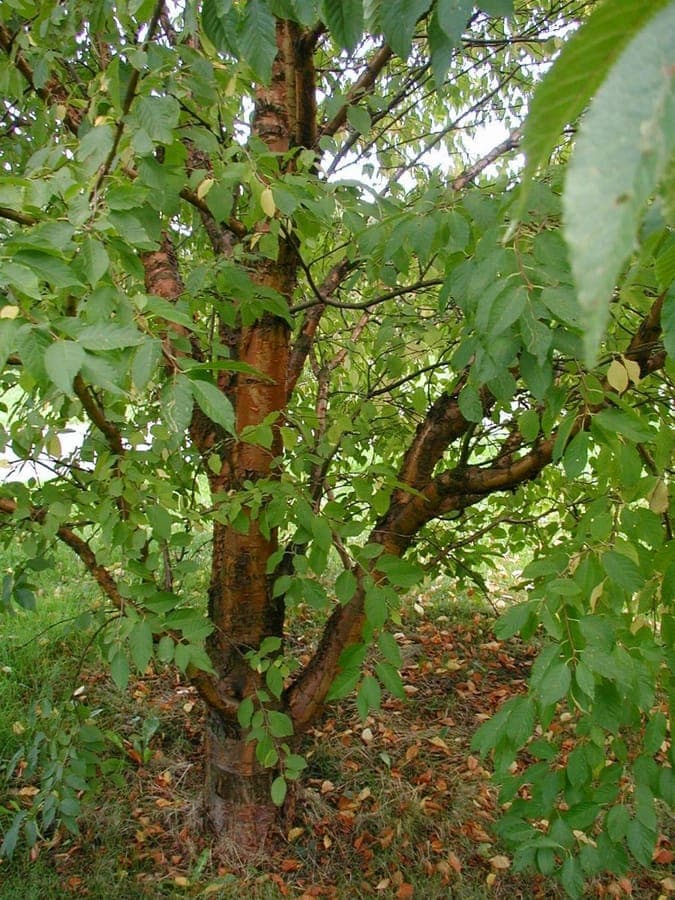
No machine-readable author provided. Sten assumed (based on copyright claims). / CC BY-SA 3.0, via Wikimedia Commons
Prunus maackii: complete guide
Prunus maackii
¿Quieres ver Prunus maackii: complete guide en tu jardín?
1 minuto, sin tarjeta de crédito
Overview
Prunus maackii, commonly known as the Manchurian cherry or Amur cherry, is a stunning ornamental tree native to the Far East. This impressive species belongs to the Rosaceae family and is renowned for its unique and striking bark, which comes in reddish-brown to golden-yellow hues and elegantly peels in thin strips from the trunk. This distinctive feature makes the tree a real showstopper in the garden even during the winter months.
The tree grows to 10 to 15 meters in height and forms an elegant, upright growth pattern. The Manchurian cherry blooms in spring with abundant white flowers that cluster in dense racemes. After flowering, small red fruits appear that gradually turn dark purple to black. This fruit production attracts birds, contributing to greater biodiversity in your garden.
This is an excellent choice for gardens aiming for a natural, woodland character. The tree is highly winter hardy and suited to temperate climate zones.
Appearance and bloom
The most striking feature of Prunus maackii is undoubtedly the bark. It has a glossy, reddish-brown to golden-yellow color and peels characteristically in thin, papery strips. This gives the tree a distinctive appearance that remains attractive through all seasons, especially in winter when other garden elements fade from view.
The leaves are lance-shaped and finely toothed. They are dark green in color and can take on attractive yellow to orange hues in autumn. The foliage gives the tree a full, healthy appearance throughout the growing season.
The flowering is one of the highlights of this tree. From April to May, many small white flowers appear, clustering in dense hanging racemes on the branches. These flowers have a subtle fragrance and attract pollinators. After flowering come small stone fruits about the size of a pea, initially red in color, later turning dark purple to black. These fruits remain on the tree for a long time and provide food for birds and other wildlife.
Ideal location
The Manchurian cherry thrives best in a sunny to partially shaded spot. Ensure at least 5 to 6 hours of direct sunlight per day for optimal growth and flowering. In full shade, the tree will produce fewer flowers and the bark may color less beautifully.
Choose a location that offers protection from strong winds, as long branches can be brittle when heavily laden with snow or frost. A spot at the edge of a larger planting scheme or against a wall works well.
Ensure the tree has sufficient space to develop its full mature form. Do not plant it in narrow corners or too close to buildings, as this limits air circulation and can promote disease.
Soil
Prunus maackii is not fussy about soil type but thrives best in well-draining, fertile soil. Ideally, soil should have a pH of 6.0 to 7.0, thus slightly acidic to neutral.
Ensure the soil is not waterlogged, as this can lead to root rot. Mixing organic matter such as compost or rotted leaves when planting improves soil structure and water-holding capacity.
Sandy and loamy soils can also work well, provided you fertilize regularly to replenish nutrients. In very poor soils, plant growth and flowering may decline.
Diseño gratis
¿Quieres ver Prunus maackii: complete guide en tu jardín? Crea un diseño gratis ahora.
Watering
After planting the tree, water regularly in the first growing year to help roots become firmly established. Water when the top layer of soil feels dry to the touch.
During dry periods or hot summers, pay extra attention to watering. A sturdy mulch layer around the base of the tree helps reduce moisture loss and supports root development.
Once well established, Prunus maackii is relatively drought tolerant and requires less frequent watering. However, in extreme drought, regular watering ensures better quality and richer flowering.
Pruning
The Manchurian cherry requires minimal pruning and naturally grows into an attractive form. Shape pruning should occur mainly in the juvenile stage to develop a strong, balanced branch structure.
Remove dead, damaged or diseased branches in winter or early spring. Make cuts just above a bud or lateral branch to avoid leaving stumps behind.
Beware of pruning too much or at the wrong times, as this can lead to excessive shoot growth and introduce weakness. The tree recovers quickly from gentle pruning but does not respond well to heavy cuts.
Maintenance Calendar
Spring: Check for frost damage. Perform gentle pruning as new growth begins. Start fertilizing when buds swell.
Late spring: Enjoy the blooms. Monitor moisture requirements and water during dry spells. Adjust mulch as needed.
Summer: Provide regular water during dry periods. Check for pest and disease-free growth. Enjoy the fruit formation.
Autumn: Observe the fall coloring of leaves. Collect fallen leaves. Prepare the tree for winter cold.
Winter: Admire the striking bark. Perform structural pruning if needed. Protect young trees against severe frost.
Winter hardiness
Prunus maackii is highly winter hardy and suitable for temperate climates, including northern Europe. The tree withstands temperatures down to at least -20 to -25 degrees Celsius without serious damage.
Young trees should be protected with a layer of organic mulch around the base during their first winter. In extremely cold winters with heavy frost and wind, some winter damage may occur, but the tree typically recovers well.
Companion plants
Prunus maackii combines well with understory plantings. Place shade-tolerant perennials such as hellebores, bergenia, and epimediums beneath the tree. These fill the underplanting space without competing for root nutrients.
Shrubs such as viburnum, sambucus, and ilex can serve as companions. Their complementary growth habits create visual interest.
In larger gardens, the Manchurian cherry can be used as a specimen tree for maximum effect, particularly when its bark can gleam in winter.
Closing thoughts
Prunus maackii is a trustworthy, versatile and ornamental tree type that adds value through all seasons to a garden. With its spectacular winter bark, rich spring flowering and attractive summer greenery, it becomes a permanent anchor point in garden life. With minimal maintenance and careful placement, this Manchurian cherry will be enjoyed for decades to come.
Available at major UK garden centers and nurseries.
¿Quieres ver Prunus maackii: complete guide en tu jardín? Crea un diseño gratis ahora.
Sube una foto, elige un estilo y obtén un diseño fotorrealista con lista de plantas en menos de un minuto.
Sin tarjeta de crédito


Plantas similares
Siberian crab apple: complete guide
Malus x robusta
Complete guide to the Siberian crab apple (Malus x robusta): location, soil, pruning, winter hardiness and the best companion plants for your garden.
Chinese flowering crabapple (Malus x spectabilis): complete guide
Malus x spectabilis
Meet the Chinese flowering crabapple (Malus x spectabilis): a classic spring bloomer with carmine buds and pink blossom.
Potentilla crassinervia: complete guide
Potentilla crassinervia
Potentilla crassinervia, the Corsican cinquefoil, grows wild on Corsica and Sardinia's peaks. Discover how to grow this hardy alpine rock garden gem.