
Fenzl's almond: complete guide
Prunus fenzliana
¿Quieres ver Fenzl's almond: complete guide en tu jardín?
1 minuto, sin tarjeta de crédito
Overview
Prunus fenzliana, known in German as kaukasische mandel and named after the Austrian botanist Fenzl, is a shrub to small tree in the rose family (Rosaceae). The species was described in 1892 by the botanist Fritsch and grows naturally on the rocky mountain slopes of Iran, Turkey, and the Transcaucasian region, spanning Georgia, Armenia, and Azerbaijan. In scientific literature the plant also appears under the synonym Amygdalus fenzliana.
What makes this species especially fascinating is its role as one of the principal wild ancestors of the cultivated almond, Prunus dulcis. Genetic research indicates that Fenzl's almond sits at the root of nearly every almond variety grown commercially today. For gardeners, this is a captivating piece of plant history to have in your own garden. Through gardenworld.app you can design a drought garden or a mixed early-flowering border in which this historically significant species finds its place. Botanists still debate the exact ancestry of the cultivated almond, but Prunus fenzliana is named in nearly every recent study as the most likely direct ancestor, more so than other wild Amygdalus species from the region. That makes this plant not only ornamental but also scientifically significant: a living piece of agricultural history you can plant and watch bloom in your own garden.
Appearance and bloom
Fenzl's almond grows as a broad shrub or small tree 2 to 6 metres tall, depending on site and age. The leaves are ovate-lanceolate, 3 to 8 centimetres long, fresh green, and finely toothed at the margin, unlike the silvery foliage of the closely related Prunus argentea.
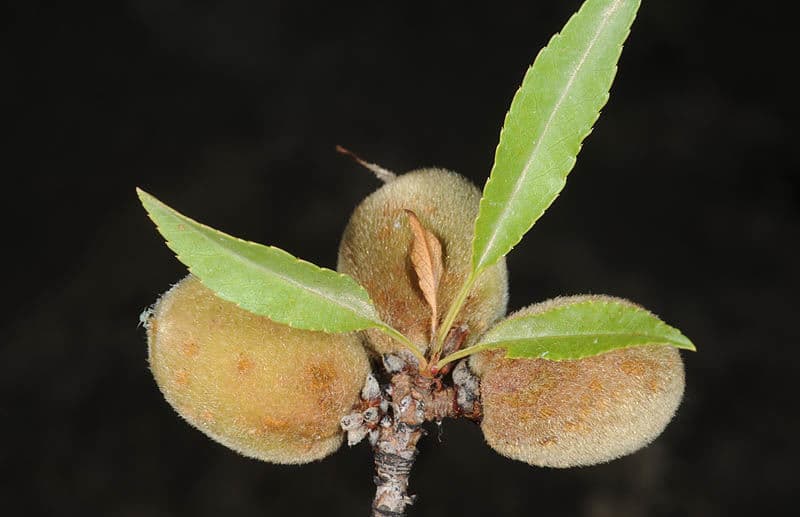
Flowering occurs early in spring, typically from March to April, well before the leaves emerge. The flowers are white to very pale pink, about 2 to 3 centimetres across, and appear abundantly along the still-bare branches. This early flowering makes the species a valuable food source for the season's first bees and bumblebees. After flowering, felted, oval almond-like fruits develop with a hard stone; the wild fruits, being bitter with amygdalin, are not suitable for direct consumption.
Ideal location
This species needs a position in full sun, with at least 6 to 8 hours of direct light daily for the most abundant flowering. A warm, sheltered spot, such as against a south-facing wall or on a sunny slope, is ideal, particularly in the first few years after planting.
Fenzl's almond tolerates drought and wind well, thanks to its origins in the rocky, continental mountain regions of the Caucasus, with hot dry summers and cold winters. Avoid damp, shady spots where the roots stay wet.
Soil
In the wild this species grows on stony, lime-rich mountain ground with excellent drainage and little organic matter. In the garden, use free-draining soil, enriched with coarse sand or gravel if needed, with a pH between 6.5 and 8.0.
Avoid heavy clay and persistently damp soil; root rot poses the greatest threat to this species, adapted as it is to dry, rocky conditions. When planting in heavier soil typical of the Netherlands or Belgium, improve the planting hole with gravel and compost, at a ratio of roughly two parts original soil to one part amendment. A slightly raised planting bed or a gentle slope also helps excess rainwater drain away quickly in the wetter climate of the Netherlands and Belgium, something that happens naturally in the plant's dry Caucasian homeland thanks to the steep, rocky terrain.
Diseño gratis
¿Quieres ver Fenzl's almond: complete guide en tu jardín? Crea un diseño gratis ahora.
Watering
Young, newly planted specimens need regular watering during their first growing season to root well; water twice a week during warm, dry spells. Once established, after two to three years, Fenzl's almond becomes exceptionally drought-tolerant.
In an average Dutch or Belgian garden climate, supplemental watering of established specimens is rarely needed, except during prolonged summer drought lasting more than a month. Overwatering is more harmful than underwatering for this species.
Pruning
Fenzl's almond flowers on the previous year's wood, so prune ideally right after flowering in April or May. Remove dead, damaged, or crossing branches and thin the crown lightly if needed for good air circulation.
Avoid heavy pruning in autumn or winter, as it removes next spring's flowers. Older specimens can be rejuvenated every few years by cutting a third of the oldest wood back to ground level.
Maintenance calendar
March-April: flowering period, enjoy the white blossom, no pruning during bloom. April-May: prune right after flowering, light feeding with compost. June-August: main growth phase, water during prolonged dry spells, check for aphids and fungal issues. September-October: growth slows, stop feeding, final disease check. November-February: full winter dormancy, no protection needed for established specimens.
Winter hardiness
Prunus fenzliana is very winter hardy, corresponding to USDA zone 5 to 7, fitting its origins in the cold mountain regions of the Caucasus and eastern Anatolia, where harsh winters are common. Frost down to approximately -25 degrees Celsius poses no problem for established specimens.
In the Netherlands, Belgium, and France, this species survives winter without extra protection. Young plants do benefit from a 5 to 10 centimetre mulch layer around the root collar during their first winter.
Companion plants
Fenzl's almond combines well with other drought-tolerant, early-flowering species from continental climates, such as silver almond (Prunus argentea), apricot (Prunus armeniaca), and Mediterranean herbs like lavender and rosemary, which share the same preference for full sun and sharp drainage.
For those who prefer to harvest edible almonds, garden centres and specialist fruit tree nurseries offer the cultivated descendants of this wild species, with well-known varieties such as Prunus dulcis 'Ferragnes' and 'Ferraduel', both of which build on the genetic legacy of this wild ancestor. On gardenworld.app you can test different combinations of early-flowering trees and shrubs virtually before you start planting, so you can immediately see how the shapes and colours play off each other through the seasons.
Closing
Prunus fenzliana is a fascinating choice for anyone seeking not just a hardy, drought-tolerant shrub, but also a piece of plant history: the wild ancestor of the almond we know today from fruit orchards. Give it a sunny, well-drained spot and it will reward you year after year with an early, abundant blossom that also draws in the season's first bees. For more inspiration on drought gardens, historic fruit species, and the right plant combinations, gardenworld.app offers a valuable and practical starting point, with concrete examples for a sunny, water-wise border.
¿Quieres ver Fenzl's almond: complete guide en tu jardín? Crea un diseño gratis ahora.
Sube una foto, elige un estilo y obtén un diseño fotorrealista con lista de plantas en menos de un minuto.
Más de 10.000 jardines diseñados
Sin tarjeta de crédito


Plantas similares
Siberian crab apple: complete guide
Malus x robusta
Complete guide to the Siberian crab apple (Malus x robusta): location, soil, pruning, winter hardiness and the best companion plants for your garden.
Chinese flowering crabapple (Malus x spectabilis): complete guide
Malus x spectabilis
Meet the Chinese flowering crabapple (Malus x spectabilis): a classic spring bloomer with carmine buds and pink blossom.
Potentilla crassinervia: complete guide
Potentilla crassinervia
Potentilla crassinervia, the Corsican cinquefoil, grows wild on Corsica and Sardinia's peaks. Discover how to grow this hardy alpine rock garden gem.