
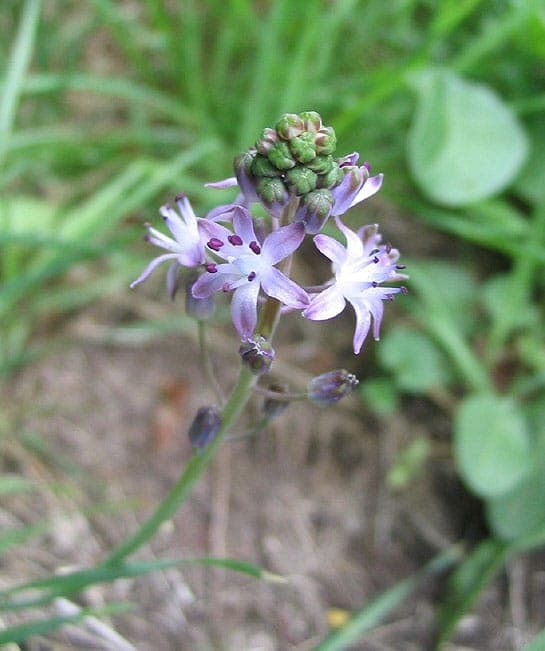
Wikimedia Commons / CC BY-SA 3.0, via Wikimedia Commons
Prospero autumnale: complete guide
Prospero autumnale
¿Quieres ver Prospero autumnale: complete guide en tu jardín?
1 minuto, sin tarjeta de crédito
Overview
Prospero autumnale commonly called autumn squill or autumn starflower is charming bulbous plant from Asparagaceae family. This small but elegant bulb flowers primarily in autumn providing valuable color when many other plants fade. The species originates from Western Europe to Mediterranean region and has become popular in gardens worldwide.
The characteristic blue star-shaped flowers are enchanting and bring fresh accent to autumn and early winter gardens. Standing merely 10 to 30 centimeters tall it offers elegant accent planting among borders between other plants or in containers. The flowering period extends from August through October crucial for garden continuity.
Appearance and bloom
Prospero autumnale is small bulbous plant with narrow grass-like leaves that appear before flowers. The foliage is dark green and pleasingly linear creating fresh texture. The plant typically reaches 10 to 30 centimeters height.
The flowers represent this plants absolute highlight. They appear in loose star-shaped clusters in beautiful sky-blue to violet-blue. Each small flower measures approximately 5 to 8 millimeters diameter gathered in clusters conspicuous in autumn gardens. Flowers appear on thin upright stems and maintain appearance long. After flowering the plant produces small seed capsules containing seeds.
Ideal location
Prospero autumnale grows best in sunny to partially shaded locations. The plant requires at least six to eight hours direct sunlight daily for optimal flowering. Shadier positions result in fewer flowers.
The plant works well in rock gardens between stones along borders in perennial beds or in well-draining containers. It integrates beautifully in naturalized plantings beneath small trees or in rocky areas. The narrow growth habit suits border fronts and placement between larger specimens.
Soil
Prospero autumnale tolerates various soil types but prefers well-drained lime-free to limy soils with pH 7.5 to 8.0. The plant grows well in sandy to loamy soils and tolerates fairly poor substrates.
Always ensure excellent drainage because the plant dislikes wet feet in winter. Adding sand or gravel improves drainage problems. The plant struggles in heavy clay and may fail in such conditions.
Diseño gratis
¿Quieres ver Prospero autumnale: complete guide en tu jardín? Crea un diseño gratis ahora.
Watering
Once established Prospero autumnale is fairly independent regarding watering. The plant is moderately drought-tolerant and requires occasional water during growth. Regularly moist not wet soil is ideal during growing season.
In autumn and winter when the plant actively grows gentle watering supports development. Ensure water drains well and does not accumulate. Overly wet conditions cause leaf spot problems and rotting.
Pruning
Prospero autumnale requires virtually no pruning. The plant grows compactly and maintains itself well. Faded flowers may be removed for neater appearance. However leave some flowers for seed ripening for next season.
Faded foliage may be removed after winter when it browns. This stimulates new leaf growth. Alternatively allow the plant to manage itself naturally.
Maintenance calendar
- May-June: Plant bulbs at 5-8 cm depth
- August-October: Autumn flowering and seed ripening
- October-November: Collect seeds or lift bulbs
- December-March: Plant dormancy bulbs overwinter
- April-May: New foliage emerges
Winter hardiness
Prospero autumnale is completely hardy to minus 15 degrees Celsius and grows well in temperate European climates. Bulbs cannot tolerate excessively wet winters so ensure good drainage. Damage from wet feet is more likely than frost damage.
In continental climates with cold winters extra protection helps. In warmer regions the plant grows well without special winter care. Bulbs perform well in ground and need not be lifted annually.
Companion plants
Prospero autumnale combines beautifully with Sedum (stonecrop), Sempervivum (houseleek), Liriope (lilyturf), Carex (sedge), Stipa (feather grass), Teucrium (germander) and Allium (ornamental onion). These combinations exploit autumn flowering and create beautiful texture combinations.
Closing
Prospero autumnale is much-underestimated plant offering unique autumn color and elegance when many gardens fade. Its compact growth enchanting blue flowers and winter hardiness make it essential in every modern garden. With intelligent design from GardenWorld integrate this gem into your front yard and ensure lasting enjoyment. Discover how these flowering stars transform your autumn garden and add character to your outdoor spaces.
¿Quieres ver Prospero autumnale: complete guide en tu jardín? Crea un diseño gratis ahora.
Sube una foto, elige un estilo y obtén un diseño fotorrealista con lista de plantas en menos de un minuto.
Más de 10.000 jardines diseñados
Sin tarjeta de crédito


Plantas similares
Narrow-leaved dracaena: complete guide
Dracaena angustifolia
Everything about Dracaena angustifolia - the narrow-leaved dracaena: location, care, overwintering and use as a houseplant or patio plant.
Chaparral yucca: complete guide to Hesperoyucca whipplei
Hesperoyucca whipplei
Hesperoyucca whipplei (Our Lord's candle) is a dramatic rosette-forming plant from California that produces a towering flower spike, ideal for dry and gravel gardens.
False lily-of-the-valley: complete guide
Maianthemum dilatatum
Everything about Maianthemum dilatatum, the false lily-of-the-valley. Care, shade location, propagation and garden combinations for this popular shade ground cover.