
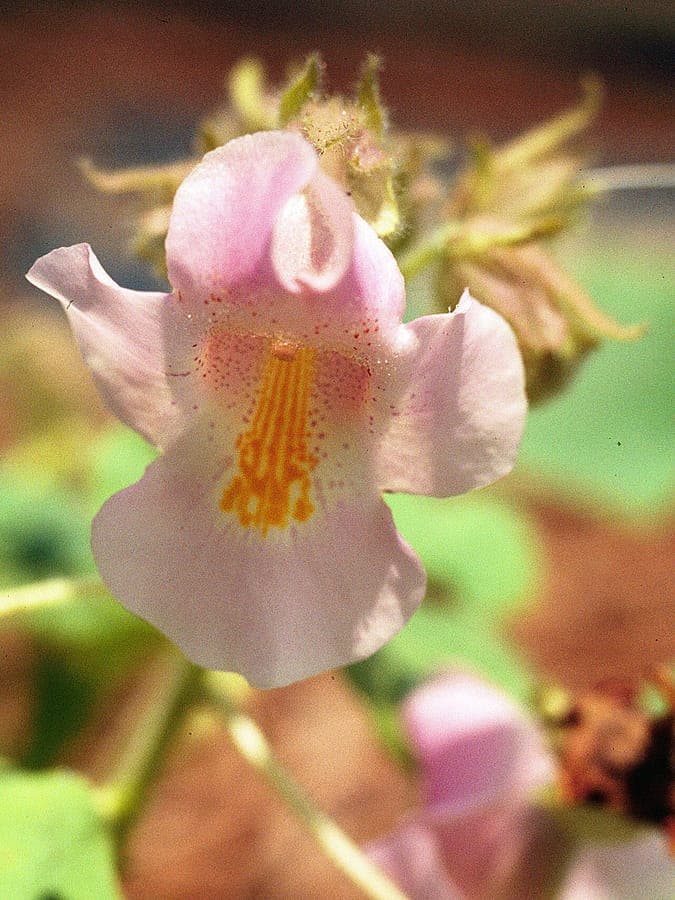
John D. Byrd, Mississippi State University, Bugwood.org / CC BY 3.0 us, via Wikimedia Commons
Proboscidea louisianica: complete guide
Proboscidea louisianica
¿Quieres ver Proboscidea louisianica: complete guide en tu jardín?
1 minuto, sin tarjeta de crédito
Overview
Proboscidea louisianica, better known as Ram's horn or Devil's claw, is a unique annual plant from North America grown for its striking purple flowers and characteristic curved fruits. This exotic appearance grows 60-100 cm tall and produces numerous, pleasantly scented flowers throughout summer.
The plant is particularly famous for its remarkable, horn-like fruits that form after blooming. These fruits are dark grayish-brown and can be dried for ornamental use. The plant can be grown in containers or in ground.
Appearance and bloom
Proboscidea louisianica grows as a thick, hairy plant with rough-textured foliage. The leaves are large, oval-heart-shaped, approximately 10-15 cm long, with coarse-toothed margins. All plant parts are rough-haired.
Flowers appear from July to September and are approximately 3-5 cm wide, tubular, usually purple to pink, sometimes white. They have a strong, pleasantly musky fragrance.
The fruits are the most striking feature - long, curved pods with two long "horns" at the tip. The fruits begin green and become dark brown to black at maturity. This characteristic shape inspires the common name "Ram's horn".
Ideal location
Ram's horn grows best in full sun with at least 6-8 hours of direct sunlight daily. The plant tolerates light shade but produces fewer flowers in insufficient light.
Ensure adequate warmth - the plant is heat-loving and doesn't grow well in cold. Sheltered locations work better than windy positions.
Diseño gratis
¿Quieres ver Proboscidea louisianica: complete guide en tu jardín? Crea un diseño gratis ahora.
Soil
Ram's horn thrives in loam, well-draining soil with reasonable organic content. The plant is not particularly demanding for nutrients but grows better in fertile soil.
Well-draining soil is essential - waterlogging leads to rot.
Watering
Water regularly, especially during dry periods. Maintain moderate moisture without waterlogging. Young plants need more water than established specimens.
During very hot periods, daily watering may be necessary.
Pruning
Minimal pruning required. The plant can be shaped by pinching back growth tips for more compact growth.
Maintenance calendar
April-May: Sowing or planting. June: Growth begins. July-September: Bloom and fruit development. October: Fruits ripen. November: Harvest fruits or leave for ornamental use.
Winter hardiness
Ram's horn is not winter hardy and dies at first frost. The plant must be reseeded or replanted annually.
Companion planting
Ram's horn works well in mixed summer annual borders or as an interesting specimen in containers. It combines well with other heat-loving annuals.
Closing
Proboscidea louisianica offers unique interest through its remarkable fruits and pleasantly scented flowers. For gardeners seeking something unusual, this is a valuable choice.
At GardenWorld, we help with interesting garden plants. Visit gardenworld.app for more ideas.
Check local seed packets or plant material at garden centers and nurseries near you.
¿Quieres ver Proboscidea louisianica: complete guide en tu jardín? Crea un diseño gratis ahora.
Sube una foto, elige un estilo y obtén un diseño fotorrealista con lista de plantas en menos de un minuto.
Más de 10.000 jardines diseñados
Sin tarjeta de crédito


Plantas similares
Acer pycnanthum: complete guide
Acer pycnanthum
Acer pycnanthum, the Japanese swamp maple, is a fast-growing tree with early red flowers and brilliant autumn color, ideal for damp garden settings.
Freeman maple: complete guide
Acer × freemanii
Everything about the Freeman maple (Acer x freemanii): a fast-growing shade tree with spectacular autumn colour for large gardens.
Silver vine: complete guide
Actinidia polygama
Discover silver vine (Actinidia polygama): a hardy climbing plant with silvery foliage, loved by gardeners and cats alike.