
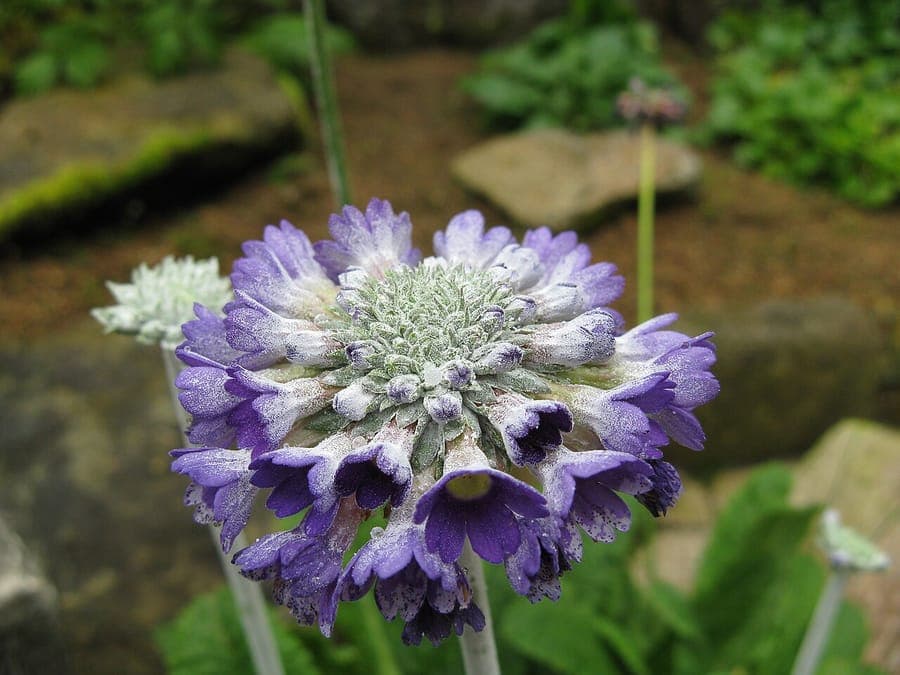
KENPEI / CC BY-SA 3.0, via Wikimedia Commons
Capitata primrose: complete guide
Primula capitata
¿Quieres ver Capitata primrose: complete guide en tu jardín?
1 minuto, sin tarjeta de crédito
Overview
Primula capitata is an elegant mountain plant from the Primrose family (Primulaceae), native to Central and East Himalaya through South Tibet. First botanically described in 1850, this attractive species remains popular in British alpine gardens but remains rare in continental Europe.
The species grows in mountainous environments at elevations of 2500-3500 meters where conditions are relatively moist and growing seasons are brief. In gardens it requires special attention: moist soil during growth, but frost protection and dry winters.
Appearance and Bloom
Capitata primrose forms a rosette of oblong foliage that feels textured and may be slightly hairy. Flowers emerge in September-October on stiff stems, grouped in characteristic dense 'head' inflorescences (giving the species its name). Color ranges from purple to deep violet, rarely lighter.
Flowers cluster densely in a spherical head of 2-3 centimeters diameter, making the plant unforgettably beautiful as weather turns cold. Each tiny bloom is plump with golden stamens.
Ideal Location
Capitata primrose thrives in dappled shade, not full sun. In its native habitat it naturally grows in dappled light beneath low shrubs or on north-facing slopes. In gardens position it beneath conifers or on the north side of larger structures.
The plant suits shaded alpine troughs and raised beds in regions with adequate moisture and high humidity. Unsuitable for dry, sunny garden locations. Ideal in moisture-retentive clay soils under shelter.
Soil
Capitata primrose grows on acidic to neutral soils (pH 6-7) in mountainous regions. In gardens, achieve high moisture capacity without waterlogging. A mix of 50% potting soil, 30% peat moss, and 20% sand provides good rooting environment.
Amend garden soils generously with organic matter - compost, leaf mold - and improve drainage with sand. The plant loves moist but not waterlogged conditions. In dry soils it performs poorly and dies prematurely.
Diseño gratis
¿Quieres ver Capitata primrose: complete guide en tu jardín? Crea un diseño gratis ahora.
Watering
Capitata primrose requires consistently moist soil throughout the growing season (April to October). Water regularly, especially during dry periods. In peak heat, daily watering is acceptable. The plant fails if it dries for extended periods.
In winter after blooming, greatly reduce watering as the plant is essentially dormant. Never allow it to stand in stagnant water - root rot will develop. Ideal: soil always moist but well-drained.
Pruning
Capitata primrose requires virtually no pruning. Remove only spent flowers after blooming and dead foliage in spring. The plant naturally grows in neat rosettes.
If the plant becomes large after many years and develops thick stems, carefully remove the oldest foliage to make space for new growth. However: this is rarely needed in home gardens.
Maintenance Calendar
APRIL-MAY: Growth begins after winter dormancy. Water regularly. No fertilizer - this plant prefers nutrient-lean conditions. JUNE-SEPTEMBER: Active growth. Keep soil consistently moist. Ensure dappled shade. OCTOBER-NOVEMBER: Blooming. Moisture needs remain high. Continue watering. DECEMBER-MARCH: Winter dormancy. Water very sparingly. Frost protection only in extremely cold zones.
Winter Hardiness
Capitata primrose is winter-hardy to zone 7 (-15°C). It survives mild winters in the Netherlands and Belgium, but suffers damage in very severe winters. In mountainous areas above 800 meters or in continental climates, winter protection is recommended.
The plant tolerates frost better than extreme wet winters. In climates with abundant rain and wet soil, it dies sooner than from frost damage. Protected positioning in a greenhouse-like environment or under a shelter is ideal for long-term success.
Companion Planting
Effective companion plants:
- Other mountain primulas (Primula japonica)
- Columbines (Aquilegia species)
- Fine-textured ferns (Polystichum setiferum)
- Moss ground cover (Isothecium myosuroides)
- Bright blue forget-me-nots (Myosotis)
Plant in groups of 3-5 with 30 centimeters spacing. In specialized troughs for alpine enthusiasts, exceptionally rewarding.
Closing
Capitata primrose is an exotic mountain flower that represents a true achievement for serious alpine gardeners. It demands specific growing conditions but rewards effort with unique autumn blooming. Not for beginners, but extremely valuable for those venturing into moisture-loving alpines.
¿Quieres ver Capitata primrose: complete guide en tu jardín? Crea un diseño gratis ahora.
Sube una foto, elige un estilo y obtén un diseño fotorrealista con lista de plantas en menos de un minuto.
Más de 10.000 jardines diseñados
Sin tarjeta de crédito


Plantas similares
Primula incana: complete guide to silvery alpine primrose
Primula incana
Silvery primrose (Primula incana), a delicate alpine flower with white blooms and powdered grey-green leaves. Growing, care, and cultivation guide.
Mealy cowslip: complete guide
Primula pulverulenta
Grow the Mealy cowslip (Primula pulverulenta): striking candelabra flowers in red and purple tones, moisture-loving and ideal for shady, damp garden corners.
Cliff dwarf-primrose: complete guide
Androsace laevigata
Full guide to growing Androsace laevigata, a rare Pacific Northwest alpine cushion plant. Planting, care, and garden design tips explained.