
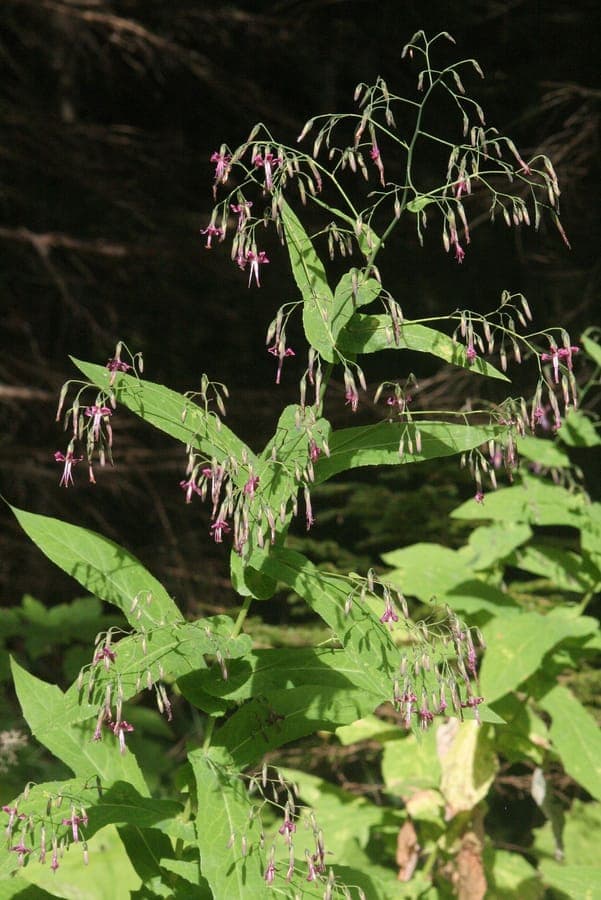
HermannSchachner / CC0, via Wikimedia Commons
Rattlesnake root: complete guide
Prenanthes purpurea
¿Quieres ver Rattlesnake root: complete guide en tu jardín?
1 minuto, sin tarjeta de crédito
Overview
Rattlesnake root (Prenanthes purpurea) is an elegant woodland plant native from Europe through the Caucasus region. This wildflower is renowned for its tall stems, distinctive purple flowers, and finely toothed leaves. The plant naturally grows in mountain forests and shaded areas, making it ideal for shadowy corners in gardens. With its subtle elegance and low maintenance requirements, rattlesnake root is a perfect choice for gardeners preferring natural, understated beauty.
Appearance and bloom
Rattlesnake root reaches 50 to 120 centimeters tall. The stems are often red or purple spotted, complementing the purple flowers beautifully. Leaves are lance-shaped with fine marginal teeth. Flowers appear in July and August in considerable quantities. They are small, approximately 8 to 10 millimeters wide, growing in loose clusters atop stems. Color varies from pale purple to deep purple depending on growing conditions and local genetics.
Ideal location
Rattlesnake root thrives in partial to full shade. Place the plant in forest patches where filtered light penetrates. The plant also grows in full shade, though flowers are less abundant. Choose a sheltered location, as strong wind can bend tall stems. Ideal positions are under deciduous trees, along woodland paths, or in north-facing borders. Avoid direct afternoon sun exposure.
Soil
Rattlesnake root prefers nutrient-rich, well-draining soil. A mixture of garden soil with ample organic material such as leaf mold or compost works excellently. The plant thrives on slightly acidic to neutral soil (pH 5 to 7). Ensure sufficient drainage so rain does not cause waterlogging. Soil improvement with peat or leaf mold increases success chances, especially on heavy clay soils.
Diseño gratis
¿Quieres ver Rattlesnake root: complete guide en tu jardín? Crea un diseño gratis ahora.
Watering
Rattlesnake root requires regular, even moisture, especially during growth and blooming in summer. Do not let soil dry out completely, but avoid waterlogging. Water if soil feels dry during hot periods. In damper woodland locations, natural rain may suffice. Mulching around the plant helps retain moisture and moderates soil temperature.
Maintenance
Maintenance is straightforward. Regularly remove spent flowers for increased bloom (deadheading). In autumn, cut dead leaf and flower material back to ground level. The plant often perpetuates itself via self-seeding in favorable conditions. Ensure self-sown seedlings have adequate space. Division of plants can occur in spring for propagation.
Maintenance calendar
May-June: Support young plants with stakes if needed. June-July: Flowering begins; remove spent flowers. July-August: Peak bloom; ensure regular watering. September: Seed set; collect seeds if desired. October-November: Plant death; cut dead material back to ground. December-April: Dormancy period; minimal care required.
Winter hardiness
Rattlesnake root is fully hardy in temperate and continental zones. The plant dies back to ground in autumn and regrows each spring from underground tubers. In very severe winters (below -20 degrees Celsius), extra mulch (leaves or compost) can protect roots. The plant requires no special winter protection in moderate climates.
Companion plants
Rattlesnake root pairs nicely with other shade plants. Add shade-loving species such as helleborus, hosta, and liriope. Position alongside blooming violets or trilliums for color contrast. This plant adds depth and naturalness to woodland landscapes. Underplanting with carpet sedum or alpine plants provides low-dimensional structure.
Closing thoughts
Rattlesnake root offers elegant, subtle beauty in shaded garden corners. With its European origin and low maintenance needs, it is an ideal wildflower. Visit gardenworld.app for more guides on shade planting and natural garden design. Gardenworld.app helps you create elegant, self-maintaining gardens.
¿Quieres ver Rattlesnake root: complete guide en tu jardín? Crea un diseño gratis ahora.
Sube una foto, elige un estilo y obtén un diseño fotorrealista con lista de plantas en menos de un minuto.
Más de 10.000 jardines diseñados
Sin tarjeta de crédito


Plantas similares
Calendula stellata: complete guide
Calendula stellata
Complete guide to Calendula stellata, the star-flowered marigold from Sicily: location, soil, watering and companion planting tips.
Korean chrysanthemum: complete guide
Chrysanthemum x rubellum
Chrysanthemum x rubellum is a hardy autumn perennial with single pink to copper flowers from August to November. Care and combinations.
Helianthus divaricatus: complete guide
Helianthus divaricatus
Helianthus divaricatus is a North American woodland sunflower with yellow summer blooms, ideal for naturalistic borders and shady edges.