
Red-stemmed cinquefoil: complete guide
Potentilla rubricaulis
¿Quieres ver Red-stemmed cinquefoil: complete guide en tu jardín?
1 minuto, sin tarjeta de crédito
Overview
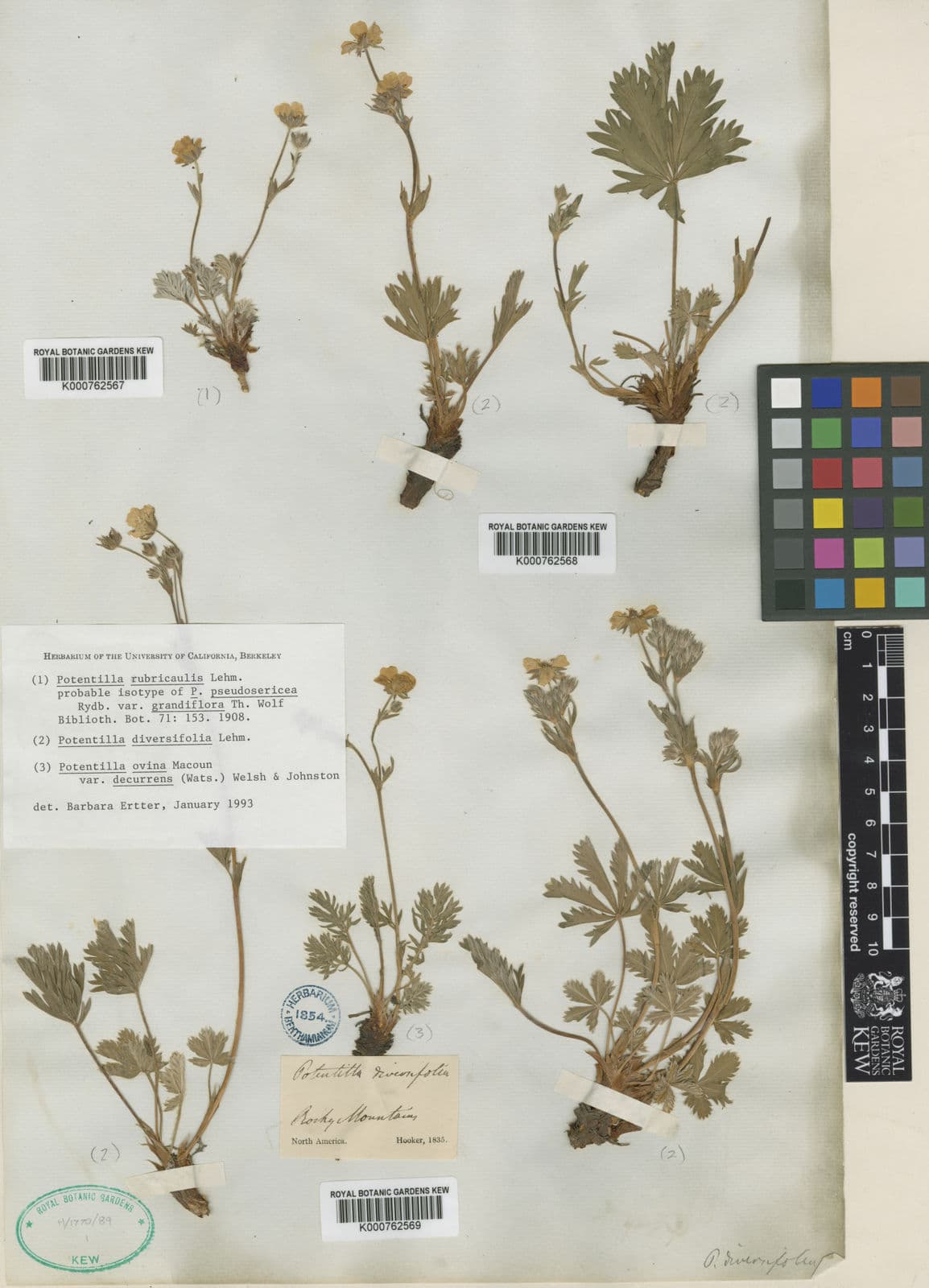
Potentilla rubricaulis, the red-stemmed cinquefoil (also known as Rocky Mountain cinquefoil), is a low-growing perennial in the rose family (Rosaceae) named for its strikingly reddish-brown stems, which stand out against the silvery-grey foliage. The species was described in 1830 by the botanist Lehmann and grows naturally across a wide range, from Alaska and the Yukon in the north to Colorado and Utah in the south, with populations in between across Alberta, British Columbia, Idaho, Montana, Saskatchewan, Wyoming, and the Northwest Territories.
This broad distribution, spanning arctic tundra to high alpine terrain in the Rocky Mountains, makes red-stemmed cinquefoil somewhat more adaptable than some of its strictly arctic relatives such as Potentilla pedersenii, to which it is closely related; some botanists treat the two as varieties of one another. For rock garden enthusiasts, this is an attractive, characterful species with a clearly recognisable feature. Through gardenworld.app you can put together a rock garden design in which small, tough high-mountain plants like this find a permanent home among stone and gravel. Within the genus Potentilla, which counts hundreds of species worldwide, the group surrounding rubricaulis and pedersenii forms a notoriously tangled complex, with boundaries between species blurred by natural crossing where their ranges overlap across Canada and Alaska. For the gardener, what matters most is that once planted in the right spot, this species forms a decorative carpet of silvery foliage and red stems for years with minimal care.
Appearance and bloom
The plant grows as a low, cushion-forming mat 5 to 20 centimetres tall, spreading 20 to 35 centimetres. The leaves are palmately divided into narrow leaflets covered in silky, silvery-grey hairs. The most distinctive feature is the stem itself: reddish-brown to deep red, creating a striking contrast against the silvery foliage and yellow flowers.
Flowering runs from June into August, somewhat longer than in the more northerly related species, thanks to the southern populations found at higher elevations in the Rocky Mountains. The flowers are bright yellow, five-petaled, and about 1 to 1.5 centimetres wide, borne on the characteristic red stems. After flowering, small dry fruits form and remain on the plant well into autumn, adding a subtle winter interest.
Ideal location
Red-stemmed cinquefoil thrives in full sun, with at least 6 hours of direct light daily for the best flowering and the most compact growth habit. A raised rock bed, alpine trough, or scree area with sharp drainage is ideal, as is a sloped site where water never stands.
Good air circulation matters, particularly in the more humid climate of the Netherlands, Belgium, and France compared to the dry mountain air of its native habitat. Avoid overly sheltered, damp corners and instead give the plant an open, breezy spot on a low wall, a bank, or between boulders.
Soil
In the wild this species grows on rocky, gravelly soils low in nutrients, often on moraine debris or weathered rock. In the garden, use a mix of 50 percent coarse sand or fine gravel and 50 percent lean alpine potting compost, with a pH between 6.0 and 7.5.
Avoid heavy, moisture-retentive clay and overly fertile garden soil; these quickly cause root rot in a plant accustomed to extremely well-drained mountain ground. A drainage layer of coarse gravel at least 10 centimetres deep beneath the planting site prevents rainwater from pooling. If your garden lacks naturally rocky ground, this species also grows well in a shallow terracotta pot or alpine trough with at least three drainage holes; raise the pot on pot feet in winter so meltwater and rain drain away immediately rather than sitting around the roots, which causes rot faster than it would in open ground.
Diseño gratis
¿Quieres ver Red-stemmed cinquefoil: complete guide en tu jardín? Crea un diseño gratis ahora.
Watering
Once well rooted, red-stemmed cinquefoil is highly drought-tolerant. During the first year after planting, water regularly during dry, warm spells in May and June to help the root system establish well.
After establishment, supplemental watering is rarely needed; natural rainfall is sufficient in most years. Only water during prolonged drought of more than three weeks. Excess water poses a far greater risk than too little for this mountain species.
Pruning
This compact species needs almost no pruning. In autumn, around September or October, trim off dried flower stems to keep the plant tidy and to better showcase the characteristic red stems.
Heavy pruning is unnecessary and can harm the plant. If the mat becomes bare in the centre after a few years, you can carefully divide and replant sections in a fresh spot to renew its vigour.
Maintenance calendar
March-April: check for frost damage, remove rotted or damaged foliage. May-June: main growth phase, water during prolonged dry spells, no feeding needed. June-August: flowering period, enjoy the yellow flowers on red stems, minimal maintenance. September-October: trim off dried flower stems for a tidy winter appearance. November-February: full winter dormancy, no protection needed except in persistently waterlogged ground.
Winter hardiness
Potentilla rubricaulis is very winter hardy, corresponding to USDA zone 3 to 5 depending on the exact source population; the northern Alaska and Yukon forms are even hardier than the more southerly Colorado and Utah populations. Frost down to -35 degrees Celsius poses no problem as long as the soil stays well drained.
In the Netherlands, Belgium, and France, the plant survives every winter without extra protection. As with many arctic-alpine species, cold is not the greatest danger; wet, soggy winter ground in which the roots rot is the real risk.
Companion plants
Combine red-stemmed cinquefoil with other genuine high-mountain plants for an authentic alpine scene: moss campion (Silene acaulis), alpine avens (Geum rossii, also known as Acomastylis rossii), and alpine forget-me-not (Eritrichium nanum) all share the same preference for rocky, well-drained ground.
Because this wild species is rarely available at mainstream garden centres, you can pair it in the same border with the far better-known shrubby cinquefoil cultivars, such as Potentilla fruticosa 'Abbotswood' or 'Pink Beauty', for extra flower power and volume. On gardenworld.app you can test different combinations of rock plants and shrubby cinquefoils virtually before you start planting.
Closing
Red-stemmed cinquefoil is an appealing choice for anyone seeking an authentic, low-growing mountain plant with a distinctive feature in its red stems. Give it a sunny, exceptionally well-drained spot, and it will demand almost no further attention. For more inspiration on rock gardens and mountain plant combinations, gardenworld.app offers a useful starting point.
¿Quieres ver Red-stemmed cinquefoil: complete guide en tu jardín? Crea un diseño gratis ahora.
Sube una foto, elige un estilo y obtén un diseño fotorrealista con lista de plantas en menos de un minuto.
Más de 10.000 jardines diseñados
Sin tarjeta de crédito


Plantas similares
Siberian crab apple: complete guide
Malus x robusta
Complete guide to the Siberian crab apple (Malus x robusta): location, soil, pruning, winter hardiness and the best companion plants for your garden.
Chinese flowering crabapple (Malus x spectabilis): complete guide
Malus x spectabilis
Meet the Chinese flowering crabapple (Malus x spectabilis): a classic spring bloomer with carmine buds and pink blossom.
Potentilla crassinervia: complete guide
Potentilla crassinervia
Potentilla crassinervia, the Corsican cinquefoil, grows wild on Corsica and Sardinia's peaks. Discover how to grow this hardy alpine rock garden gem.