
Wikimedia Commons / Public domain, via Wikimedia Commons
Bog Pondweed: complete guide
Potamogeton polygonifolius
¿Quieres ver Bog Pondweed: complete guide en tu jardín?
1 minuto, sin tarjeta de crédito
Overview
Bog Pondweed (Potamogeton polygonifolius), also known as Oblong-leaved Pondweed, is an aquatic plant of European bogs, marshes, and cold mountain waters. This plant is characterized by reddish spotting on its foliage, especially under nutrient-poor water conditions. For conservation-minded gardeners and bird enthusiasts, Bog Pondweed offers direct connection to natural aquatic landscapes.
Appearance and Flowering
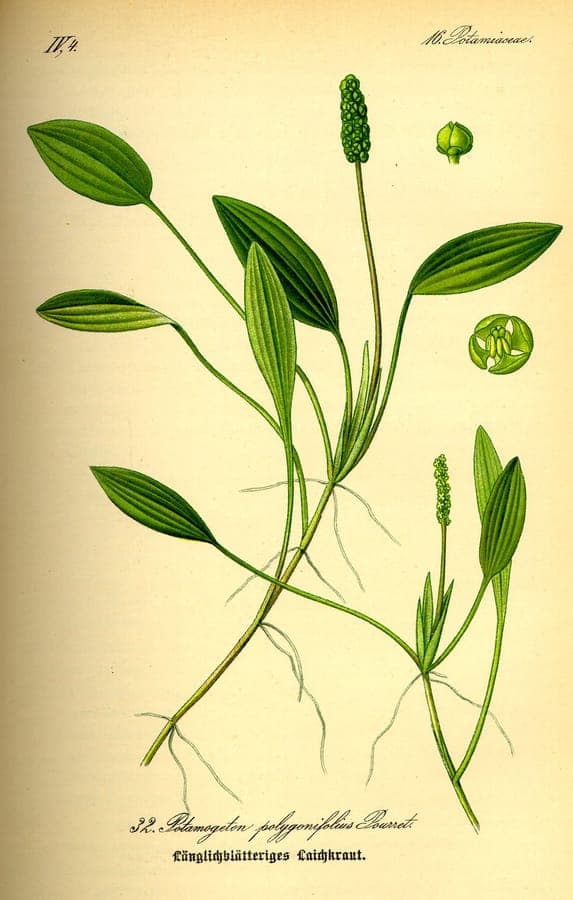
Bog Pondweed displays two distinct leaf types: submerged leaves are oblong to lanceolate with characteristic red or brown spotting and margins. Surface leaves are more oval and may float. The plant reaches 30-80 cm height when submerged.
Small greenish flowers appear in dense spikes from June through October. These subtle blooms support numerous insect species and small aquatic invertebrates. The reddish foliage pigmentation gives the plant season-long aesthetic interest.
Ideal Location
This plant thrives in nutrient-poor, slightly acidic waters (pH 4.5-6.0) of lakes, ponds, and wetlands. It grows optimally in cool waters of 8-15 degrees Celsius. The plant tolerates full sun to partial shade, though sunny locations intensify red pigmentation.
In garden settings, select locations with natural water quality and minimal human disturbance.
Substrate Requirements
Bog Pondweed grows in sandy, peat-rich substrates with organic matter. In artificial waters, plant directly on peat-based layers or in sand-peat mixture. The plant accepts no fertilizer and thrives in nutrient-poor water.
This plant serves as an excellent indicator of nutrient-poor water quality - vigorous growth signals a healthy aquatic ecosystem.
Diseño gratis
¿Quieres ver Bog Pondweed: complete guide en tu jardín? Crea un diseño gratis ahora.
Water Management
As a fully submerged plant, no traditional watering is required. In natural wetlands, rainfall sustains water levels. In closed water systems, ensure good oxygenation and minimal nutrient input.
Ideal water parameters: pH 4.5-6.0, dissolved oxygen at least 6 mg/liter, temperature preference 8-15 degrees Celsius.
Pruning
Minimal pruning needed. Remove dead material in autumn. The plant naturally sheds old leaves seasonally.
It is best to leave this plant undisturbed in natural conditions. Pruning is only necessary in aquaria for shape control.
Maintenance Calendar
April-May: Verify water pH and oxygen levels. Begin new growth season. June-October: Enjoy flowering and bird habitat function. Monitor red pigmentation development. November-March: Minimal activity; allow plant dormancy.
Winter Hardiness
Bog Pondweed is hardy to very low temperatures (to -20 degrees Celsius) in USDA zones 3-7. The plant grows slowly in winter, a normal survival strategy.
Companion Plants
In bird-rich wetlands, combine with:
Arabella (Littorella uniflora) for nutrient-poor habitat Fibrous sedges (Carex) at margins Water-milfoil (Myriophyllum) for oxygen production Sphagnum moss for margin planting Native waterfowl as primary users
This combination creates complete wetland ecology.
Closing Thoughts
Bog Pondweed is a distinctive plant for conservation-minded gardeners who value native aquatic flora. Its reddish foliage, preference for nutrient-poor waters, and bird habitat function make it an important element of sustainable water gardens.
Locate this plant from specialized aquatic plant suppliers focused on conservation. For additional water management information, visit gardenworld.app.
¿Quieres ver Bog Pondweed: complete guide en tu jardín? Crea un diseño gratis ahora.
Sube una foto, elige un estilo y obtén un diseño fotorrealista con lista de plantas en menos de un minuto.
Más de 10.000 jardines diseñados
Sin tarjeta de crédito


Plantas similares
Robbins' pondweed: complete guide
Potamogeton robbinsii
Complete care guide for Potamogeton robbinsii, the submerged aquatic plant perfect for wildlife ponds and natural water gardens.
Flatstem pondweed: complete guide
Potamogeton zosteriformis
Complete care guide for Potamogeton zosteriformis, the flatstem pondweed perfect for clear freshwater ponds and naturalistic water gardens.
Largeleaf pondweed: complete guide
Potamogeton amplifolius
Everything about largeleaf pondweed (Potamogeton amplifolius): pond cultivation, water depth, substrate, care calendar and ecological role in garden ponds.