
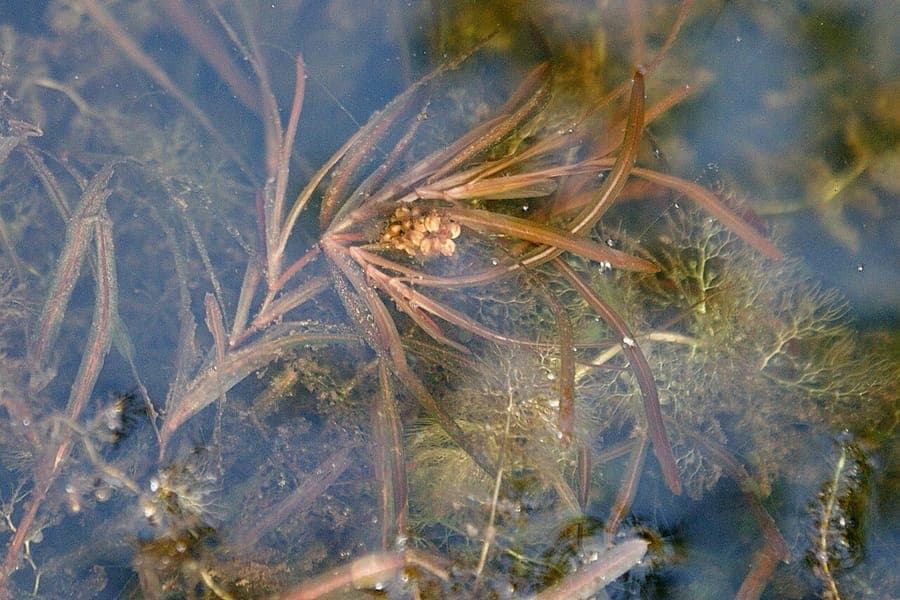
Krzysztof Ziarnek, Kenraiz / CC BY-SA 3.0, via Wikimedia Commons
Blunt-leaved Pondweed: complete guide
Potamogeton obtusifolius
¿Quieres ver Blunt-leaved Pondweed: complete guide en tu jardín?
1 minuto, sin tarjeta de crédito
Overview
Blunt-leaved Pondweed (Potamogeton obtusifolius) is a submerged aquatic plant with wide distribution across temperate regions of the Northern Hemisphere. This flexible species grows in diverse water types, from nutrient-poor mountain streams to moderately nutrient-rich river systems. For gardeners and pond keepers, Blunt-leaved Pondweed offers a reliable method to improve water quality and attract waterfowl.
Appearance and Flowering
Blunt-leaved Pondweed displays characteristic, obtuse leaves that are lanceolate and 1-3 cm in length. Leaves display a glossy green to reddish-brown coloration depending on light conditions. The plant forms dense, resilient stems reaching up to 60 cm in optimal conditions.
Small greenish flowers appear in compact spikes above water from June through September, creating interesting visual contrast with the submerged foliage.
Ideal Location
This plant thrives in temperate waters ranging from 0.3 to 1.5 meters in depth. It tolerates a broad spectrum of water conditions, from fast-flowing streams to still lakes. Optimal growth occurs in clear water with gentle water movement.
Full sun to partial shade is acceptable, though adequate light supports efficient photosynthesis.
Substrate Requirements
Blunt-leaved Pondweed grows in sandy, silty, and gravelly substrates. Plant directly in pond-bottom substrate without specialized potting. The plant accepts nutrient-poor to moderately nutrient-rich waters (oligotrophic to mesotrophic).
The plant actively improves water quality by absorbing excess nutrients, preventing algal blooms.
Diseño gratis
¿Quieres ver Blunt-leaved Pondweed: complete guide en tu jardín? Crea un diseño gratis ahora.
Water Management
As a fully submerged plant, no traditional watering is required. In enclosed water bodies, ensure regular water circulation and oxygenation through fountains or air pumps.
Water parameters: pH 6.5-7.5, dissolved oxygen at least 4 mg/liter, optimal water temperature 8-18 degrees Celsius.
Pruning
Minimal maintenance required. Occasionally remove large plant fragments or dead material in autumn-winter. This prevents water decomposition and maintains visibility.
During growing season, gently remove excess stems to stimulate fresh growth.
Maintenance Calendar
May-June: Check water conditions; encourage new growth. July-September: Monitor flowering and oxygen production. October-November: Begin gentle removal of senescent material. December-April: Minimal activity; regularly verify water quality.
Winter Hardiness
Blunt-leaved Pondweed is hardy in temperate zones (USDA 5-9) and survives temperatures to -15 degrees Celsius. In very cold winters, the plant protects itself by sinking and minimizing growth.
Companion Plants
Combine in water gardens with:
Water-milfoil (Myriophyllum) for supplementary oxygen production Duckweed (Lemna) for microhabitats Filamentous algae for biological filtration Common reed (Phragmites australis) at margins Aquatic snails for nutrient cycling
This combination provides complete aquatic ecology.
Closing Thoughts
Blunt-leaved Pondweed is a beneficial, persistent aquatic plant suitable for both natural water settings and managed ponds. Its versatility and water-quality improvement make it essential for sustainable water gardens.
Obtain from aquatic plant suppliers. For additional water gardening inspiration, visit gardenworld.app.
¿Quieres ver Blunt-leaved Pondweed: complete guide en tu jardín? Crea un diseño gratis ahora.
Sube una foto, elige un estilo y obtén un diseño fotorrealista con lista de plantas en menos de un minuto.
Más de 10.000 jardines diseñados
Sin tarjeta de crédito


Plantas similares
Robbins' pondweed: complete guide
Potamogeton robbinsii
Complete care guide for Potamogeton robbinsii, the submerged aquatic plant perfect for wildlife ponds and natural water gardens.
Flatstem pondweed: complete guide
Potamogeton zosteriformis
Complete care guide for Potamogeton zosteriformis, the flatstem pondweed perfect for clear freshwater ponds and naturalistic water gardens.
Largeleaf pondweed: complete guide
Potamogeton amplifolius
Everything about largeleaf pondweed (Potamogeton amplifolius): pond cultivation, water depth, substrate, care calendar and ecological role in garden ponds.