
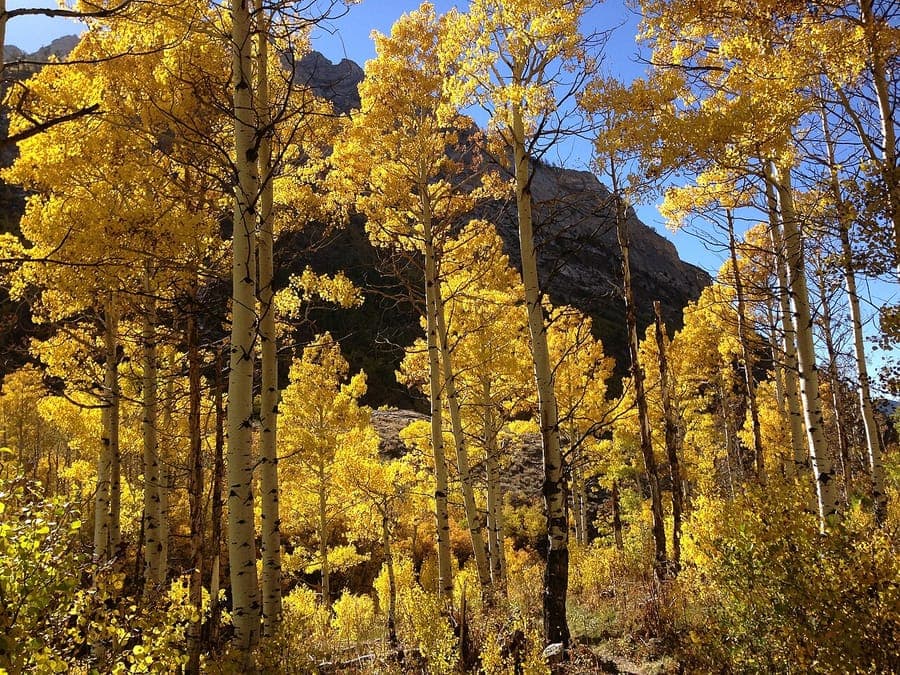
Famartin / CC BY-SA 3.0, via Wikimedia Commons
Quaking aspen: complete guide
Populus tremuloides
¿Quieres ver Quaking aspen: complete guide en tu jardín?
1 minuto, sin tarjeta de crédito
Overview
The quaking aspen (Populus tremuloides), also known as trembling aspen, is a fast-growing deciduous tree from North America. The tree is especially known for its characteristic trembling leaves that quiver and rustle even in still conditions. This unique effect occurs because the leaf stalks (petioles) are flattened laterally, allowing the leaves to oscillate easily. With its rapid growth, golden-yellow autumn color and graceful appearance, the quaking aspen is an interesting choice for larger gardens.
Appearance and bloom
Populus tremuloides reaches an average height of 20-25 meters in open terrain, but can exceed 30 meters under favorable conditions. The bark is smooth and greenish-white, especially on young twigs. The leaf is round to ovate, with a truncated apex and fine serration along the edges. The leaf is glossy dark green in summer and changes to beautiful golden-yellow to red-orange in autumn.
Flowers appear early in spring (March-April) before leaf emergence. Male flowers are red catkins, female ones greener. Female flowers produce small seeds surrounded by white fluffy material.
Ideal location
Quaking aspen grows best in full sun (at least 6 hours of direct sunlight daily). The tree tolerates partial shade but grows less vigorously there. The tree may need protection from very strong wind which can lead to branch breakage. A location with space for the full crown is ideal.
Ensure adequate distance from houses and sewers - roots can become invasive.
Soil
Populus tremuloides is very adaptable and grows on a wide range of soil types, from sand to heavy clay. The tree prefers well-draining soil but also tolerates wetter locations. A pH between 4.3 and 9 is suitable. Add organic material at planting time to promote root development.
The tree grows well on poorer soils and does not require much enrichment.
Watering
Once established, quaking aspen is quite drought-tolerant. Water regularly in the first and second growing seasons. During dry periods, extra water can be helpful. The tree thrives in water-rich conditions and also tolerates wet soil.
Water intelligently: the goal is not just moisture-driven root development but to stimulate deeper roots.
Diseño gratis
¿Quieres ver Quaking aspen: complete guide en tu jardín? Crea un diseño gratis ahora.
Pruning and maintenance
Quaking aspen grows fast and upright without requiring much pruning. In young years you can prune the tree in February for structure. Remove dead, damaged or diseased branches when you see them. The tree tolerates harder pruning and can be cut back significantly.
Let the tree grow naturally for the best trembling effect of the leaves.
Maintenance calendar
JANUARY-FEBRUARY: Winter pruning; remove damaged branches MARCH-APRIL: Flowering period; prepare growing season MAY-JUNE: Strong growth; monitor for weeds and diseases JULY-AUGUST: Warm season; keep moist in dry spells SEPTEMBER-OCTOBER: Peak autumn color; no pruning NOVEMBER-DECEMBER: Winter preparation; leaf cleanup
Winter hardiness
Quaking aspen is very winter hardy, down to -40 degrees Celsius. The tree overwinters without problems in the UK and Northern Europe. The tree loses its leaves in autumn and goes into winter dormancy. The trembling stops, of course, in the winter season.
The yellow autumn color is spectacular but fleeting - pay attention to winter branch structure.
Companion plants
Populus tremuloides combines well with:
- Betula (birches) - similar light leaf effect
- Acer species (maples) - autumn color partners
- Vaccinium (blueberries) - understory with berries
- Ferns - shade cover at base
- Narcissus (daffodils) - spring bloomers under crown
Final thoughts
Quaking aspen is a spectacular tree for those with space. With its trembling leaves, rapid growth and beautiful autumn color, it brings movement, sound and color to large gardens. The tree requires minimal maintenance and grows on many soil types. For woodland gardens, woodland plantings or as a solo specimen, this tree adds dimension.
Procure saplings from reputable tree nurseries. With gardenworld.app you get advice on the best spot in your garden for this beautiful tree.
¿Quieres ver Quaking aspen: complete guide en tu jardín? Crea un diseño gratis ahora.
Sube una foto, elige un estilo y obtén un diseño fotorrealista con lista de plantas en menos de un minuto.
Más de 10.000 jardines diseñados
Sin tarjeta de crédito


Plantas similares
Grey poplar: complete guide
Populus x canescens
Everything about Populus x canescens - a fast-growing hybrid poplar with silver-grey foliage, ideal as a windbreak or specimen tree in large gardens.
Populus adenopoda: complete guide
Populus adenopoda
Chinese aspen: a fast-growing tree for large gardens. Cultivation tips, pruning, and use as windbreak or shade tree.
Populus fremontii: complete guide
Populus fremontii
Fremont's cottonwood is a majestic American tree with rapid growth and drought tolerance. Read our guide for cultivation tips and garden integration.