
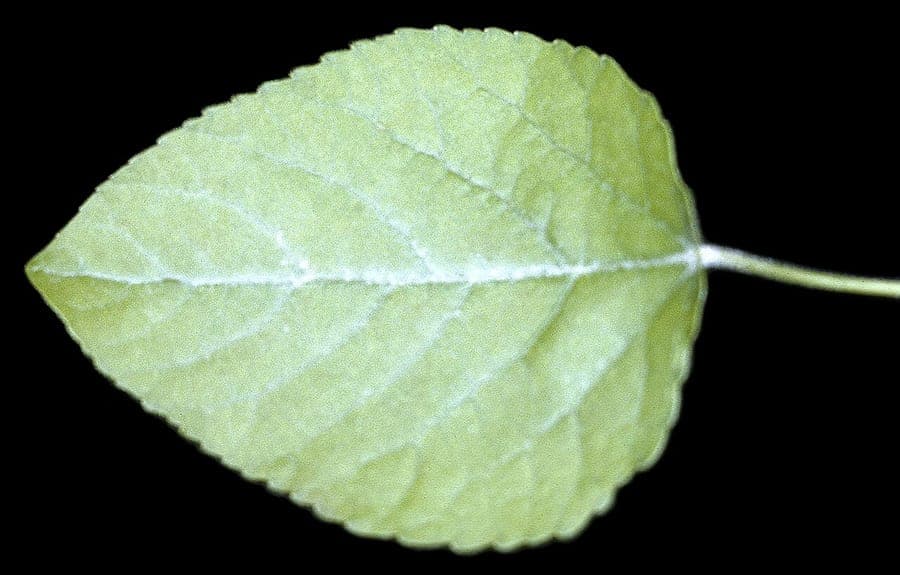
Robert H. Mohlenbrock. USDA NRCS. 1995. Northeast wetland flora: Field office guide to plant species. Northeast National Technical Center, Chester. Courtesy of USDA NRCS Wetland Science Institute. / Public domain, via Wikimedia Commons
Populus heterophylla: complete guide to swamp poplar
Populus heterophylla
¿Quieres ver Populus heterophylla: complete guide to swamp poplar en tu jardín?
1 minuto, sin tarjeta de crédito
Overview
Populus heterophylla, commonly known as swamp poplar, downy poplar, or swamp cottonwood, is an impressive North American tree naturally growing in wet, marshy environments from eastern Canada to the southeastern United States. This member of the Salicaceae family (willow family) distinguishes itself through its ability to thrive in situations where other trees cannot grow. For homeowners with wet, problematic sites, Populus heterophylla is an extremely valuable tree choice.
This tree grows rapidly and can eventually become very tall, making it suitable for situations where height is needed. However, it's not a tree for very small gardens; it's a tree for larger properties or public spaces. It provides bird food, bank stabilization, and structural beauty throughout the year.
Appearance and Bloom
Populus heterophylla possesses leaves that, as the scientific name indicates, are highly variable in shape (heterophylla means 'different leaves'). Young leaves are often oblong and have soft hairiness (hence 'downy'), while older leaves become more diamond-shaped. This leaf polymorphism makes the tree extremely botanically interesting.
The leaves are 5-12 cm long, glossy green in summer and changing to dirty yellow to brown in fall. The leaf stalk (petiole) is flattened, causing leaves to tremble (quiver) even in light breezes, giving the tree a dynamic quality.
Blooming occurs in early spring, before leaf emergence. The flowers are catkins (densely clustered small flowers), with male catkins yellow to red colored and female catkins green. These flowers are not particularly showy, but they provide bird food.
Following bloom, small fruits develop. These ripen in June-July and open to release seed with white fluffy filaments (cottonwood seed), hence the name 'cottonwood'. This seed floats on water, appropriately for a tree thriving in marshy environments.
Ideal Location
Populus heterophylla thrives in full sun to light half-shade. Minimum 4-6 hours of direct sun is beneficial, though the tree also grows reasonably well in half-shade.
The most striking aspect of this tree is its preference for wet conditions. This is one of the few trees that successfully grows in adjacent wetlands, along river banks, and in areas where water regularly stagnates. This makes it invaluably valuable for gardens with erosion problems or permanent inundation.
Function: Populus heterophylla has strong roots that stabilize banks, prevent erosion, and trap sediment. This makes it a preferred choice for wetland restoration projects.
Soil
Populus heterophylla is not particularly fussy about soil chemistry and grows in acidic to alkaline soils. pH between 4.6 and 5.9 is beneficial, but the tree tolerates much wider ranges well.
Soil texture: The tree grows in heavy clay, loam, sand, and mixtures. Poor drainage is not a problem; in fact, the tree performs better in poorly-drained soils than in normal soils.
Soil fertility: Poor soils are acceptable, though nutrient-rich soils promote better growth. Adding processed compost around the roots of young plants helps.
Diseño gratis
¿Quieres ver Populus heterophylla: complete guide to swamp poplar en tu jardín? Crea un diseño gratis ahora.
Watering
Once established, Populus heterophylla requires minimal supplemental water, especially in normal rainfall areas. For young plants, however, regular water is beneficial in the first growing season.
In marshy environments, extra water is not needed; natural site conditions already provide very moisture-rich conditions. In drier locations, periodic watering can help, especially in very dry summers.
Note: This is one of the very few trees that tolerates saturation damage. Other trees would die in similar conditions.
Pruning
Populus heterophylla naturally develops a strong, dominant form and requires little formative pruning. The tree typically forms a single, strong central leader and strong lateral branches.
Light maintenance pruning in late winter (February-March) can be done to remove dead or damaged branches. The tree tolerates pruning well and will resprout from damaged areas.
Avoid heavy pruning in fall, which can stimulate new growth that is frost-sensitive.
Maintenance Calendar
Spring (March-May): Light maintenance pruning. Check for insect damage (rarely problematic). Water as needed.
Summer (June-August): Seed dissemination occurs. Monitor growth. Remove dead wooding from dead branches.
Fall (September-October): Observe fall coloring. Prepare for winter. Leaf raking as needed.
Winter (November-February): Minimal activity. Frost damage inspection. Prune damaged branches.
Winter Hardiness
Populus heterophylla is extremely winter hardy and thrives in USDA hardiness zones 4B through 9. This means it grows in nearly all North American climates, including very cold areas. The tree stems from regions with cold winters and tolerates severe frost well.
Snow and ice loading can be a problem for very young plantings, but mature trees tolerate heavy snow well.
Companion Plants
Populus heterophylla combines well with other water-navigator trees such as Nyssa sylvatica (tupelo) and Thuja occidentalis (Eastern white cedar). Complementary shrubs and small trees include Ilex verticillata (Winterberry) for winter bird food, Calycanthus floridus (Carolina allspice) for winter fragrance, and Aronia arbutifolia (Red chokeberry) for red foliage contrast.
Palmetto plants such as Onoclea sensibilis (Sensitive fern) grow well in moist understories.
Closing
Populus heterophylla deserves recognition as a sustainable, ecologically valuable tree for gardens with wet conditions and erosion problems. With its rapid growth, bird-feeding benefits, and ability to withstand extreme wet conditions, it offers unique value. Seek inspiration on gardenworld.app for water-focused garden design. Visit your local tree nursery for quality plants and expert advice on your landscape project.
Whether you seek to prevent erosion, help bird populations, or simply want a sustainable tree for your wet site, Populus heterophylla delivers everything. Start your garden transformation today on gardenworld.app.
¿Quieres ver Populus heterophylla: complete guide to swamp poplar en tu jardín? Crea un diseño gratis ahora.
Sube una foto, elige un estilo y obtén un diseño fotorrealista con lista de plantas en menos de un minuto.
Más de 10.000 jardines diseñados
Sin tarjeta de crédito


Plantas similares
Grey poplar: complete guide
Populus x canescens
Everything about Populus x canescens - a fast-growing hybrid poplar with silver-grey foliage, ideal as a windbreak or specimen tree in large gardens.
Populus adenopoda: complete guide
Populus adenopoda
Chinese aspen: a fast-growing tree for large gardens. Cultivation tips, pruning, and use as windbreak or shade tree.
Populus fremontii: complete guide
Populus fremontii
Fremont's cottonwood is a majestic American tree with rapid growth and drought tolerance. Read our guide for cultivation tips and garden integration.