
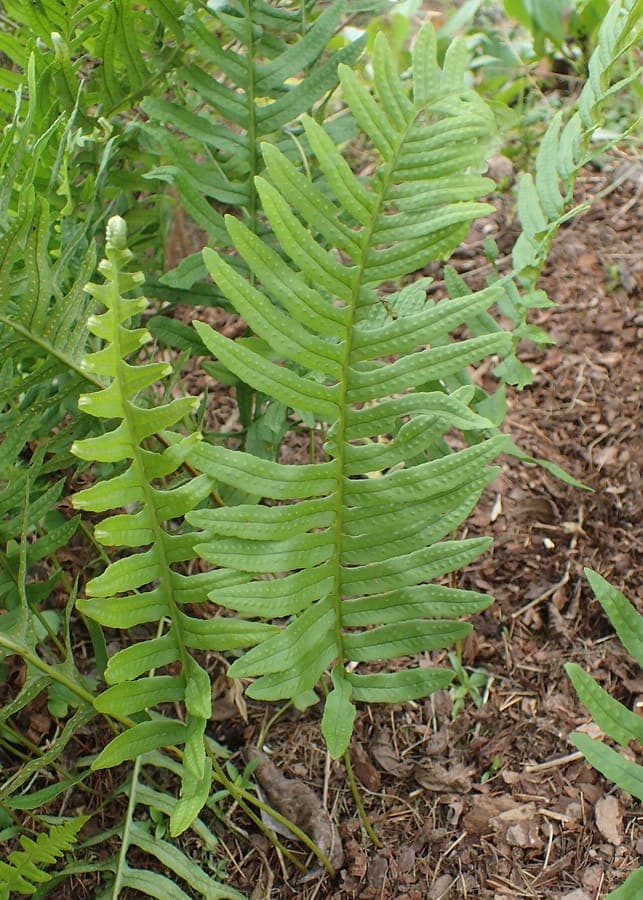
Krzysztof Ziarnek, Kenraiz / CC BY-SA 4.0, via Wikimedia Commons
Intermediate polypody: complete guide
Polypodium interjectum
¿Quieres ver Intermediate polypody: complete guide en tu jardín?
1 minuto, sin tarjeta de crédito
Overview
The Intermediate Polypody (Polypodium interjectum) is an elegant evergreen fern that grows in wet shade corners. This is a more robust fern than its closely related P. cambricum, and therefore better suited to Dutch and Belgian conditions.
The plant grows much larger than the Welsh Polypody and forms strong, expanding colonies. For gardeners with moist, shaded corners, this is a highly valuable choice. The fern is very long-lived and virtually maintenance-free.
Appearance and Reproduction
The Intermediate Polypody reaches 12-20 inches (30-50 cm) tall. The fronds are doubly pinnate, with broader, coarser serrated edges than P. cambricum. The foliage is dark green and very graceful.
The plant is evergreen, so foliage persists year-round. Young fronds are bright green and unfurl in spirals in spring. By summer the plant reaches full size. The underside of fronds bears sporangia (sori) that are brown colored.
Ideal Location
The Intermediate Polypody is a fern for very shady, moist locations. Bases of trees, boggy woodland areas, pond margins - these are its natural habitats. The plant can thrive in shade so deep that almost nothing else survives.
The plant grows best where two to four hours of indirect daylight are present. Full shade is tolerated. Sea breeze and salt are very problematic.
Soil
The Intermediate Polypody prefers moist, humus-rich soil. Much leaf mold and organic matter help. The plant grows in much moister soils than P. cambricum.
The pH may be neutral to slightly acidic. The plant tolerates light freshwater stagnation better than drought. Waterside locations are perfect.
Diseño gratis
¿Quieres ver Intermediate polypody: complete guide en tu jardín? Crea un diseño gratis ahora.
Watering
The Intermediate Polypody loves plenty of moisture. In normal years no supplemental water is needed. During very dry periods some water may help. The root zone should never dry out.
Maintenance
This fern requires minimal maintenance. Remove only diseased or damaged fronds. The plant grows slowly to moderately and does not form problematic vegetative masses.
Maintenance Calendar
Spring (March-May): Young fronds unfurl. Plant becomes active again after winter. Light feeding may help.
Summer (June-September): Growth continues. Fronds reach full size. Sporangia ripen. Regular moisture is essential.
Fall (September-November): Growth continues on warmer days. Fronds remain green. Much leaf litter falls, providing humus.
Winter (December-February): Plant remains somewhat active even in winter. Foliage stays green and grows slowly. Gentle maintenance needed.
Winter Hardiness
The Intermediate Polypody is winter hardy to approximately 5°F (-15°C). This is sufficient for nearly all of the Netherlands and Belgium. Extremely cold winters may be problematic.
Companion Plants
Other evergreen ferns, Helleborus niger (Christmas rose), Osmunda regalis (Royal fern), Polystichum setiferum (Soft shield fern) and Scolopendrium (Hart's tongue) form beautiful associations. For contrast: evergreen Hedera (Ivy).
Closing Thoughts
The Intermediate Polypody is indispensable for moist, deeply shaded garden corners. With minimal maintenance it thrives for years, elegant and robust. On gardenworld.app you will find more information.
Consult garden retailers for this valuable fern. With the Intermediate Polypody, you create permanent moisture-loving, shade-tolerant vegetation.
On gardenworld.app discover more about moss ferns and pond margins.
¿Quieres ver Intermediate polypody: complete guide en tu jardín? Crea un diseño gratis ahora.
Sube una foto, elige un estilo y obtén un diseño fotorrealista con lista de plantas en menos de un minuto.
Más de 10.000 jardines diseñados
Sin tarjeta de crédito


Plantas similares
Dryopteris sieboldii: complete guide
Dryopteris sieboldii
Discover Dryopteris sieboldii (Siebold's Buckler Fern), an elegant evergreen fern from Asia. Growing tips, care, and uses in shade gardens.
Dryopteris tyrrhena: complete guide
Dryopteris tyrrhena
Discover Dryopteris tyrrhena (Mediterranean Buckler-fern), a rare and exquisite fern species. Growing tips, care, and shade garden design.
Dryopteris villarii: complete guide
Dryopteris villarii
Dryopteris villarii, known as rigid buckler fern, is a shade-loving fern form from the Alps. Discover how to grow and maintain this elegant alpine fern in your garden.