
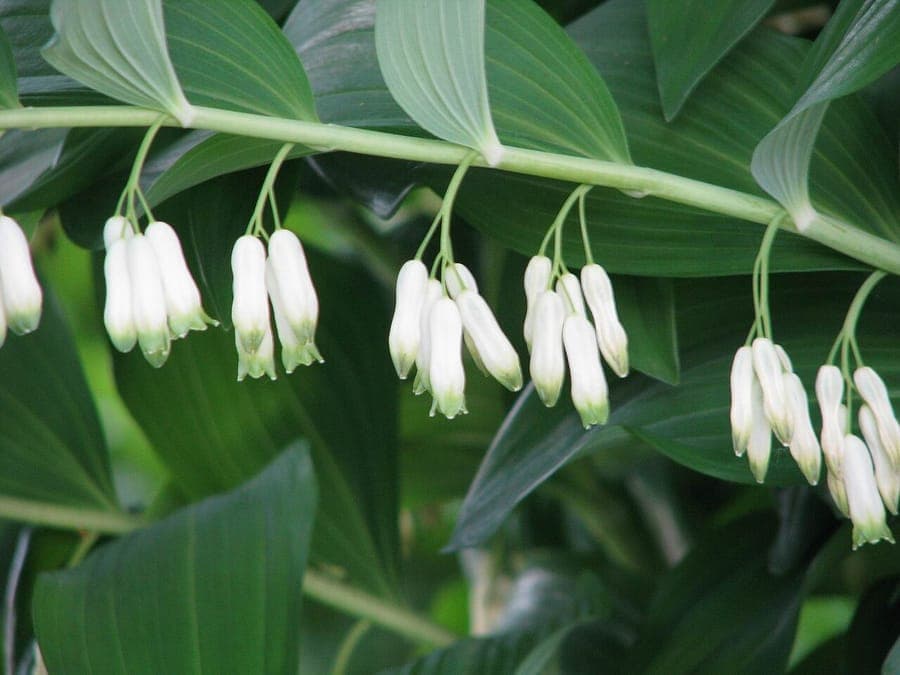
Borealis55 / CC0, via Wikimedia Commons
Solomon's Seal: complete guide
Polygonatum multiflorum
¿Quieres ver Solomon's Seal: complete guide en tu jardín?
1 minuto, sin tarjeta de crédito
Overview
Solomon's Seal (Polygonatum multiflorum), renowned for its graceful form and delicate pendant flowers, is a woodland classic spanning from Europe to the Caucasus. This member of the Asparagaceae family (formerly Liliaceae) is essential for shaded gardens. Named for the distinctive scars left on rhizomes resembling ancient seals, this plant brings architectural elegance to any shade garden.
This plant is essential for woodland gardens, natural plantings, and shaded borders. With its arching form reaching 40-60 centimeters, it adds drama and grace to shadowed spaces.
Appearance and Bloom
Solomon's Seal displays gracefully arching stems lined with alternate, ovate, glossy green leaves. Small, tubular white flowers dangle delicately from leaf axils during April-May. The light fragrance is barely perceptible. After bloom, green berries mature to blue-black.
The characteristic arching habit creates an architectural presence unmatched by other shade plants. Growth is upright initially, then gracefully bending under its own weight.
Ideal Location
This is a deep-shade plant. Position under trees, against north-facing walls, or in wooded corners. The plant tolerates some afternoon sun in northern climates but thrives in full shade. Adequate air circulation prevents fungal issues.
Grouped plantings under trees create enchanting shaded landscapes.
Diseño gratis
¿Quieres ver Solomon's Seal: complete guide en tu jardín? Crea un diseño gratis ahora.
Soil
This plant requires fertile, humus-rich soil. Target pH 5.5-6.5 for optimal growth. Significant soil amendment is needed in poor soils. Excellent drainage is critical - Solomon's Seal abhors winter waterlogging.
Annual mulching with leaf litter maintains soil structure and moisture.
Watering
Regular watering during the growing season is essential. The plant enjoys well-moistured soil without waterlogging. In dry periods, water regularly, especially during the first season.
Woodland settings with high leaf litter well simulate natural conditions.
Pruning
Minimal pruning is needed. Remove dead stems in early spring. Carefully remove any diseased or damaged growth. The plant forms its own natural shape.
Maintenance Calendar
February-March: Remove dead growth. April-May: Monitor for bloom. June-July: Normal maintenance. August-September: Apply mulch. October-January: Minimal care.
Winter Hardiness
Fully hardy throughout Europe to zone 5 (-29°C). The plant tolerates severe winters without protection. Good drainage is critical in wet winters.
Companion Plants
Perfect partners include other shade plants: European hellebore, Astilbe, Hosta, ferns. Ivy forms beautiful underplanting. Hostas provide summer interest.
Groupings of 3-5 plants create spectacular displays.
Closing
Solomon's Seal is a must-have for shade gardeners. Its elegance, reliability, and architectural form make it indispensable. Discover today why this is a classic. Visit gardenworld.app for more inspiration!
gardenworld.app: your guide to shade gardens! gardenworld.app: where elegance meets nature!
¿Quieres ver Solomon's Seal: complete guide en tu jardín? Crea un diseño gratis ahora.
Sube una foto, elige un estilo y obtén un diseño fotorrealista con lista de plantas en menos de un minuto.
Más de 10.000 jardines diseñados
Sin tarjeta de crédito


Plantas similares
Narrow-leaved dracaena: complete guide
Dracaena angustifolia
Everything about Dracaena angustifolia - the narrow-leaved dracaena: location, care, overwintering and use as a houseplant or patio plant.
Chaparral yucca: complete guide to Hesperoyucca whipplei
Hesperoyucca whipplei
Hesperoyucca whipplei (Our Lord's candle) is a dramatic rosette-forming plant from California that produces a towering flower spike, ideal for dry and gravel gardens.
False lily-of-the-valley: complete guide
Maianthemum dilatatum
Everything about Maianthemum dilatatum, the false lily-of-the-valley. Care, shade location, propagation and garden combinations for this popular shade ground cover.