
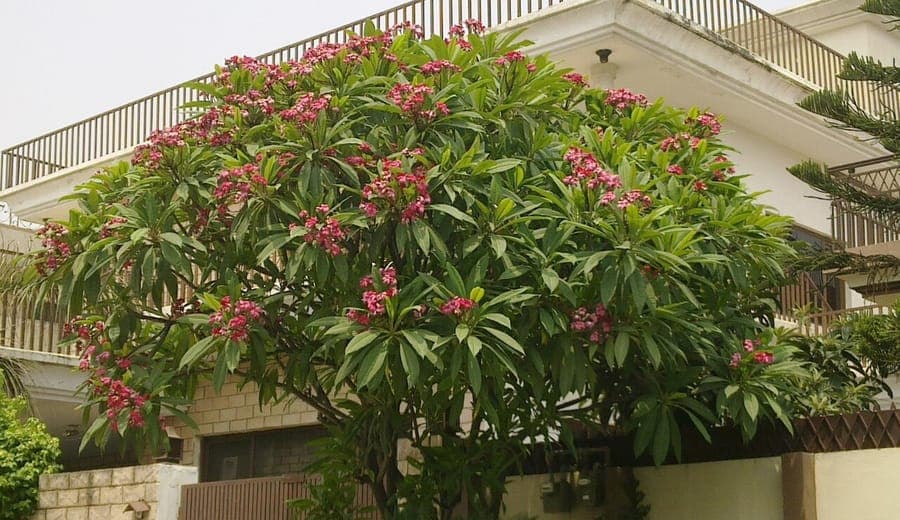
Gul Kiyani / CC BY 3.0, via Wikimedia Commons
Plumeria rubra: complete guide
Plumeria rubra
¿Quieres ver Plumeria rubra: complete guide en tu jardín?
1 minuto, sin tarjeta de crédito
Overview
The Red Frangipani (Plumeria rubra) is among the most iconic tropical trees worldwide. This tree native to Mexico through Venezuela is renowned for its breathtaking flowers in shades of red, pink, white, and yellow. The plant is synonymous with Hawaiian lei traditions and is widely used in weddings and ceremonies.
The tree grows as an ornamental, deciduous shrub or small tree with characteristic spirally-growing branches. The leaves are elongated and glossy green with prominent veins. The flowers are large and densely clustered at branch ends.
Appearance and Bloom
Plumeria rubra can reach 7-9 meters tall in optimal conditions. The tree grows with a striking spiral structure where branches wind like a DNA helix. The bark is smooth and gray, often with vertical scars.
The leaves grow at the ends of longer branches and are large - approximately 15-35 centimeters long and 5-10 centimeters wide. They have a glossy, dark green color with very visible veins.
The flowers are the highlight of this plant - approximately 4-6 centimeters in diameter with five strong petals. They are highly variable in color - red, pink, white, orange to yellow. Most specimens have a bicolor pattern, such as red with yellow edges or pink with white core. The flowers are highly fragrant with a sweet, intoxicating scent.
The blooming period typically runs from spring through autumn, with intense blooming in summer. The flowers grow in dense clusters at branch tips.
Ideal Location
Plumeria rubra thrives in hot, sunny locations. Plant it where it receives at least 6-8 hours of direct sunlight daily. The more sun, the richer the flower color will be.
The tree grows well in container culture on a terrace or balcony, provided you give it a sheltered position against strong wind. In subtropical climates you can keep it outside, but in temperate zones container culture with winter storage is recommended.
Soil
Plumeria rubra prefers well-draining, nutrient-rich potting mix. Use a blend of compost, sand, and perlite in ratio 2:1:1. The tree must never sit in waterlogged soil.
The pH should be slightly acidic to neutral (5.5-7.0). Add compost to existing soil annually. In ground in tropical climates you can plant it directly, but always ensure excellent drainage.
Diseño gratis
¿Quieres ver Plumeria rubra: complete guide en tu jardín? Crea un diseño gratis ahora.
Watering
Plumeria rubra loves regular water during the growing season, but hates waterlogging. Water when the top layer of soil feels dry - approximately once every three to four days in summer.
In winter, when the tree loses many leaves (sometimes almost completely), water much less. This is natural dormancy. You can even minimize watering.
Always water at soil level, not over flowers or leaves. This prevents disease.
Pruning
Plumeria rubra grows as an interesting spiral shape and needs minimal pruning. You can, however, remove dead flowers (deadheading) to encourage continued blooming.
Prune only when necessary - for example, to maintain shape or remove very dead branches. Pruning back after winter can trigger blooming, but do so carefully.
Maintenance Calendar
Spring: Growing period begins. Start regular watering. Add phosphorus-potassium-rich fertilizer for blooming.
Summer: Regular watering and feeding every two weeks. Deadhead spent flowers. Monitor for pests.
Autumn: Reduce feeding. Gradually reduce watering. Harvest seed pods (optional).
Winter: Minimal watering (dormancy). No feeding. Indoor storage in cold areas.
Winter Hardiness
Plumeria rubra is not winter-hardy. It's tropical in origin and cannot tolerate frost. In USDA 10-11 you can keep it outside, but in colder climates you must arrange indoor storage.
The tree can tolerate temperatures of 10-15°C during dormancy, but must be completely protected from frost. Moving to an indoor location before the first frost in autumn is essential.
Companion Plants
Plumeria rubra pairs well with other tropical flowering plants:
- Plumeria alba (white frangipani, highly complementary)
- Heliconia (parrot's beak, also tropical)
- Anthurium (flamingo flower family)
- Bougainvillea (brightly colored)
- Ixora (scarlet flowers)
Combine for an explosion of tropical color.
Conclusion
Plumeria rubra offers far more than beauty - it provides a tropical sensation with its airy flowers in rich colors. Red frangipani is universally appreciated and beloved in warm climates.
The plant is elegant, enchanting, and relatively easy to grow for someone willing to provide its basic needs. Find it at tropical plant suppliers and online. Start with a small specimen and give it warmth and care.
More tropical flowering plants and gardening tips at gardenworld.app.
¿Quieres ver Plumeria rubra: complete guide en tu jardín? Crea un diseño gratis ahora.
Sube una foto, elige un estilo y obtén un diseño fotorrealista con lista de plantas en menos de un minuto.
Más de 10.000 jardines diseñados
Sin tarjeta de crédito


Plantas similares
Asclepias speciosa: complete guide
Asclepias speciosa
Showy milkweed: striking pink-white flowers, fragrant blooms. Essential monarch butterfly host plant.
Plumeria obtusa: complete guide
Plumeria obtusa
Discover the Singapore graveyard flower: an exotic evergreen with mesmerizing white blooms and exquisite fragrance. Expert cultivation, care, and maintenance tips.
Wrightia arborea: complete guide
Wrightia arborea
Wrightia arborea, known as doodhi, is an elegant tree from South Asia with delicate white flowers. Discover how to cultivate this exotic plant.